On this page
- 01Key takeaways
- 02What is the difference between organic social and paid advertising?
- 03Which should your business choose?
- 04What is the earn, prove, buy model?
- 05How much do organic and paid social cost?
- 06How quickly does each one work?
- 07Which builds more trust?
- 08When should you not use paid social?
- 09How do organic and paid work best together?
- 10Does the answer change by platform, goal or sector?
- 11What does this look like in practice?
- 12Organic vs paid checklist
- 13Guides on organic vs paid foundations
- 14Guides on how organic and paid differ
- 15Guides on organic vs paid costs
- 16Guides on organic or paid by goal
- 17Guides on organic or paid by stage
- 18Guides on organic vs paid by platform
- 19Guides on organic vs paid by sector
- 20Guides on running organic and paid together
- 21Guides on measuring organic and paid
- 22Guides on organic vs paid in practice
- 23Next step
- 24Sources and further reading
- 25Frequently asked questions
Key takeaways
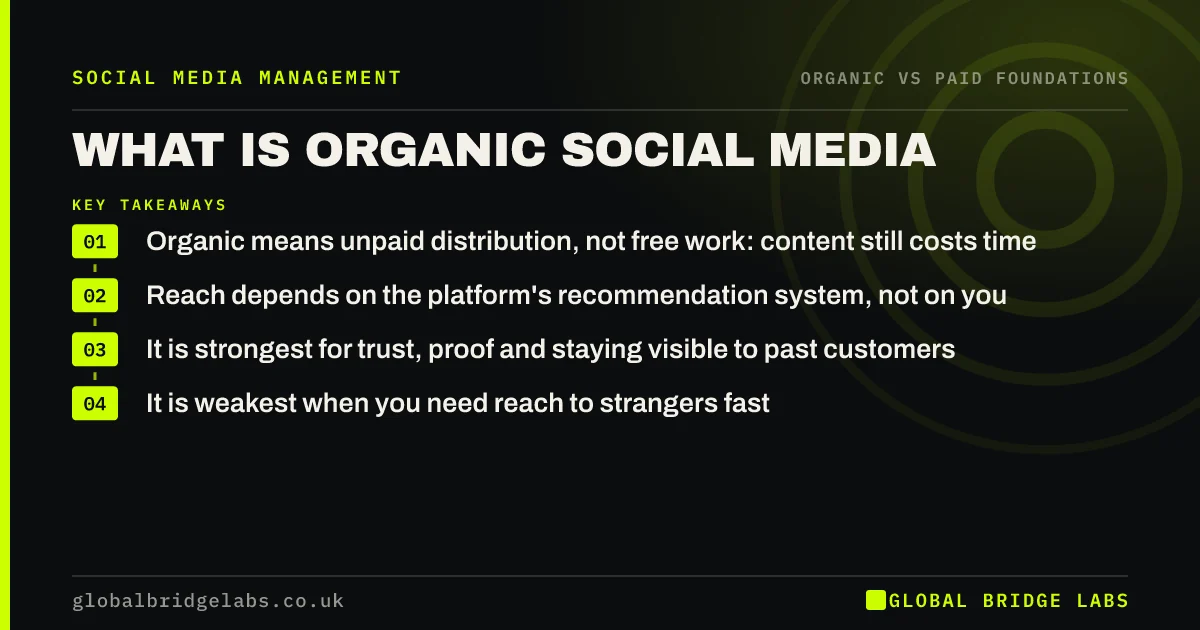
Organic social media vs paid advertising is not an either-or choice for most UK businesses. Organic builds trust and proves which messages work, at the cost of time. Paid buys reach and speed, at the cost of money, and stops when spending stops. Start organic, prove what brings enquiries, then pay to reach more people with it.
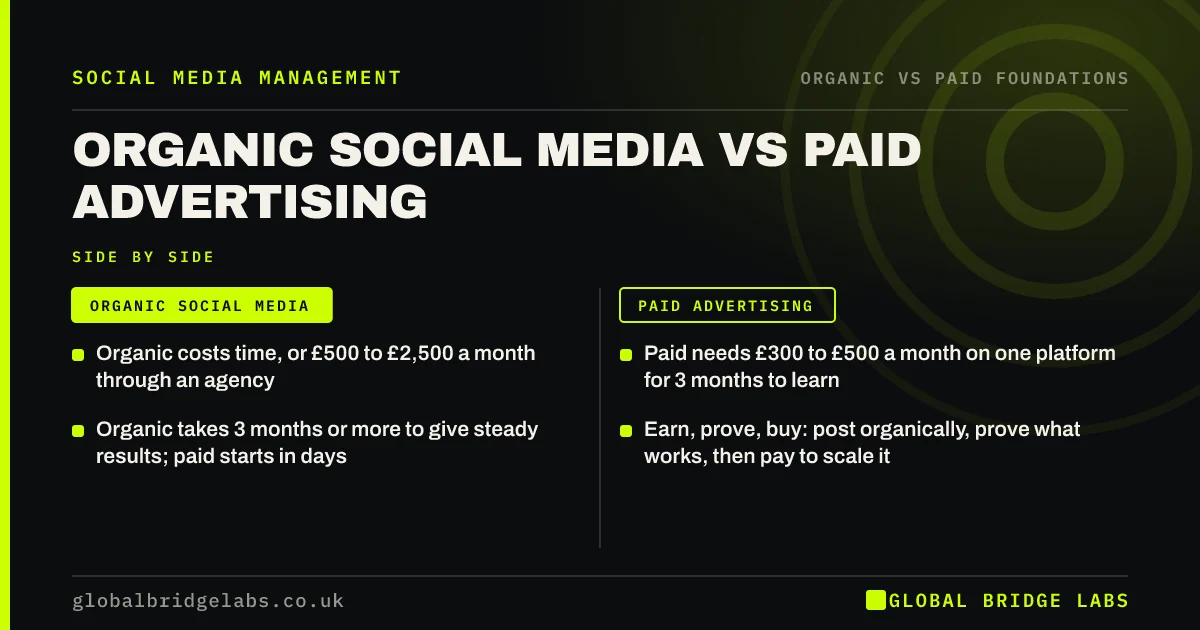
- Organic costs time, or £500 to £2,500 a month through an agency.
- Paid needs £300 to £500 a month on one platform for 3 months to learn.
- Organic takes 3 months or more to give steady results; paid starts in days.
- Earn, prove, buy: post organically, prove what works, then pay to scale it.
Want to know which your business should choose first? Message us on WhatsApp.
Chat on WhatsApp →What is the difference between organic social and paid advertising?
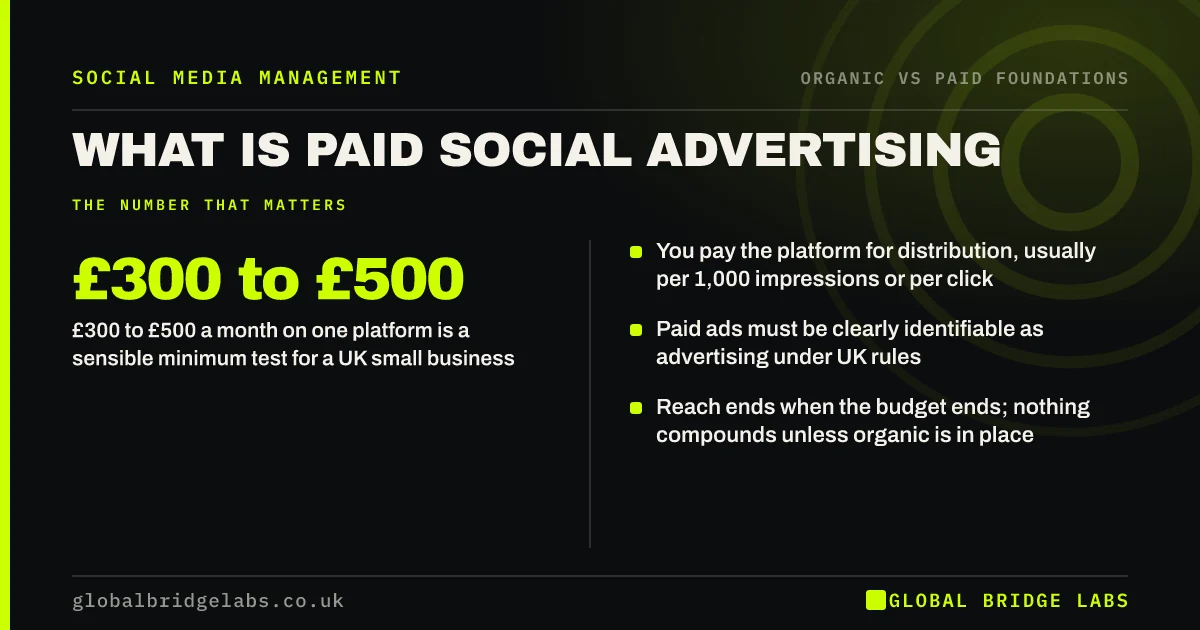
Organic social media is the unpaid content a business publishes on its own profiles, reaching followers and people the platform recommends it to. Paid social advertising is content a business pays a platform to show to a chosen audience. The difference is who pays for distribution, and it drives everything else: cost, speed, targeting, trust and how long results last.
Global Bridge Labs (GBL) is a UK–Sri Lanka delivery partner that runs organic and paid social for UK small businesses. This guide sets out how to choose between them, and how to combine them, using the same model we use with clients.
- Organic: unpaid reach, decided by the platform, slower, builds trust, keeps working.
- Paid: bought reach to an audience you choose, faster, measurable, stops with the budget.
Which should your business choose?
Most businesses should start with organic and add paid once a post or offer has proved it brings enquiries. Choose paid first only when you have a deadline, a clear offer and a budget you can hold for three months. Choose organic only when trust, referrals and repeat custom drive your sales and you have capacity to fill slowly.
Five questions settle it for most firms: what is the goal, how soon do you need results, do you have content that already works, can you hold a budget for three months, and who will run it.
- Trust, repeat customers, referrals: organic first.
- New customers fast, launches, events: paid, built on organic proof.
- No proven content yet: organic first, or paid as small, capped research.
- Under £300 a month: concentrate on organic or one platform only.
What is the earn, prove, buy model?
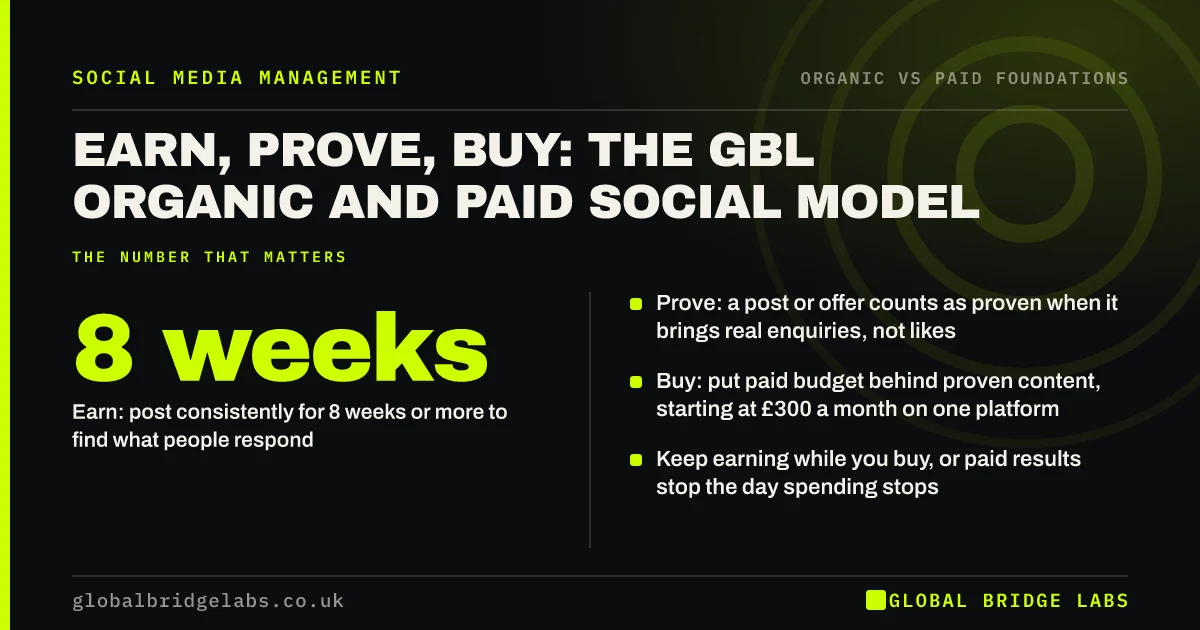
Earn, prove, buy is the GBL model for combining organic and paid social. Earn attention with consistent organic posts on one main platform. Prove which posts and offers bring real enquiries, not just likes. Buy more reach only for what is proven, starting on one platform with a capped budget. Keep earning while you buy.
The model exists because the most expensive mistake in social media is paying to amplify content nobody wanted. Paid social multiplies what already works; it rarely fixes what does not. Each stage has an exit test, so you only spend on ads when the evidence says it will pay back.
- Earn: post consistently for about eight weeks and learn what people respond to.
- Prove: a post or offer counts as proven when it brings enquiries organically.
- Buy: amplify proven content, starting at £300 to £500 a month on one platform.
- Repeat: feed what paid teaches you back into organic content.
How much do organic and paid social cost?
Organic social costs time. For one main platform with three posts a week plus replies, most small businesses spend around 4 to 6 hours a week. Through an agency, UK organic retainers commonly run from about £500 to £2,500 a month. Paid social costs the same content work plus ad spend and, if outsourced, management.
These are indicative UK market ranges, not a GBL price list. Most UK businesses are small, according to government business population estimates, so budgets for large brands are a poor guide.
- Organic in-house: staff or owner time plus tools.
- Organic via agency: about £500 to £2,500 a month.
- Paid ad spend: about £300 to £500 a month minimum test on one platform.
- Paid management: about £300 to £1,000 a month flat, or 10% to 20% of spend.
- Hidden costs: creative, tracking, landing pages and learning spend.
- Organic vs paid social: what each one really costs
- The hidden costs of paid social beyond the ad spend
- Organic vs paid: a worked 12-month cost comparison
Want a costed organic and paid plan for your business? Message us on WhatsApp and we will discuss your requirements.
Chat on WhatsApp →How quickly does each one work?
Paid social starts delivering within hours of approval, but results are unstable at first. Meta explains that ad sets go through a learning phase, needing about 50 optimisation events in a week, before delivery settles. Organic usually needs three to six months of consistent posting before enquiries are steady, but keeps working once established.
Speed has a price. Paid results stop the day spending stops, while organic posts stay on your profile as proof and, on search-led platforms such as YouTube and Pinterest, keep bringing views for months.
Which builds more trust?
Organic content usually builds more trust, because finished work, customer stories and honest answers feel like evidence rather than persuasion. The ASA requires paid social content to be obviously identifiable as advertising, so buyers know when they are being sold to. Ads still work, but they work better when the profile behind them is active and real.
Many people who see an ad check the business profile before acting. An empty or out-of-date profile wastes the click; a credible one converts it. That is the most practical reason to keep organic running once ads start.
When should you not use paid social?
Do not use paid social to rescue content that brought no response organically, to spread a small budget across several platforms, or before tracking and replies are in place. Do not use it when you are fully booked and only need to stay visible. And do not judge it during the learning phase.
Equally, do not rely on organic alone for a launch, an event with a date or a new area where nobody knows you. Organic reach is decided by the platform, so it cannot guarantee that the right people see something by a deadline.
- No proof yet: fix content before paying.
- Tiny budget: one platform or none.
- No tracking: set it up first.
- Hard deadline: do not rely on organic alone.
How do organic and paid work best together?
Organic and paid work best when each does a separate job. Organic tests messages, shows proof and keeps past customers close. Paid takes proven posts to new people and retargets those who engaged. The IPA's research on long and short-term marketing shows brand building and activation work best together, and social is no different.
In practice that means building ads from your best organic posts, retargeting people who engaged with them, keeping one message across both, and reporting both in one monthly review with enquiries by source at the top.
- Use organic posts to test ad creative.
- Retarget organic engagers with a clear offer.
- Keep one message across posts and ads.
- Measure each on its own KPIs, in one report.
Does the answer change by platform, goal or sector?
Yes. TikTok and Instagram Reels still give small accounts real organic reach; Facebook page posts reach fewer followers but groups still work; LinkedIn rewards founders posting as themselves, while its ads are precise but costly. For B2B, the LinkedIn B2B Institute's 95-5 rule notes most buyers are out of market at any time, which favours consistent organic presence.
Goals change it too: awareness and launches lean paid, community and repeat business lean organic. Sectors add rules: clinics, estate agents, recruiters and financial firms face restrictions on claims or targeting that shape what paid can do.
What does this look like in practice?
A pattern we see often: a UK home improvement firm with 12 staff had boosted random posts for a year, on three platforms, and could not say what any of it produced. Organic posting was irregular. We paused the boosts, moved to three organic posts a week on one platform and logged every enquiry's source for two months.
Two kinds of post, short before-and-after videos and plain price explainers, brought enquiries without spend. Those became the only ads, on one platform with a capped budget, retargeting people who had engaged. Across our client work we publish an average reach lift of +184% in the first 90 days. Reach is the easy part; the enquiry change came from advertising only what had already worked.
Organic vs paid checklist
- Write one goal and the date you need results by.
- Pick one main platform where your buyers already are.
- Post consistently for at least eight weeks.
- Log every enquiry's source, including calls and messages.
- Mark posts as proven only when they bring enquiries.
- Work out the most you can pay per enquiry.
- Set up tracking and tagged links before any ad.
- Run a capped three-month paid test behind proven posts.
- Keep organic running while ads run.
- Review both every quarter and adjust the split.
Guides on organic vs paid foundations
- What is organic social media, and what can it do?
- What is paid social advertising, and how does it work?
- Earn, prove, buy: the GBL organic and paid social model
- Organic vs paid social: the 8 differences that matter
- Organic or paid social? Five questions that decide it
- Does organic social media still work for small businesses?
- How organic and paid social work together
- The risks of relying on organic social alone
- The risks of relying on paid social ads alone
Guides on how organic and paid differ
- Organic reach vs paid reach: who actually sees your posts
- Paid vs organic social: how quickly does each work?
- Do buyers trust social ads or organic posts more?
- Organic vs paid targeting: choosing who sees you
- Organic posts keep working, ads stop: the longevity gap
- How much control do you have: organic vs paid?
- Do social ads get less engagement than organic posts?
- Should social ads look like organic posts?
- Do social ads help your organic reach?
- What organic and paid social each teach you about buyers
Guides on organic vs paid costs
- Organic vs paid social: what each one really costs
- Organic vs paid cost per lead: comparing like with like
- How much time does organic social media take each week?
- Organic vs paid social ROI: which returns more?
- A small budget: put it into organic content or ads?
- The hidden costs of paid social beyond the ad spend
- Organic or paid social: which is the bigger financial risk?
- Are customers from social ads worth less than organic ones?
- Payback time: when organic and paid social earn it back
- Organic vs paid: a worked 12-month cost comparison
Guides on organic or paid by goal
- Brand awareness: organic social or paid ads?
- Lead generation: organic social or paid social ads?
- Website traffic from social: organic posts or paid ads?
- Building a community: can paid social help?
- Launching a product: organic build-up or paid push?
- Promoting an event: organic posts or paid social ads?
- Hiring through social: organic posts or paid job ads?
- Should you run ads to grow your followers?
- Repeat customers: organic posts or paid retargeting?
- Testing a new idea: organic posts or a small ad test?
Guides on organic or paid by stage
- New business: start with organic or paid social?
- Adding paid to organic social: the first 90 days
- Too reliant on ads? Shift the balance back to organic
- What happens when you stop running social ads?
- Several locations: organic pages or paid local ads?
- Local businesses: organic posts or paid ads nearby?
- Long sales cycles: organic or paid social to stay in mind?
- Sole traders: your time or ad money on social?
- Social growth stalled? When paid breaks a plateau
- First social media hire: organic or paid specialist?
Guides on organic vs paid by platform
- Facebook organic vs paid: what still works for free
- Instagram organic vs paid: where ads earn their place
- LinkedIn organic vs paid: free reach or costly clicks?
- TikTok organic vs paid: is free reach enough?
- YouTube organic vs paid ads for small businesses
- Pinterest organic vs paid: when promoted pins pay
- X organic vs paid: is either worth it for business?
- Nextdoor organic vs paid: free posts or local ads?
- Founder posts vs paid ads: which builds more trust?
- Partnership ads vs organic creator posts: which to pay for?
Guides on organic vs paid by sector
- Trades businesses: organic or paid social for local jobs?
- E-commerce: organic social or paid ads for online sales?
- Accountants: organic content or paid social for clients?
- Restaurants and cafes: organic posts or paid social ads?
- Clinics: organic social or paid ads within the rules?
- Logistics firms: organic or paid social for B2B contracts?
- Salons and beauty: organic posts or paid ads for bookings?
- Estate agents: organic social or paid ads for valuations?
- Gyms and studios: organic or paid social for members?
- SaaS start-ups: organic social or paid ads for sign-ups?
Guides on running organic and paid together
- Retarget people who engaged with your organic posts
- Use organic posts to test ad creative before you pay
- Dark posts vs boosted page posts: which to use?
- One message across organic and paid social
- Where organic and paid sit in the social funnel
- Using customer posts in your ads: rules and results
- Comments on your ads: reply, hide or ignore?
- How many posts should be ads and how many organic?
- Use organic insights to sharpen your ad targeting
- Who does what when you run organic and paid together?
Guides on measuring organic and paid
- Organic vs paid social KPIs: measure each on its own terms
- How to compare organic and paid social results fairly
- Separate paid and organic social traffic in GA4
- Is paid social taking credit for organic sales?
- Organic vs paid social benchmarks for UK small firms
- Do your ads reach the same people as your organic posts?
- When to stop a social ad campaign and go back to organic
- How many of your enquiries come from organic vs paid?
- How long before you judge organic or paid results?
- An organic vs paid social report template for owners
Guides on organic vs paid in practice
- Organic vs paid checklist: 20 checks before you choose
- An organic vs paid decision worksheet for small firms
- Organic vs paid social examples from UK small businesses
- Mistakes businesses make choosing organic or paid social
- Organic and paid social terms explained in plain English
- Questions to ask an agency about organic and paid social
- When does an organic post become an ad? UK rules
- Plan a year of organic and paid social in one page
- Make the business case for paid social to your director
- Signs your business needs paid social, not more posts
Next step
Answer the five questions in this guide, then score yourself on the 20-point checklist. If you have proven content, a three-month budget and tracking in place, start a capped paid test on one platform. If not, spend the next quarter earning and proving organically.
Message us on WhatsApp for the earn, prove, buy worksheet and a costed plan, or book a 30-minute consultation.
Chat on WhatsApp →Sources and further reading
- The Long and the Short of It: balancing short and long-term marketing strategies · IPA
- About the learning phase · Meta
- Recognising ads: brand-owned and paid social media · ASA / CAP
- The 95-5 rule: most B2B buyers are out of market · LinkedIn B2B Institute
- Adults' media use and attitudes · Ofcom
- Business population estimates for the UK and regions 2025 · Department for Business and Trade
Frequently asked questions
Is organic or paid social better for a small business?
Neither is better in general. Organic builds trust and works over time at the cost of effort; paid buys reach and speed at the cost of money. Most small businesses should start organic to learn what their buyers respond to, then add paid behind the posts and offers that already bring enquiries.
How much should a small business spend on paid social?
A sensible starting test for a UK small business is about £300 to £500 a month on one platform for at least three months, plus content and any management fee. Spend more only once you know your cost per enquiry and what a customer is worth. Below that, concentrate on organic.
Does organic social media still work?
Yes, but differently. Page posts reach fewer followers than they used to, while recommendation feeds, short video, community groups and search-led platforms still reward useful content. Organic remains the main way buyers check whether a business is credible, which also makes any paid advertising work better.
Can you succeed on social media without paid ads?
Many local, referral-led and community-driven businesses do. Paid becomes necessary when you need to reach people who do not know you, when timing matters or when competitors advertise heavily. Most businesses benefit from at least occasional, focused paid support built on proven organic content.
How long does it take to see results from organic vs paid social?
Paid can reach people within hours, but stable results usually take four to six weeks of learning and three months before judging. Organic usually needs three to six months of consistent posting before enquiries are steady, then keeps building. Plan review dates for each before you start.
Written by

Global Bridge Labs (GBL) is a UK–Sri Lanka partner for social media, websites and BPO. Everything here comes from client delivery, not theory.