On this page
- 01Key takeaways
- 02Can you use customer posts in your ads?
- 03What permission do you need?
- 04Why does customer content perform well?
- 05What rules apply to claims?
- 06What about personal data?
- 07What does this look like in practice?
- 08Customer content checklist
- 09Next step
- 10Sources and further reading
- 11Frequently asked questions
Key takeaways
Customer posts often make strong ads because they look real and show genuine results. But using them in paid ads needs written permission from the creator, because they own the copyright, and any identifiable people need to agree too. Claims in the post become your advertising claims, so they must be accurate.
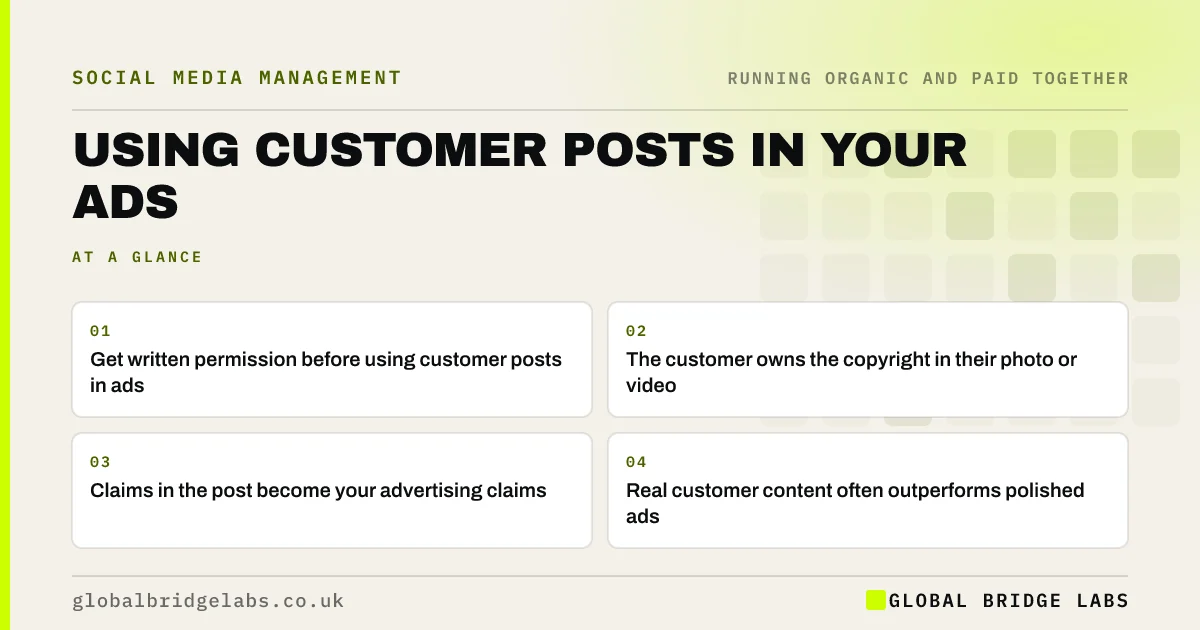
- Get written permission before using customer posts in ads.
- The customer owns the copyright in their photo or video.
- Claims in the post become your advertising claims.
- Real customer content often outperforms polished ads.
Want to use customer content in ads properly? Ask us on WhatsApp.
Chat on WhatsApp →Can you use customer posts in your ads?
Yes, with permission. Sharing a customer's post organically with credit is common practice, but using it in paid ads is commercial use. The customer usually owns the copyright, as GOV.UK's guidance on copyright explains, so you need clear written permission covering ads.
What permission do you need?
Get written permission that covers what you will use, where, for how long and whether you can edit it.
- Which post or posts.
- Which platforms and formats.
- How long you can use it.
- Whether you can edit or crop it.
- Consent from anyone identifiable in it.
Why does customer content perform well?
Customer content performs well because it looks like the feed and shows real results from real people. It acts as social proof. Ads built from it often feel more trustworthy than brand-made creative.
Want a simple permission form for customer content? Message us on WhatsApp.
Chat on WhatsApp →What rules apply to claims?
Once used in an ad, a customer's claims become your claims and must be accurate and typical. Reviews and testimonials must be genuine; the CMA's guidance on consumer reviews applies. Do not edit content to change its meaning.
What about personal data?
If the content shows identifiable people, get their consent too. The ICO's guidance on valid consent applies if you rely on consent: it must be freely given, specific and easy to withdraw.
What does this look like in practice?
A pattern we see: a garden furniture retailer reposted customer patio photos organically, and they outperformed its studio images. With written permission from three customers, it used the photos in ads for summer, which lowered cost per sale compared with its studio-image ads.
Customer content checklist
- Ask for written permission before ad use.
- Specify platforms, duration and edits.
- Get consent from anyone identifiable.
- Check claims are accurate and typical.
- Do not change the meaning by editing.
- Credit the customer where appropriate.
Next step
Collect three customer posts you would like to use in ads and send each customer a short permission request covering ads, platforms and duration.
Message us on WhatsApp for a customer content permission template, or book a 30-minute consultation.
Chat on WhatsApp →Sources and further reading
- How copyright protects your work · GOV.UK
- Publishing consumer reviews and complying with consumer protection law · Competition and Markets Authority
- What is valid consent? · Information Commissioner's Office
Frequently asked questions
Do I need permission to repost a customer's photo?
For organic reposting, asking permission and crediting the customer is good practice. For paid ads, you need clear written permission, because ads are commercial use and the customer owns the copyright. Include which platforms, how long and whether you can edit the content.
Can I use customer reviews in social ads?
Yes, if they are genuine, accurately quoted and represent typical experience. Do not edit reviews to change their meaning or cherry-pick misleadingly. The CMA's guidance on consumer reviews and the CAP Code both apply to testimonials used in marketing, so keep a record of the original review.
Should I pay customers for their content?
You can, but paid content changes the relationship: if you pay or give something in return for a post, it may need to be labelled as an ad. For simply using existing content in your own ads, written permission is the key requirement.
Written by

Global Bridge Labs (GBL) is a UK–Sri Lanka partner for social media, websites and BPO. Everything here comes from client delivery, not theory.