On this page
- 01Key takeaways
- 02Are paid social customers worth less?
- 03Why might organic customers be worth more?
- 04How do you compare customer value by source?
- 05What if paid customers are worth less?
- 06What if there is no difference?
- 07What does this look like in practice?
- 08Customer value checklist
- 09Next step
- 10Sources and further reading
- 11Frequently asked questions
Key takeaways
Customers from social ads are sometimes worth less over time than customers who found you organically, because ads can attract deal-seekers while organic followers already trust you. It varies by business. Compare repeat rate, average order and refunds by source over six months before deciding how much a paid customer is really worth.
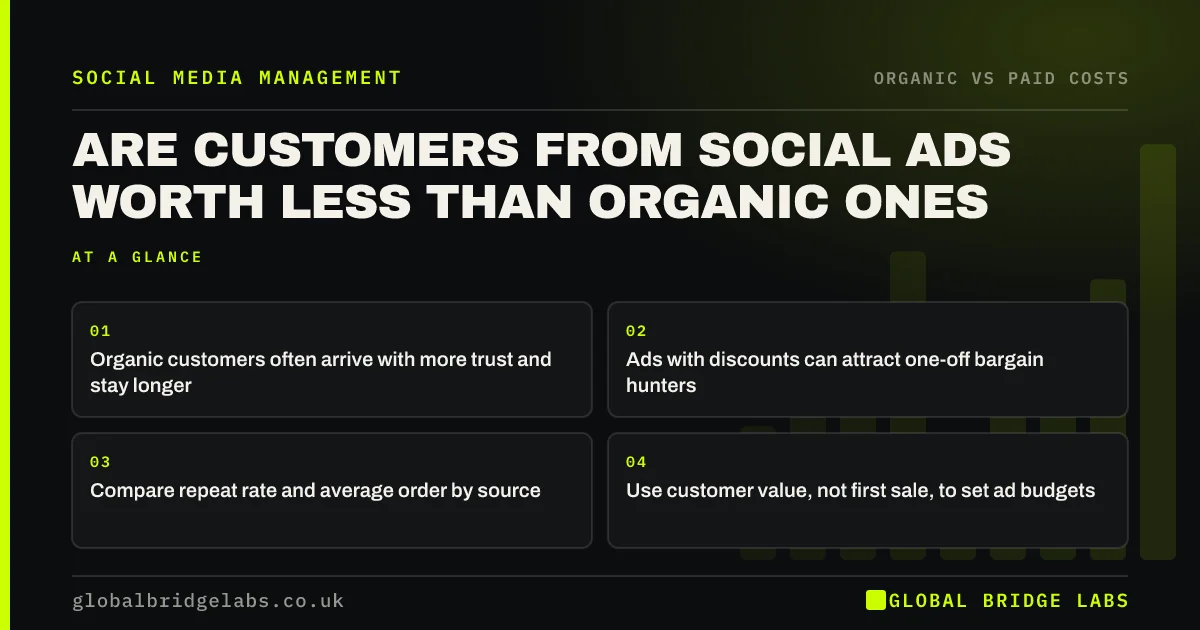
- Organic customers often arrive with more trust and stay longer.
- Ads with discounts can attract one-off bargain hunters.
- Compare repeat rate and average order by source.
- Use customer value, not first sale, to set ad budgets.
Want to compare customer value by source? Message us on WhatsApp.
Chat on WhatsApp →Are paid social customers worth less?
Sometimes. Customers who followed you for months before buying already know what you offer and tend to be good fits. Ad customers may be first-time buyers responding to an offer. In some businesses there is no difference; in others the gap is large. Only your own data can tell.
Why might organic customers be worth more?
Organic customers have usually seen several posts, understood your offer and chosen you without a discount. That trust tends to show up in higher repeat rates and fewer returns or complaints.
- They know what to expect.
- They often buy at full price.
- They are more likely to recommend you.
- They engage with future posts, which keeps them returning.
How do you compare customer value by source?
Tag each customer's first source, then compare six-month repeat rate, average order value and refunds. GA4 attribution reports help for online sales; for services, record the source in your CRM or a spreadsheet when the enquiry arrives.
What if paid customers are worth less?
If paid customers are worth less, lower the cost per customer you are willing to pay through ads, avoid heavy discount offers, and add follow-up through email and organic content to turn first buyers into repeat customers.
What if there is no difference?
If paid and organic customers are worth the same, paid becomes easier to justify, because you can scale it with confidence. The IPA's research suggests ads that build the brand as well as sell tend to attract longer-lasting customers than pure discount activity.
What does this look like in practice?
A pattern we see: an online coffee subscription found ad customers cancelled sooner than customers from organic posts and referrals. Replacing a heavy first-box discount ad with an ad built from a popular organic brewing video brought customers who stayed longer, at a higher cost per sign-up but better value overall.
Customer value checklist
- Record each customer's first source.
- Compare repeat rate after six months.
- Compare average order value by source.
- Check refunds and complaints by source.
- Avoid discount-led ads if they attract one-off buyers.
- Set ad budgets from customer value, not first sale.
Next step
Pull your last six months of customers, mark their first source and compare repeat rate by source. Use the result to set the maximum you will pay for a customer through ads.
Message us on WhatsApp for the customer value by source sheet, or book a 30-minute consultation.
Chat on WhatsApp →Sources and further reading
- Get started with attribution · Google Analytics Help
- About key events · Google Analytics Help
- The Long and the Short of It: balancing short and long-term marketing strategies · IPA
Frequently asked questions
Do customers from Facebook ads stay loyal?
Some do and some do not; it depends on your product, offer and follow-up. Discount-led ads often attract one-off buyers. Ads showing real value, followed by good service and ongoing organic content, tend to produce customers who return. Compare repeat rates by source in your own data.
What is customer lifetime value?
Customer lifetime value is the total profit a typical customer brings over their relationship with your business. Comparing it by source shows whether customers from ads, organic social, search or referrals are worth more, which tells you how much you can afford to pay to win each one.
Should I avoid discounts in social ads?
Not entirely, but be careful. Discounts can lift short-term sales while attracting customers who only buy on offer. Test a value-led ad without a discount alongside a discount ad, and compare not just first sales but repeat purchases over the following months.
Written by

Global Bridge Labs (GBL) is a UK–Sri Lanka partner for social media, websites and BPO. Everything here comes from client delivery, not theory.