On this page
- 01Key takeaways
- 02Is organic or paid better for brand awareness?
- 03How does paid social build awareness?
- 04How does organic social build awareness?
- 05Why does awareness matter for sales?
- 06How should you measure awareness?
- 07What does this look like in practice?
- 08Awareness checklist
- 09Next step
- 10Sources and further reading
- 11Frequently asked questions
Key takeaways
For brand awareness, paid social reaches new people quickly and predictably, while organic social builds the familiarity and memory that make awareness last. If nobody in your market knows you, paid gets your name in front of them; organic gives them something worth remembering when they look. Most businesses need both for awareness that turns into sales.
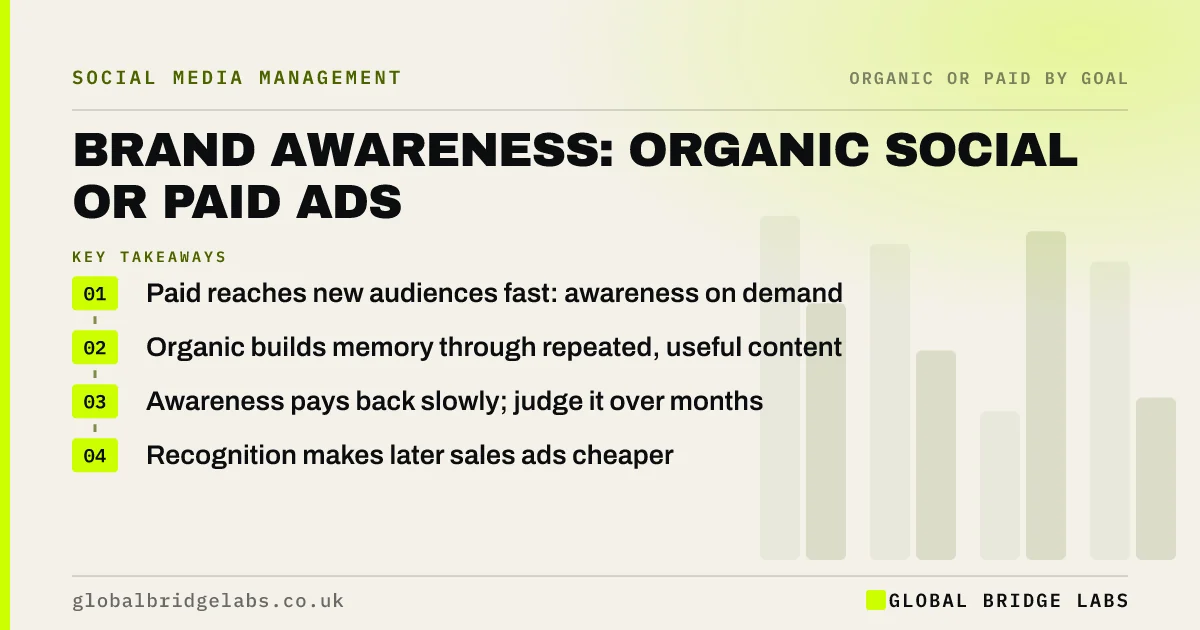
- Paid reaches new audiences fast: awareness on demand.
- Organic builds memory through repeated, useful content.
- Awareness pays back slowly; judge it over months.
- Recognition makes later sales ads cheaper.
Want an awareness plan that fits your budget? Message us on WhatsApp.
Chat on WhatsApp →Is organic or paid better for brand awareness?
Paid is better for reaching people who have never heard of you, because you can buy impressions in a defined area or audience. Organic is better for building lasting familiarity with people who have seen you, because it gives them repeated, useful reasons to remember you. Awareness needs both reach and repetition.
How does paid social build awareness?
Paid awareness campaigns use reach or video view objectives to put a message in front of as many relevant people as possible at a low cost per impression. They work best with short, memorable creative and a consistent visual identity, repeated over several weeks.
- Choose reach or video views as the objective.
- Target a clear location or audience.
- Use short, recognisable creative.
- Run for weeks, not days.
How does organic social build awareness?
Organic builds awareness by showing up consistently with content people save, share and remember. Shares extend reach to friends and colleagues, and recommendation feeds can show posts to non-followers. It is slower than paid, but the familiarity it builds is earned rather than bought.
Why does awareness matter for sales?
Awareness matters because people buy from businesses they recognise. The IPA's work on long and short-term marketing shows brand building increases the effectiveness of later sales activity. In B2B, the LinkedIn B2B Institute's 95-5 rule notes most buyers are not in market at any one time, so awareness keeps you in mind until they are.
How should you measure awareness?
Measure awareness by reach to your target area, growth in branded search, direct website visits and how many enquiries say they had seen you around. Do not expect awareness campaigns to produce immediate enquiries; judge them over three months or more.
What does this look like in practice?
A pattern we see: a new independent gym opened in a town with two big chains. Four weeks of local video ads made the name familiar, while daily organic posts of real members training gave people a reason to visit the profile. Sign-ups at the open day included many who said they had seen the gym everywhere.
Awareness checklist
- Define the audience or area to reach.
- Use paid reach for people who do not know you.
- Post organically to build familiarity.
- Keep visuals and messages consistent.
- Track branded search and direct visits.
- Judge awareness over three months.
Next step
Decide whether your awareness gap is reach, because nobody has seen you, or memory, because people have seen you but forget. Use paid for the first and organic for the second.
Message us on WhatsApp for a brand awareness plan, or book a 30-minute consultation.
Chat on WhatsApp →Sources and further reading
Frequently asked questions
How much should I spend on brand awareness ads?
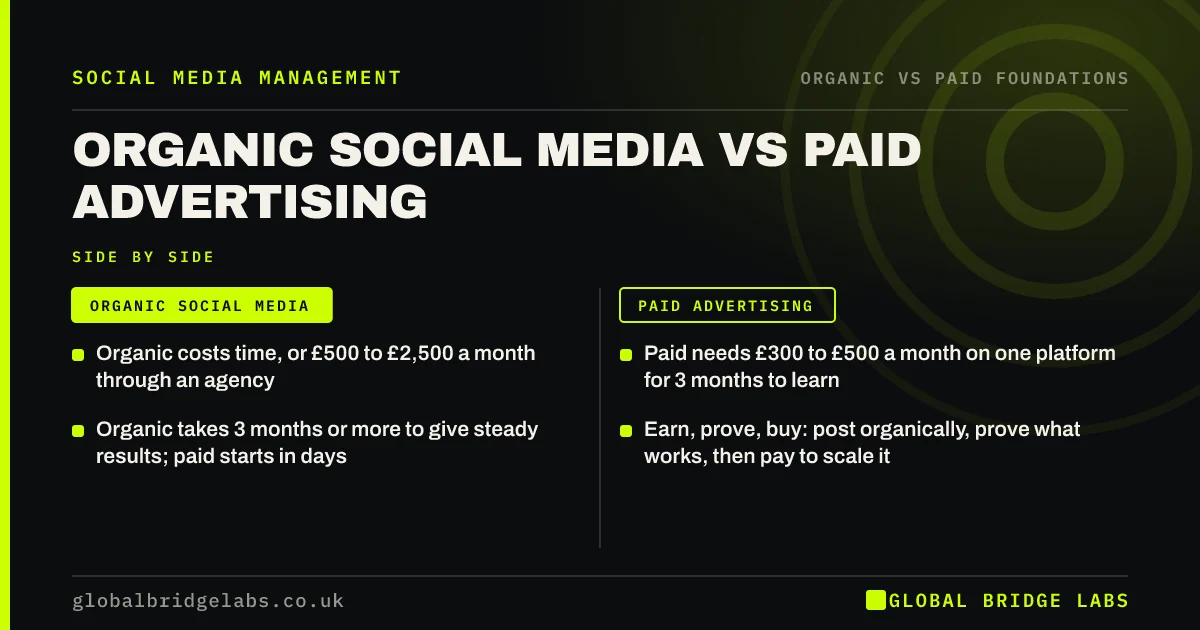
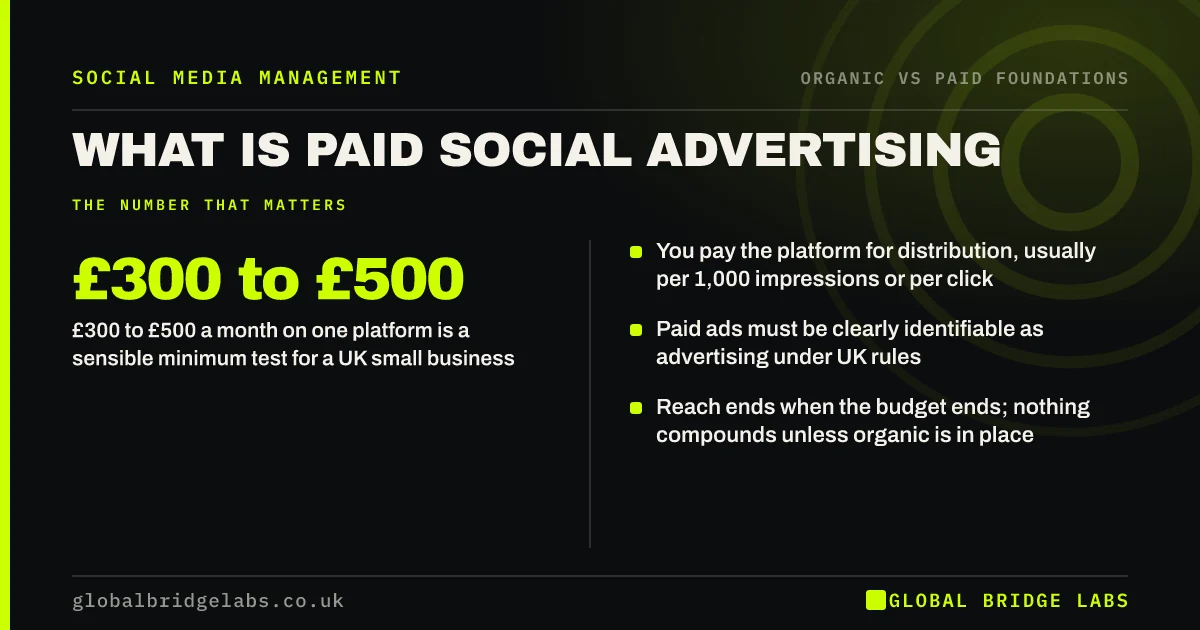
For a local UK small business, a few hundred pounds a month on one platform, held for at least two or three months, is a sensible start. Awareness needs repetition, so a steady budget over time usually works better than a large one-off burst. Track reach and branded search.
Can organic social build brand awareness on its own?
Yes, especially on recommendation-led platforms and in active local communities, but it takes longer and is less predictable. Organic is strongest at turning first impressions into familiarity. If you need a whole area to know your name quickly, paid reach is the faster route.
How do I know if awareness is working?
Look for rising branded searches, more direct website visits, more people saying they have seen you before, and lower costs on later sales ads. Awareness works over months, so compare quarter to quarter rather than week to week, and ask new customers how they heard of you.
Written by

Global Bridge Labs (GBL) is a UK–Sri Lanka partner for social media, websites and BPO. Everything here comes from client delivery, not theory.