On this page
- 01Key takeaways
- 02Why are organic and paid hard to compare?
- 03What makes a fair comparison?
- 04How do you track both consistently?
- 05How do you read the results?
- 06What should the comparison change?
- 07What does this look like in practice?
- 08Fair comparison checklist
- 09Next step
- 10Sources and further reading
- 11Frequently asked questions
Key takeaways
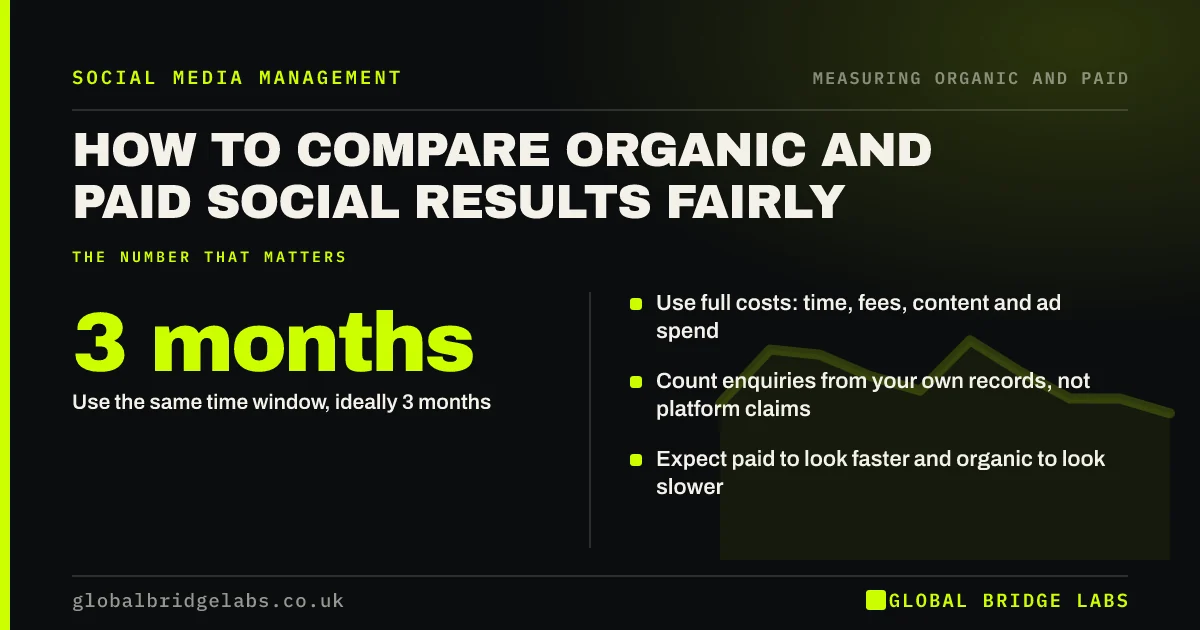
To compare organic and paid social fairly, use full costs on both sides, the same time window, the same definition of a result and your own records of enquiries by source. Platform reports show paid results generously and organic results poorly. A fair comparison often finds both working, at different speeds.
- Use full costs: time, fees, content and ad spend.
- Use the same time window, ideally 3 months.
- Count enquiries from your own records, not platform claims.
- Expect paid to look faster and organic to look slower.
Want a fair comparison of your organic and paid results? Message us on WhatsApp.
Chat on WhatsApp →Why are organic and paid hard to compare?
They are hard to compare because paid platforms track and report their own results automatically, while organic results often arrive by phone, messages or later searches that are never tagged. Costs are also counted differently: ad spend is visible, time is not.
What makes a fair comparison?
A fair comparison uses the same rules on both sides.
- Full costs for each, including time.
- The same time window.
- The same definition of a result.
- Results from your own records.
- Tagged links for both.
How do you track both consistently?
Tag every link with UTM parameters so GA4 separates organic and paid social, set enquiries as key events and ask every enquirer how they found you. Google's guidance on campaign URLs explains how to set up the tags.
Want help setting up a fair comparison? Message us on WhatsApp and we will discuss your requirements.
Chat on WhatsApp →How do you read the results?
Compare cost per enquiry and, where possible, cost per customer. Paid usually looks better in the first months; organic usually improves over time. Look at the trend, not a single month. GA4's attribution reports show how channels contribute along the way.
What should the comparison change?
Use the comparison to adjust the balance at the margin, not to switch one off. If both pay back, keep both. If one clearly does not after a fair test, change how it is run before deciding to stop it.
What does this look like in practice?
A pattern we see: a dog training business was ready to stop posting because ads seemed to bring all its clients. Asking every new client how they found the business showed many had followed its organic videos for months before clicking an ad. Both stayed, with the ads now retargeting video viewers.
Fair comparison checklist
- Count full costs for both.
- Pick a three-month window.
- Define one result, such as an enquiry.
- Tag all links with UTMs.
- Ask every enquirer how they found you.
- Compare trends, not single months.
Next step
For the next three months, tag every social link, log every enquiry's source and record full costs. Compare cost per enquiry at the end before changing your split.
Message us on WhatsApp for a comparison tracker, or book a 30-minute consultation.
Chat on WhatsApp →Sources and further reading
- Get started with attribution · Google Analytics Help
- URL builders: collect campaign data with custom URLs · Google Analytics Help
- Meta Business Help Centre · Meta
Frequently asked questions
Why do my ads seem to get all the credit?
Ad platforms track and report conversions automatically and often count people who saw an ad but would have bought anyway. Organic results arrive through untracked routes such as calls and direct searches. Your own records of how customers found you give a fairer picture.
How long should I compare organic and paid for?
Three months is a sensible minimum. Paid campaigns need time to learn and organic needs time to build. Shorter comparisons usually favour paid, because it produces results faster. Look at the trend across the whole period, not just the totals, and compare like with like on costs.
Can analytics show organic social results accurately?
Only partly. Analytics captures clicks from tagged links but misses people who saw posts and later called, searched your name or walked in. Combine analytics with asking customers how they found you to get a more complete picture of organic results.
Written by

Global Bridge Labs (GBL) is a UK–Sri Lanka partner for social media, websites and BPO. Everything here comes from client delivery, not theory.