On this page
- 01Key takeaways
- 02Do people trust social media ads?
- 03Why does organic content earn more trust?
- 04How does trust affect ad results?
- 05How do you make ads more trustworthy?
- 06When does trust matter most?
- 07What does this look like in practice?
- 08Trust checklist
- 09Next step
- 10Sources and further reading
- 11Frequently asked questions
Key takeaways
Buyers generally trust organic content more than ads, because organic posts, reviews and real examples feel like evidence rather than persuasion. UK rules require ads to be clearly labelled, so people know when they are being sold to. Ads still work, but they work better when the profile behind them shows real proof.
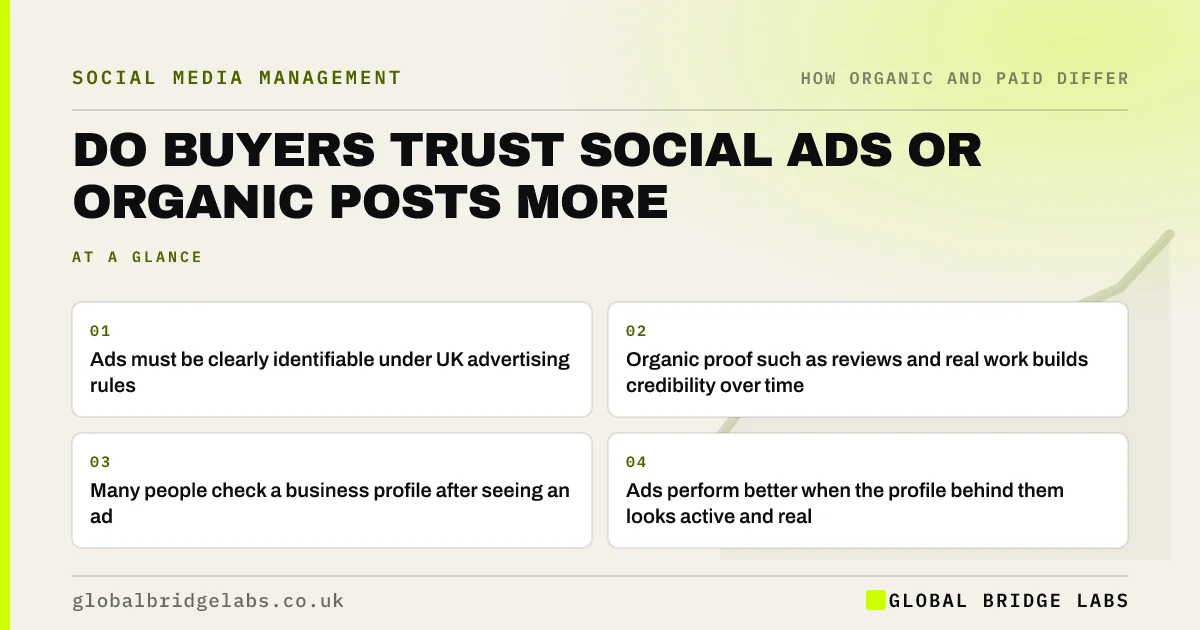
- Ads must be clearly identifiable under UK advertising rules.
- Organic proof such as reviews and real work builds credibility over time.
- Many people check a business profile after seeing an ad.
- Ads perform better when the profile behind them looks active and real.
Want to know if your profile builds trust? Send it to us on WhatsApp.
Chat on WhatsApp →Do people trust social media ads?
People trust ads less than recommendations or evidence they find themselves, but they still act on them, especially for low-risk purchases. The ASA requires paid social content to be obviously identifiable as advertising, so buyers know they are seeing an ad and judge it accordingly.
Why does organic content earn more trust?
Organic content earns trust because it shows rather than claims: finished jobs, customer stories, honest answers and real staff. Nielsen Norman Group's work on social proof shows people rely on others' experiences to judge unfamiliar options. A consistent record of organic posts provides exactly that evidence.
- Real work and results.
- Reviews and customer stories.
- Faces of the people who do the work.
- Honest answers to common questions.
How does trust affect ad results?
Trust affects ad results because many people who see an ad check the business before acting. If they find a recent, credible profile, they are more likely to enquire. If they find old posts or nothing at all, many leave. Edelman's research on brand trust shows trust is a major factor in purchase decisions.
How do you make ads more trustworthy?
Make ads more trustworthy by using real content rather than stock imagery, featuring genuine customer results with permission, being specific in claims and keeping the profile active. Ads built from posts that performed well organically often carry the authentic feel people respond to.
When does trust matter most?
Trust matters most for high-value, high-risk or regulated purchases: building work, legal and financial services, healthcare, and anything where the buyer lets you into their home or business. In those sectors, organic proof is essential, and paid works mainly as a way to get people to that proof.
What does this look like in practice?
A pattern we see: a loft conversion firm ran polished ads that sent people to a profile with no recent posts. Click-through was fine, enquiries were not. Posting weekly progress videos from real jobs and adding customer walk-throughs gave the ads something to land on, and enquiry rates from the same ads improved.
Trust checklist
- Review your profile as a buyer seeing your ad would.
- Post real work weekly.
- Feature customer stories with written permission.
- Make every claim specific and provable.
- Label all ads and paid partnerships clearly.
- Use your best organic posts as ad creative.
Next step
Ask someone outside the business to look at your profile for 30 seconds and say whether they would trust you with a job. Fix what they notice before your next ad goes live.
Message us on WhatsApp for a profile trust review, or book a 30-minute consultation.
Chat on WhatsApp →Sources and further reading
- Recognising ads: brand-owned and paid social media · ASA / CAP
- In brands we trust? 2019 Edelman Trust Barometer special report · Edelman
- Social proof in the user experience · Nielsen Norman Group
Frequently asked questions
Are organic posts more credible than ads?
Usually, yes, because they show real work and real customers rather than a paid message. Ads can still be credible when they use genuine content and specific claims. The strongest approach is an active organic profile that gives ads something trustworthy to point back to.
Do I have to label boosted posts as ads?
Platforms label boosted posts and ads as sponsored automatically. If you pay an influencer or give them free products, the ASA expects that content to be clearly labelled as an ad too. Your own organic posts about your business are marketing communications but do not need an ad label.
Why do people ignore social media ads?
People ignore ads that look generic, irrelevant or too polished, and ads from businesses they have never heard of. Ads using real content, aimed at the right audience and backed by a credible profile are more likely to get attention. Repetition to a warm audience also helps.
Written by

Global Bridge Labs (GBL) is a UK–Sri Lanka partner for social media, websites and BPO. Everything here comes from client delivery, not theory.