On this page
- 01Key takeaways
- 02Why do organic and paid need different KPIs?
- 03What KPIs should you track for organic?
- 04What KPIs should you track for paid?
- 05What should both share?
- 06How often should you review each?
- 07What does this look like in practice?
- 08KPI checklist
- 09Next step
- 10Sources and further reading
- 11Frequently asked questions
Key takeaways
Organic and paid social need different KPIs because they do different jobs. Track organic on engaged reach, saves and shares, profile visits, messages and enquiries over time. Track paid on cost per result, conversion rate and return against customer value. Report both side by side, but never judge one by the other's numbers.
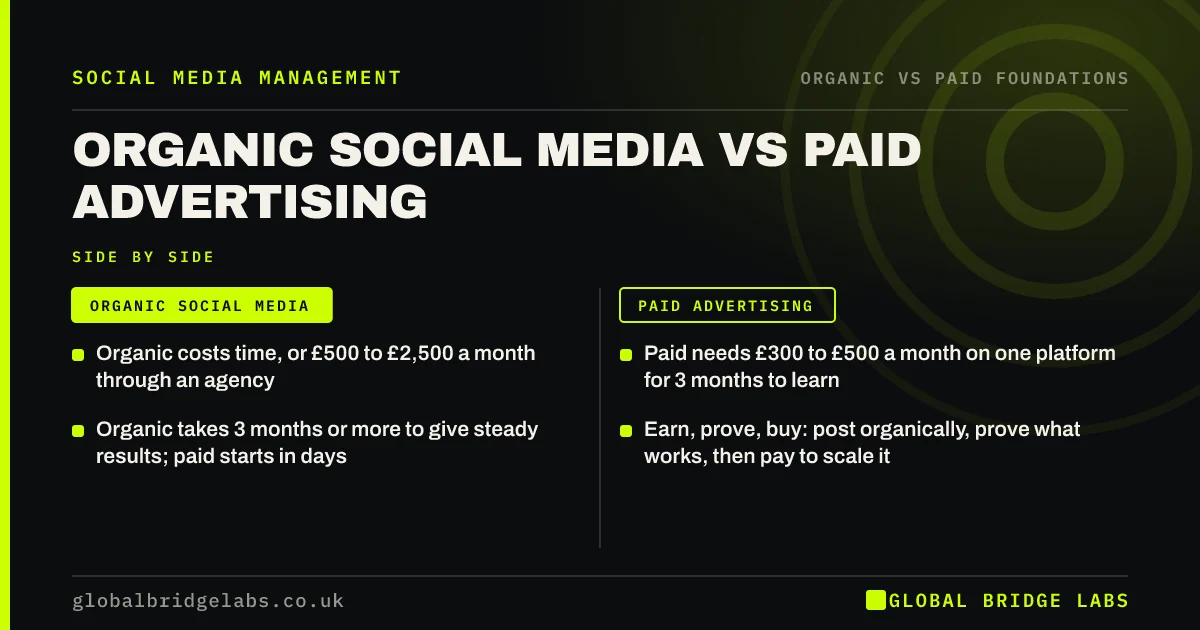
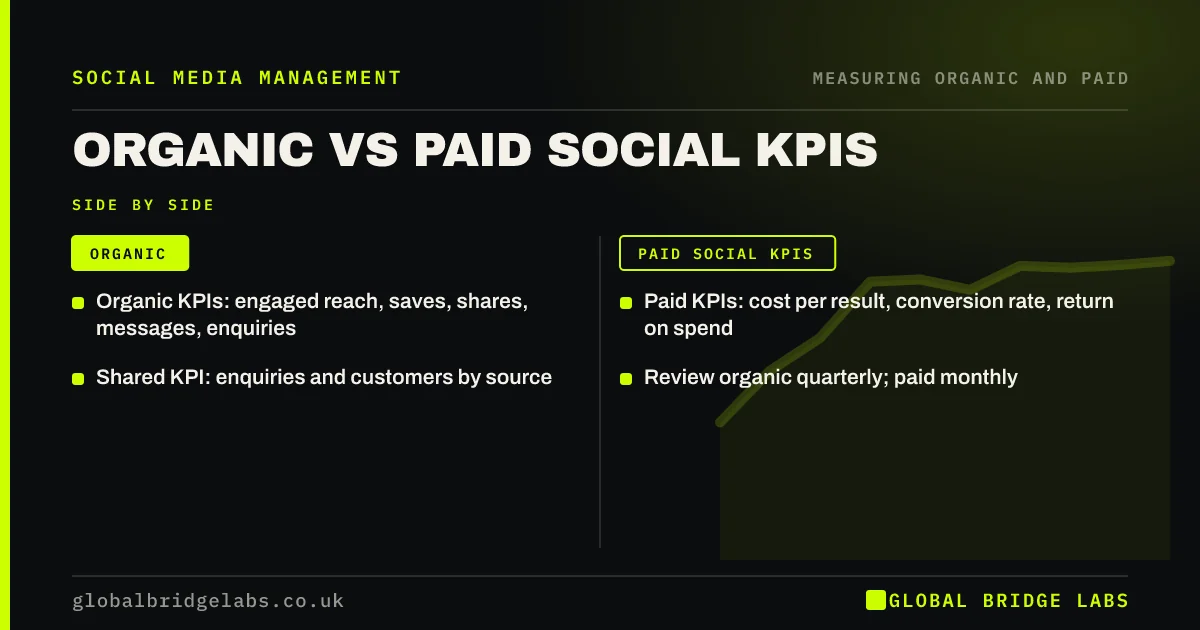
- Organic KPIs: engaged reach, saves, shares, messages, enquiries.
- Paid KPIs: cost per result, conversion rate, return on spend.
- Shared KPI: enquiries and customers by source.
- Review organic quarterly; paid monthly.
Want a KPI set for your organic and paid social? Message us on WhatsApp.
Chat on WhatsApp →Why do organic and paid need different KPIs?
Organic and paid need different KPIs because organic builds trust and audience over time, while paid buys specific results now. Judging organic on cost per lead makes it look weak; judging paid on likes makes it look pointless. The IPA's research on long and short-term effects supports measuring each on its own horizon.
What KPIs should you track for organic?
Track organic on signals of interest and business results.
- Reach to relevant people, including non-followers.
- Saves and shares per post.
- Profile visits and link clicks.
- Direct messages and comments with questions.
- Enquiries that mention social.
What KPIs should you track for paid?
Track paid on the objective you bought. GA4 key events and platform conversion tracking show actions after the click.
- Cost per enquiry, booking or sale.
- Click-through rate.
- Landing page conversion rate.
- Return on ad spend against margin.
- Frequency, to spot fatigue.
What should both share?
Both should share a bottom line: enquiries and customers by source, and cost per customer where you can calculate it. This is the number that tells you whether social media as a whole is paying back.
How often should you review each?
Review paid monthly, because spend is ongoing and changes have quick effects. Review organic quarterly, because trends take time to show. A short weekly check on both catches problems early.
What does this look like in practice?
A pattern we see: an architect's practice reported organic and paid together as total likes and followers, which said nothing useful. Splitting the report, organic on enquiries mentioning posts and paid on cost per consultation booked, showed both were working and stopped a plan to cut organic.
KPI checklist
- List three organic KPIs.
- List three paid KPIs tied to your objective.
- Track enquiries by source for both.
- Review paid monthly.
- Review organic quarterly.
- Never judge one by the other's numbers.
Next step
Pick three KPIs for organic and three for paid from the lists above and put them in one simple monthly sheet, with enquiries by source at the bottom.
Message us on WhatsApp for an organic and paid KPI sheet, or book a 30-minute consultation.
Chat on WhatsApp →Sources and further reading
- About key events · Google Analytics Help
- Meta Business Help Centre · Meta
- The Long and the Short of It: balancing short and long-term marketing strategies · IPA
Frequently asked questions
What is the most important social media KPI?
Enquiries or sales by source is the most important, because it connects social media to business results. Other KPIs, such as engagement or cost per click, are useful signals but can mislead on their own. Track them as supporting measures beneath the business result.
Should I track followers as a KPI?
Follower count is a weak KPI on its own, because followers do not always engage or buy. Track it as background, but focus on engaged reach, messages and enquiries for organic, and cost per result for paid. A small, engaged audience often beats a large inactive one.
How do I measure organic social media success?
Measure organic success with engaged reach, saves, shares, profile visits, messages and enquiries that mention social media. Review trends over three months rather than single posts. Ask new customers how they found you, since many organic effects never appear in analytics.
Written by

Global Bridge Labs (GBL) is a UK–Sri Lanka partner for social media, websites and BPO. Everything here comes from client delivery, not theory.