On this page
- 01Key takeaways
- 02How does paid social advertising work?
- 03How do you pay for social ads?
- 04How much do UK small businesses spend on social ads?
- 05What rules apply to paid social in the UK?
- 06When does paying for social reach make sense?
- 07What does this look like in practice?
- 08Paid social checklist
- 09Next step
- 10Sources and further reading
- 11Frequently asked questions
Key takeaways
Paid social advertising is content a business pays a platform to show to a chosen audience, priced by impressions, clicks or results. You set the audience, budget and goal, and the platform's ad system finds people likely to act. It buys reach and speed that organic posts cannot guarantee, but it stops the moment spending stops.
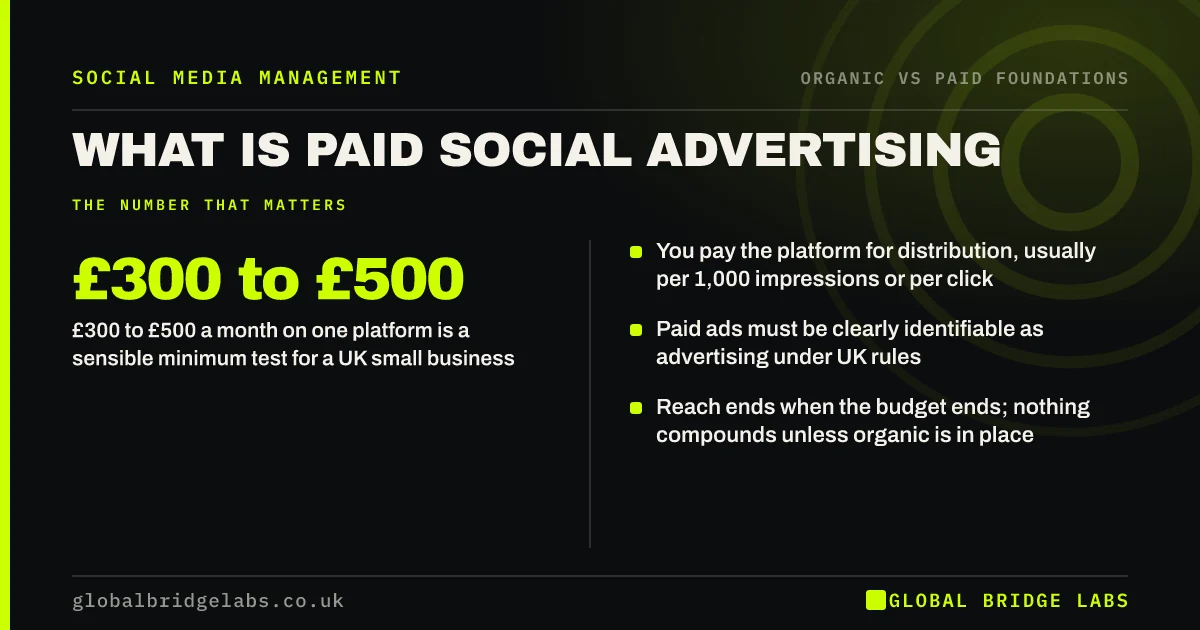
- You pay the platform for distribution, usually per 1,000 impressions or per click.
- £300 to £500 a month on one platform is a sensible minimum test for a UK small business.
- Paid ads must be clearly identifiable as advertising under UK rules.
- Reach ends when the budget ends; nothing compounds unless organic is in place.
Wondering whether paid social fits your business? Ask us on WhatsApp.
Chat on WhatsApp →How does paid social advertising work?
Paid social works through an ad manager such as Meta Ads Manager, LinkedIn Campaign Manager or TikTok Ads Manager. You choose an objective, such as leads or website visits, define an audience, set a daily or lifetime budget and upload the ad. The platform then auctions your ad against others for each person's attention.
- Objective: what you want people to do.
- Audience: location, interests, job, or your own customer lists.
- Budget: daily or lifetime, set by you.
- Creative: the image, video and words people see.
How do you pay for social ads?
Most platforms charge by impressions (cost per 1,000 views, called CPM) or by clicks, with the price set in an auction. You set a budget ceiling and the platform spends up to it. Meta's guidance on budgets explains that daily and lifetime budgets control the maximum you spend, not a guaranteed result.
How much do UK small businesses spend on social ads?
Most UK small businesses that advertise on social spend a few hundred pounds a month. A test of £300 to £500 a month on one platform for at least three months gives the system enough data to learn. Below that, results are hard to read. Management by an agency, typically £300 to £1,000 a month, is separate from the ad budget.
Want to know if £300 a month is enough for your goal? Message us on WhatsApp and we will discuss your requirements.
Chat on WhatsApp →What rules apply to paid social in the UK?
Paid social ads must follow the CAP Code, enforced by the Advertising Standards Authority (ASA). The ASA's guidance on brand-owned and paid social media says ads must be obviously identifiable as ads, and claims must be backed by evidence. Platforms add their own ad policies, and some sectors, such as finance and health, have extra rules.
When does paying for social reach make sense?
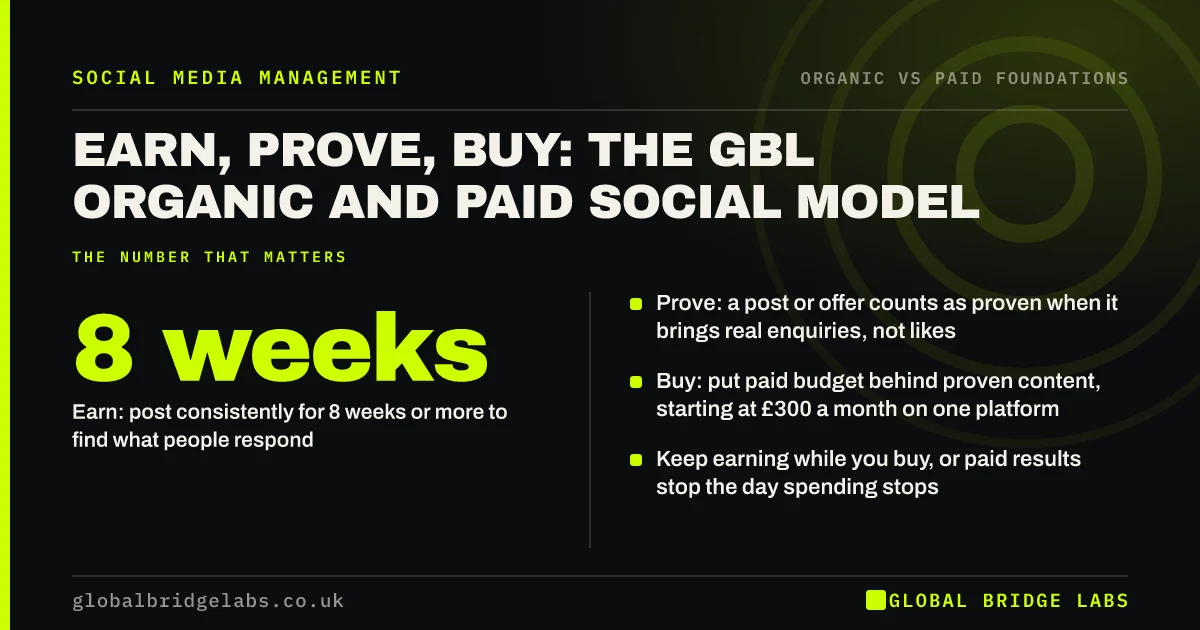
Paid social makes sense when you need to reach people who do not know you yet, when timing matters, or when you have a post or offer that already works organically and want more of the same result. It rarely makes sense to rescue content that nobody responded to without spend.
What does this look like in practice?
A pattern we see: a home furnishings retailer boosted random posts for a year and could not say what it bought. Switching to one campaign with a single objective, a clear audience and the two posts that had sold best organically gave a readable cost per sale within six weeks, at the same monthly spend.
Paid social checklist
- Pick one objective per campaign.
- Start on the platform where your organic posts work best.
- Commit a budget you can hold for three months.
- Set up tracking before the first pound is spent.
- Use creative that has already worked organically.
- Make sure every ad is clearly identifiable as an ad.
Next step
Before spending anything, choose one goal, one platform and one post that already brings enquiries, then set a three-month test budget you are comfortable losing.
Message us on WhatsApp for a paid social test plan, or book a 30-minute consultation.
Chat on WhatsApp →Sources and further reading
- Meta Business Help Centre · Meta
- About budgets · Meta
- Recognising ads: brand-owned and paid social media · ASA / CAP
Frequently asked questions
What is the difference between paid social and organic social?
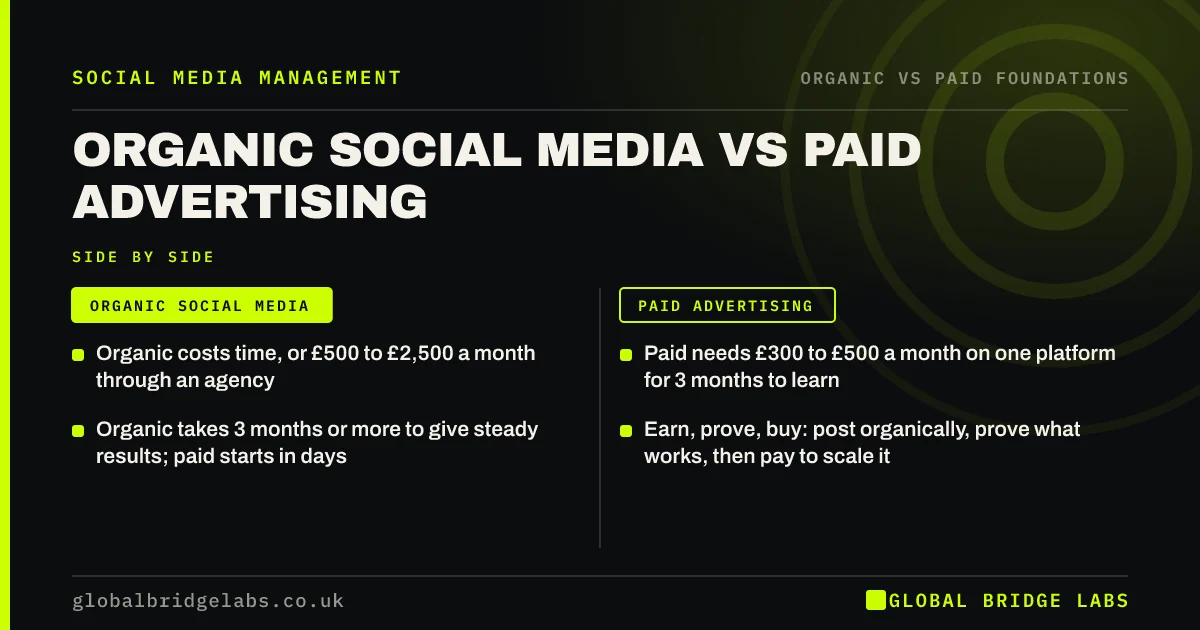
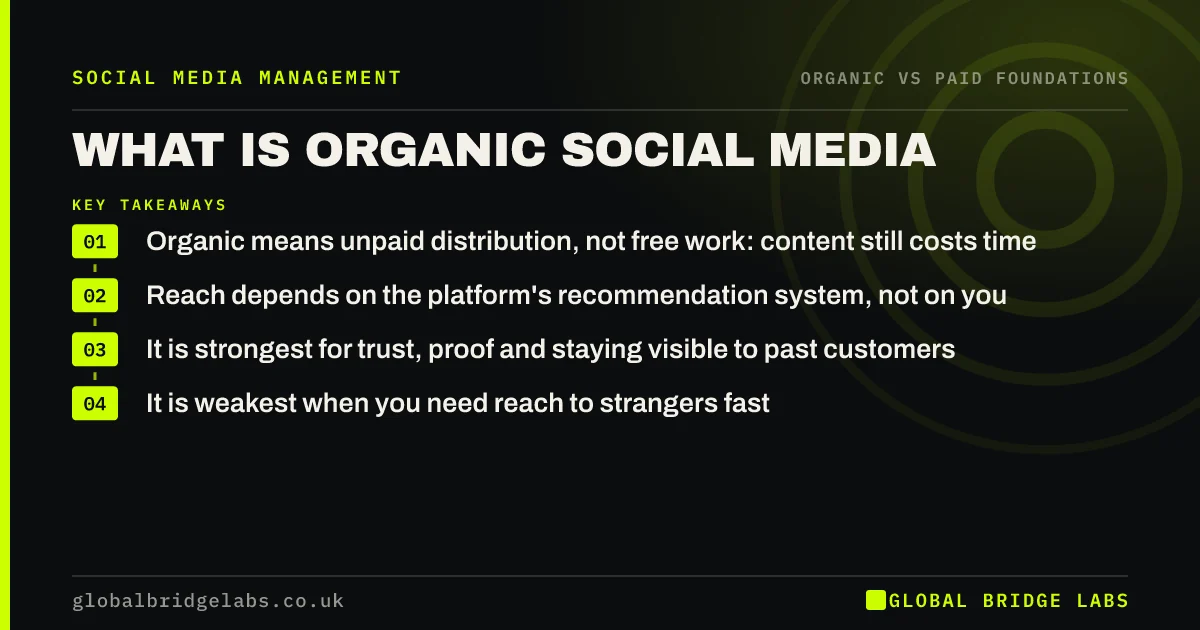
Organic social is content you publish for free that reaches followers and people the platform recommends it to. Paid social is content you pay the platform to show to an audience you choose. Organic builds trust over time; paid buys reach and speed, but stops as soon as the budget stops.
Is boosting a post paid social?
Yes. Boosting a post means paying the platform to show an existing organic post to more people, so it becomes a paid ad. It is the simplest form of paid social, with fewer targeting and objective options than a full campaign in an ad manager. The same advertising rules apply to it.
How quickly does paid social work?
Paid social can put a post in front of thousands of people within hours of approval. Useful results, such as a stable cost per enquiry, usually take longer: platforms need time and data to learn who responds. Plan on four to six weeks of learning and three months before judging a test.
Written by

Global Bridge Labs (GBL) is a UK–Sri Lanka partner for social media, websites and BPO. Everything here comes from client delivery, not theory.