On this page
- 01Key takeaways
- 02Should a local business use organic or paid social?
- 03What organic tactics work for local businesses?
- 04How do paid local ads work?
- 05How do reviews fit in?
- 06When is paid worth it for a local business?
- 07What does this look like in practice?
- 08Local business checklist
- 09Next step
- 10Sources and further reading
- 11Frequently asked questions
Key takeaways
Local businesses serving a few miles can get far with organic social: community groups, local content and reviews reach nearby people for free. Paid local ads add certainty: a defined radius sees your offer, which matters for openings, quiet weeks and new services. Start organic and community-led, then add small radius-targeted ads.
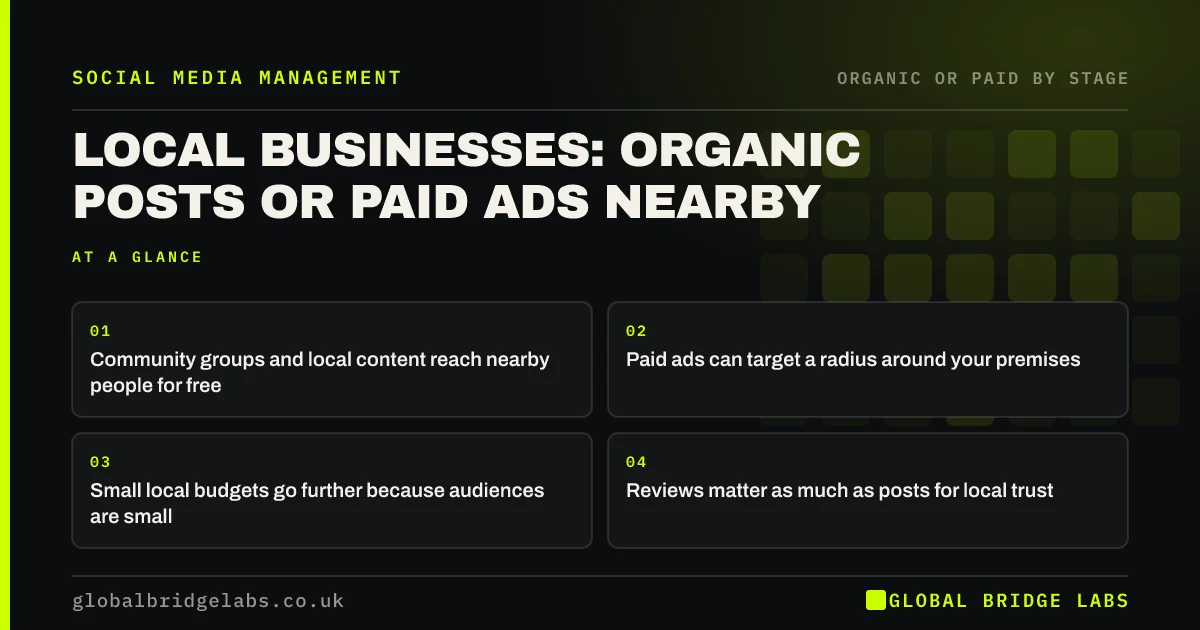
- Community groups and local content reach nearby people for free.
- Paid ads can target a radius around your premises.
- Small local budgets go further because audiences are small.
- Reviews matter as much as posts for local trust.
Want more local customers from social? Message us on WhatsApp.
Chat on WhatsApp →Should a local business use organic or paid social?
A local business should start with organic, because local audiences are small and community-minded, and posts in local groups often reach them for free. Add paid for moments that need certainty: openings, quiet periods, new services or events. Local ad budgets can be modest.
What organic tactics work for local businesses?
Local organic works through relevance: people care about places and faces they know.
- Post in local community groups where allowed.
- Show local jobs, streets and landmarks.
- Feature staff and regular customers.
- Collaborate with nearby businesses.
- Ask happy customers for reviews.
How do paid local ads work?
Paid local ads target a radius or postcodes around your premises. Because the audience is small, a modest daily budget can reach much of it repeatedly. Use local images and clear directions or booking links, and set a frequency you are comfortable with.
Want a local ad plan for your area? Send us your postcode on WhatsApp.
Chat on WhatsApp →How do reviews fit in?
Reviews are a key trust signal for local buyers. Google's local ranking guidance notes that reviews influence visibility, and the CMA's guidance on consumer reviews sets out what is allowed. Ask genuine customers, never incentivise only positive reviews, and reply to all.
When is paid worth it for a local business?
Paid is worth it when you have capacity to fill, a time-bound offer, or a new service locals do not know about. If you are fully booked through word of mouth and organic, paid may add little.
What does this look like in practice?
A pattern we see: a village pub relied on its Facebook page and saw quiet midweeks. Posting quiz nights and specials in two local groups helped, and a small radius ad on Tuesday and Wednesday afternoons, featuring that night's offer, lifted midweek covers noticeably for a modest weekly spend.
Local business checklist
- Join and post in local community groups.
- Show local places, people and jobs.
- Keep Google Business Profile current.
- Ask genuine customers for reviews.
- Use radius-targeted ads for quiet periods.
- Track where new customers come from.
Next step
Identify your quietest week or service and run a two-week radius ad behind your best local post, while keeping organic and group posting at its usual rhythm.
Message us on WhatsApp for a local social plan, or book a 30-minute consultation.
Chat on WhatsApp →Sources and further reading
- Tips to improve your local ranking on Google · Google Business Profile Help
- Meta Business Help Centre · Meta
- Publishing consumer reviews and complying with consumer protection law · Competition and Markets Authority
Frequently asked questions
How much should a local business spend on social ads?
Local audiences are small, so budgets can be modest: often a few pounds a day can reach much of a nearby radius. Concentrate spend on quiet periods, openings or new services rather than running small ads all year. Track enquiries to see what it returns.
Can I post my business in local Facebook groups?
Many local groups allow business posts on certain days or in specific threads; others ban them. Read and follow each group's rules, contribute helpfully rather than only advertising, and respond to recommendations requests. Breaking group rules can get you removed and damage your reputation.
Is Nextdoor or Facebook better for local businesses?
It depends on your area. Facebook groups are widespread and active in many towns; Nextdoor is strong in some neighbourhoods, particularly for home services. Check where locals in your area ask for recommendations and focus there, using paid on whichever brings enquiries.
Written by

Global Bridge Labs (GBL) is a UK–Sri Lanka partner for social media, websites and BPO. Everything here comes from client delivery, not theory.