On this page
- 01Key takeaways
- 02How can paid social take credit for organic sales?
- 03Why do platform and GA4 numbers differ?
- 04How do you check what ads really add?
- 05Does this mean ads do not work?
- 06How should you report attribution?
- 07What does this look like in practice?
- 08Attribution checklist
- 09Next step
- 10Sources and further reading
- 11Frequently asked questions
Key takeaways
Paid social can take credit for sales that organic, word of mouth or search would have produced anyway. Platforms often count conversions from people who merely saw an ad, and last-click analytics hides organic's earlier influence. Check what ads really add by comparing platform claims with your own records and by testing pauses or holdouts.
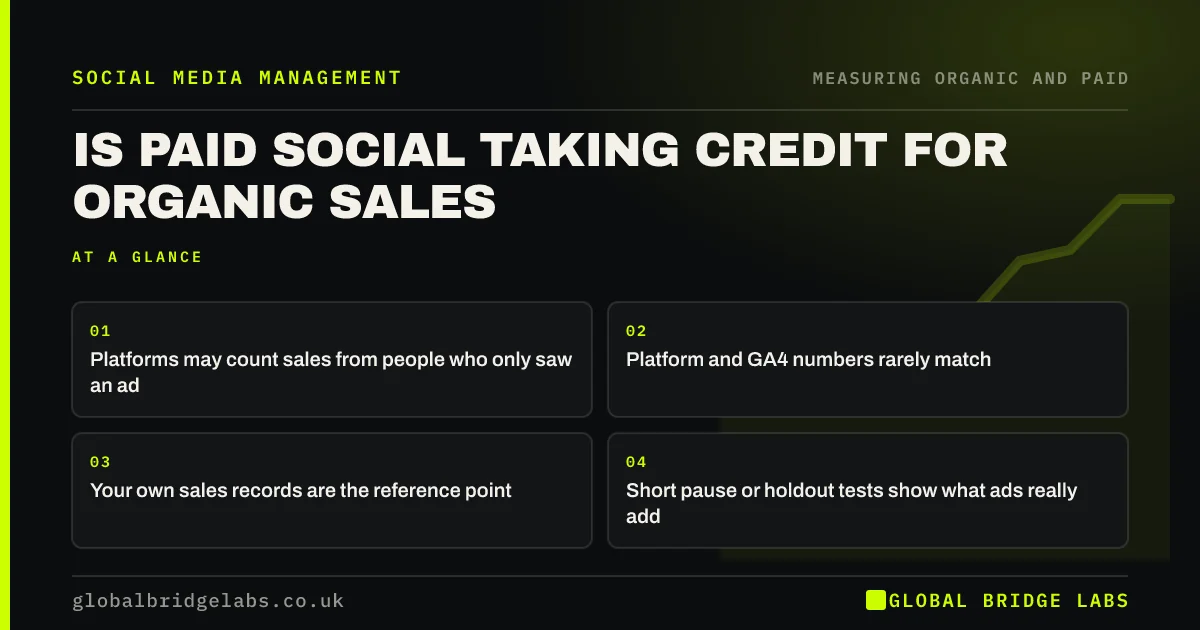
- Platforms may count sales from people who only saw an ad.
- Platform and GA4 numbers rarely match.
- Your own sales records are the reference point.
- Short pause or holdout tests show what ads really add.
Think your ads might be overclaiming? Send us your numbers on WhatsApp.
Chat on WhatsApp →How can paid social take credit for organic sales?
Ad platforms use attribution windows that can include people who saw an ad without clicking and bought later. If those people were already following you organically, the sale may have happened anyway. Meta's reporting explains attribution settings, which affect how many conversions are claimed.
Why do platform and GA4 numbers differ?
Platforms and GA4 use different attribution models, windows and data. Platforms can see in-app views; GA4 sees website visits and uses its own attribution. GA4's attribution reports show how it shares credit across channels.
- Different attribution windows.
- View-through vs click-based credit.
- Cross-device and app data differences.
- Consent choices limiting tracking.
How do you check what ads really add?
Compare total sales or enquiries with platform-claimed conversions. If ads claim most of your sales while organic and referrals are strong, they may be overclaiming. A simple test is to pause ads in one area or for a short period and see how much total demand falls.
Want help checking what your ads really add? Message us on WhatsApp and we will discuss your requirements.
Chat on WhatsApp →Does this mean ads do not work?
No. Ads often work well; the question is how much they add beyond what would happen anyway. The IPA's work shows advertising effects can be real but are often mismeasured by short-term metrics.
How should you report attribution?
Report platform figures, GA4 figures and your own records side by side, and make decisions on the most conservative. Ask customers how they found you to fill gaps.
What does this look like in practice?
A pattern we see: an online clothing brand's ads claimed more sales than the shop had made from all sources in a month. Switching the attribution comparison to click-based windows and checking against Shopify orders showed ads were still profitable, but less so, which led to a more realistic budget.
Attribution checklist
- Compare platform claims with total sales.
- Check attribution windows in ad settings.
- Report platform, GA4 and your own records.
- Ask customers how they found you.
- Test pauses or holdouts carefully.
- Decide on conservative numbers.
Next step
Add up last month's ad-claimed conversions and compare them with total sales from all sources. If the ads claim an implausible share, review attribution settings before your next budget decision.
Message us on WhatsApp for an attribution check, or book a 30-minute consultation.
Chat on WhatsApp →Sources and further reading
- Get started with attribution · Google Analytics Help
- Meta Business Help Centre · Meta
- The Long and the Short of It: balancing short and long-term marketing strategies · IPA
Frequently asked questions
Why does Facebook report more sales than I made?
Meta's reporting can include view-through conversions and modelled results, and several platforms may each claim the same sale. Compare ad-reported conversions with your actual orders. Using click-based attribution windows when comparing usually brings the platform numbers much closer to what your own sales records show.
What is view-through attribution?
View-through attribution gives an ad credit when someone saw it without clicking and later converted within a set window. It can capture real influence but also credits ads for sales that would have happened anyway, especially among existing followers and customers.
How do I know if my ads are actually working?
Compare total enquiries or sales before, during and after campaigns, check against your own records rather than platform claims, and ask customers how they found you. A short, controlled pause or holdout in one area can show how much ads add beyond organic and other channels.
Written by

Global Bridge Labs (GBL) is a UK–Sri Lanka partner for social media, websites and BPO. Everything here comes from client delivery, not theory.