On this page
- 01Key takeaways
- 02What are the risks of relying on organic social only?
- 03When is organic only a reasonable choice?
- 04When does organic only become a problem?
- 05How can you reduce the risk without big spend?
- 06What should you watch for?
- 07What does this look like in practice?
- 08Organic only risk checklist
- 09Next step
- 10Sources and further reading
- 11Frequently asked questions
Key takeaways
Relying on organic social alone carries three main risks: reach you cannot control, growth that takes months, and results that depend on one platform's recommendation system. For many local and referral-led businesses those risks are acceptable. They become serious when you need predictable enquiries, are launching something, or face competitors who advertise.
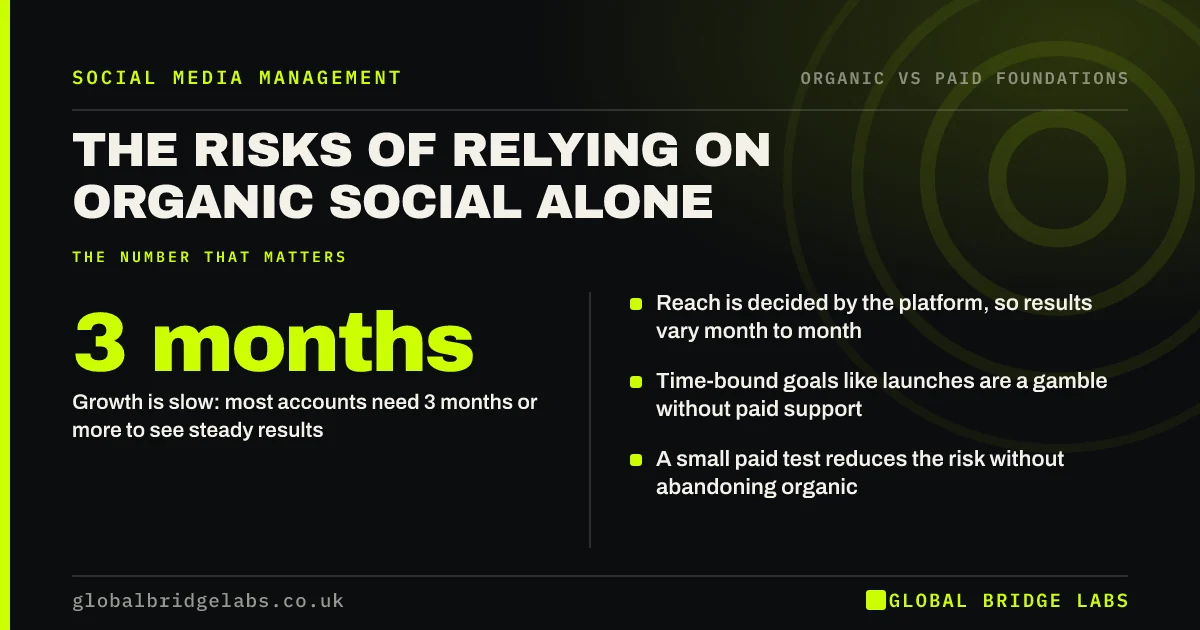
- Reach is decided by the platform, so results vary month to month.
- Growth is slow: most accounts need 3 months or more to see steady results.
- Time-bound goals like launches are a gamble without paid support.
- A small paid test reduces the risk without abandoning organic.
Wondering if organic alone is risky for you? Message us on WhatsApp.
Chat on WhatsApp →What are the risks of relying on organic social only?
The main risks are unpredictable reach, slow growth, no way to reach specific new audiences on demand, and dependence on platform rules you do not control. A change in how a platform ranks content can cut your reach overnight. LinkedIn and TikTok both describe ranking systems that adjust to user behaviour constantly.
- Reach varies with each algorithm change.
- No guaranteed audience for launches or events.
- Slow build before enquiries are steady.
- Competitors who advertise can crowd you out.
When is organic only a reasonable choice?
Organic only is reasonable when most work comes from referrals and repeat customers, when you serve a small local area with active community groups, or when you are fully booked and only need to stay visible. In those cases organic keeps you credible and paid would add little.
When does organic only become a problem?
Organic only becomes a problem when you depend on social for new enquiries, need a launch or event to fill, are entering a new area or market, or see competitors winning attention with ads. It also becomes a problem when one platform supplies most of your enquiries and changes how it ranks posts.
How can you reduce the risk without big spend?
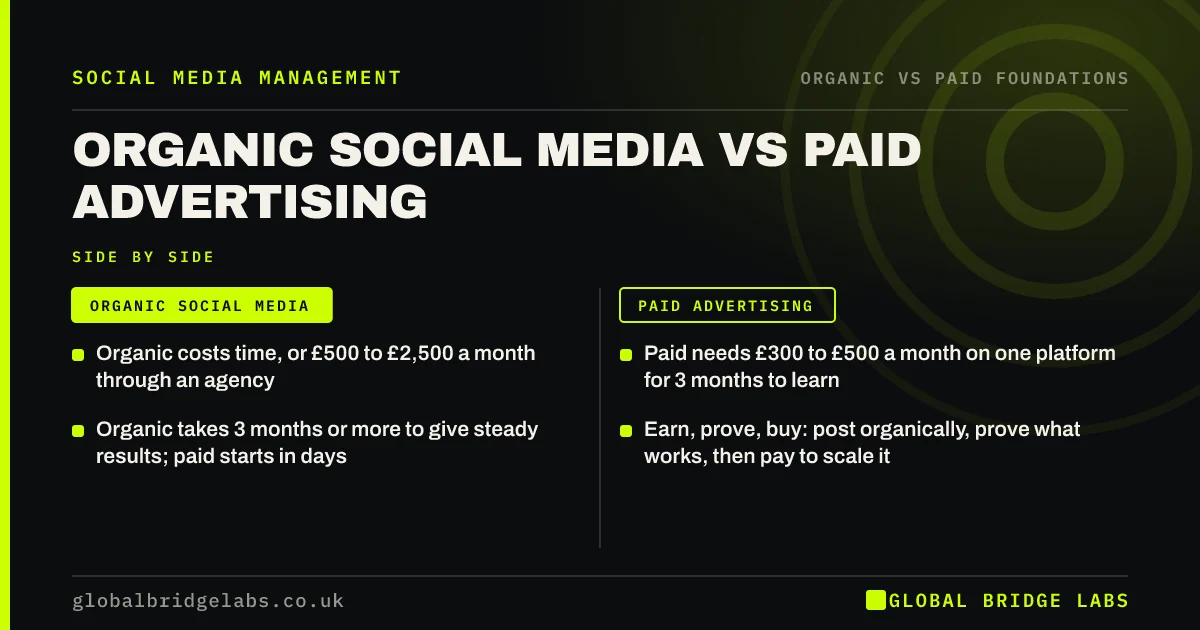
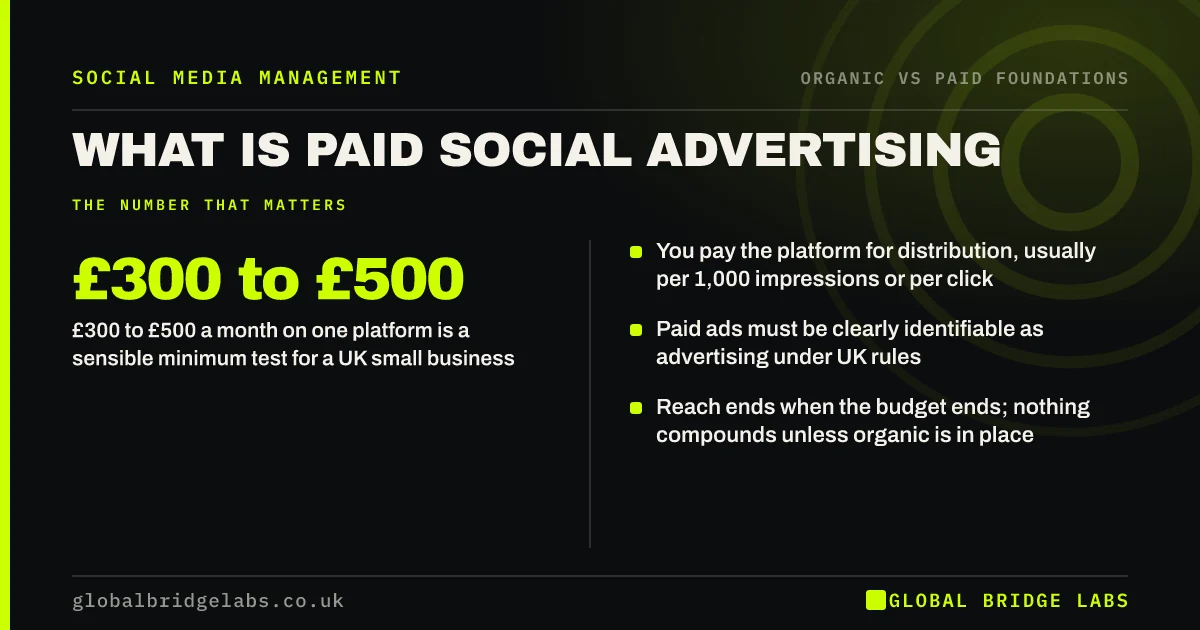
Reduce the risk by building an email or WhatsApp list from social followers, keeping a presence on a second platform, and running a small paid test behind your best post so you know paid works if you need it. A three-month test at £300 a month on one platform is enough to learn.
What should you watch for?
Watch for falling enquiries, not just falling reach. Reach changes constantly; a sustained drop in enquiries from social over two or three months is the signal that organic alone is no longer enough.
What does this look like in practice?
A pattern we see: a dog grooming salon relied entirely on Instagram posts and was fully booked for two years. When a competitor opened nearby and started running local ads, bookings dipped. A small, steady ad budget behind its best before-and-after posts restored bookings within a couple of months while organic posting continued.
Organic only risk checklist
- Check what share of new customers come from social.
- Check how many come from one platform.
- Build an email or WhatsApp list from followers.
- Keep a basic presence on a second platform.
- Run one small paid test so you know it works.
- Review enquiries monthly, not just reach.
Next step
Work out what share of new customers in the last six months came from organic social. If it is more than a third, run a small paid test this quarter so you have a backup if reach drops.
Message us on WhatsApp for an organic risk review, or book a 30-minute consultation.
Chat on WhatsApp →Sources and further reading
- LinkedIn relevance: optimising the member experience · LinkedIn Help
- How TikTok recommends videos #ForYou · TikTok Newsroom
- Meta Business Help Centre · Meta
Frequently asked questions
Can a business survive on organic social alone?
Yes, many do, particularly local, referral-led and repeat-custom businesses. The risk is not that organic fails, but that it is unpredictable. If your enquiries depend heavily on social, having a tested paid option and a list of customers you can contact directly protects you from sudden reach changes.
What happens if a platform changes its algorithm?
Your organic reach can rise or fall sharply, sometimes overnight, with no warning. Businesses that rely on one platform feel this most. Spreading presence across two platforms, building a direct contact list and having a small paid option ready all reduce the impact of algorithm changes.
Is organic social riskier than paid?
They carry different risks. Organic risks unpredictable reach and slow results but costs mainly time. Paid risks wasted money if content or targeting is wrong, and results stop when spend stops. Combining a steady organic presence with a small, tested paid budget reduces both sets of risk.
Written by

Global Bridge Labs (GBL) is a UK–Sri Lanka partner for social media, websites and BPO. Everything here comes from client delivery, not theory.