On this page
- 01Key takeaways
- 02What can you control with paid social?
- 03What can you control with organic social?
- 04What can you not control with either?
- 05When does control matter most?
- 06How do you get the best of both?
- 07What does this look like in practice?
- 08Control checklist
- 09Next step
- 10Sources and further reading
- 11Frequently asked questions
Key takeaways
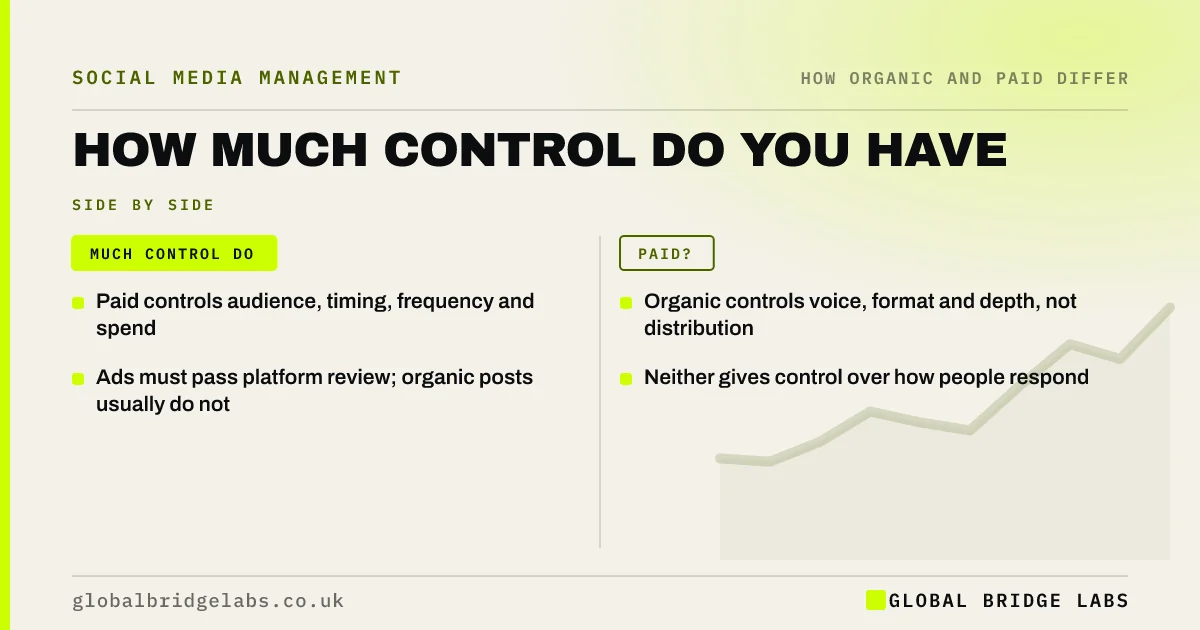
Paid social gives you control over who sees a message, when and how often, within a budget you set. Organic gives you control over what you say and how you say it, but not over who sees it. If certainty about audience and timing matters, pay; if voice, depth and relationship matter, organic gives more freedom.
- Paid controls audience, timing, frequency and spend.
- Organic controls voice, format and depth, not distribution.
- Ads must pass platform review; organic posts usually do not.
- Neither gives control over how people respond.
Want more predictable results from social? Message us on WhatsApp.
Chat on WhatsApp →What can you control with paid social?
With paid social you control the audience, the schedule, the budget, the objective and how often people see an ad. Meta's budget tools let you cap daily or total spend and set start and end dates. This makes paid suited to time-bound and audience-specific goals.
- Audience: who sees the ad.
- Timing: start, end and schedule.
- Budget: daily or lifetime cap.
- Objective: what the platform optimises for.
What can you control with organic social?
With organic social you control the message, tone, format and length, and you can post anything that fits platform rules without ad review. You cannot control who sees it or when. That freedom suits storytelling, opinions, behind-the-scenes content and long-form expertise.
What can you not control with either?
You cannot control how people react, whether they share, or what they say in comments. Paid also does not guarantee results: the auction decides price, and ads must pass review under Meta's Advertising Standards and other platform policies. Organic reach can change without notice.
When does control matter most?
Control matters most for launches, events, limited-time offers, recruitment with closing dates and anything regulated where wording must be approved. In those cases paid's predictability is worth the cost. For ongoing relationship building, organic's creative freedom matters more.
How do you get the best of both?
Use organic for the story and paid for the schedule. Publish rich organic content freely, then pick the pieces that need guaranteed reach and run them as ads with clear audiences and dates.
What does this look like in practice?
A pattern we see: an accountancy practice needed every client to know about a tax deadline change by a set date. Organic posts reached some clients; an ad targeted at an uploaded client list, with a lawful basis confirmed, made sure the rest saw it before the deadline.
Control checklist
- Note which goals have fixed dates.
- Note which goals need a defined audience.
- Use paid for those, organic for the rest.
- Set budget caps and end dates on every campaign.
- Check ad wording against platform policies before launch.
- Keep organic for story, opinion and depth.
Next step
List your marketing goals for the next quarter and mark which need a guaranteed audience by a date. Plan paid support for those and keep everything else organic.
Message us on WhatsApp for a control and timing plan, or book a 30-minute consultation.
Chat on WhatsApp →Sources and further reading
- Meta Business Help Centre · Meta
- About budgets · Meta
- Meta Advertising Standards · Meta Transparency Center
Frequently asked questions
Is paid social more predictable than organic?
Yes, in terms of reach and timing: a set budget buys a fairly predictable number of impressions in a set period. Results such as enquiries are less predictable, because they depend on the ad, the offer and the audience. Organic is less predictable in both reach and results.
Can my ads be rejected?
Yes. Every ad is reviewed against the platform's advertising policies, and ads can be rejected for wording, imagery, restricted products or landing pages. Rejected ads can usually be edited and resubmitted. Organic posts face community standards but not the same ad review process.
Can I control who sees my organic posts?
Not directly. You can influence it through content, captions, location tags and the groups you post in, and some platforms let you restrict posts by location or language. The platform's ranking system ultimately decides who sees each post in their feed.
Written by

Global Bridge Labs (GBL) is a UK–Sri Lanka partner for social media, websites and BPO. Everything here comes from client delivery, not theory.