On this page
- 01Key takeaways
- 02When should you stop a social ad campaign?
- 03What signals that a campaign is failing?
- 04What should you try before stopping?
- 05How do you stop without losing momentum?
- 06When should you not stop?
- 07What does this look like in practice?
- 08Stop or continue checklist
- 09Next step
- 10Sources and further reading
- 11Frequently asked questions
Key takeaways
Stop a social ad campaign when cost per result stays above what a customer is worth after the learning phase and at least one round of changes, when frequency is high and results are falling, or when its job is done. Do not stop in the first weeks of learning. When you stop, move its best creative into organic and keep retargeting if it pays.
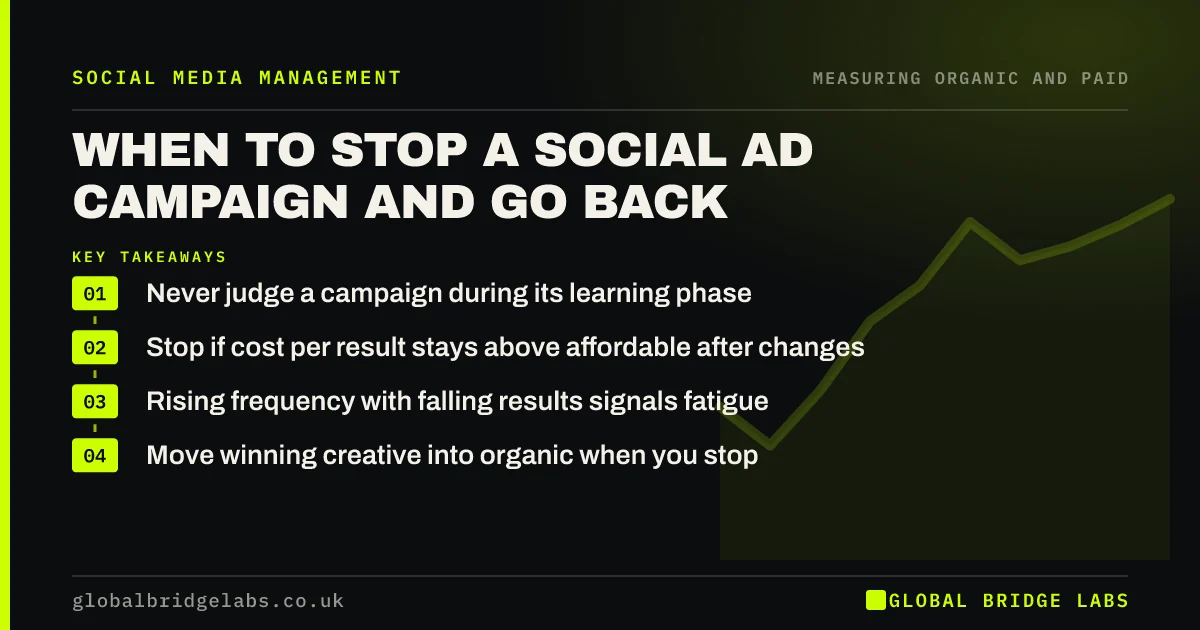
- Never judge a campaign during its learning phase.
- Stop if cost per result stays above affordable after changes.
- Rising frequency with falling results signals fatigue.
- Move winning creative into organic when you stop.
Unsure whether to stop a campaign? Send us the numbers on WhatsApp.
Chat on WhatsApp →When should you stop a social ad campaign?
Stop a campaign when it has had a fair chance and still costs more per result than you can afford, when its goal is met, such as an event passing, or when fatigue has set in and fresh creative does not help. Meta's guidance on the learning phase explains why early results are unstable.
What signals that a campaign is failing?
Watch for these signals after the learning phase.
- Cost per result above your affordable figure for several weeks.
- Click-through falling while frequency rises.
- Leads that rarely become customers.
- No improvement after creative and audience changes.
What should you try before stopping?
Before stopping, try fresh creative from your best organic posts, a clearer offer, a broader audience and a better landing page or form. Change one thing at a time and give it two to three weeks.
How do you stop without losing momentum?
Wind down rather than switch off: reduce budget, keep retargeting if it pays, and step up organic posting using the campaign's best creative. Meta's budget tools let you lower spend gradually. Keep the campaign saved so you can restart.
When should you not stop?
Do not stop during the first weeks of learning, during a short-term dip caused by seasonality, or because likes are low on a campaign optimised for leads. Judge on cost per result against GA4 key events or platform conversions.
What does this look like in practice?
A pattern we see: a cleaning company stopped a lead campaign after ten days because the first leads were expensive. Restarting with the same budget and leaving it alone for six weeks brought cost per lead down to an affordable level. A later campaign that stayed expensive after two creative changes was stopped and its best video moved into organic.
Stop or continue checklist
- Wait until learning is complete.
- Compare cost per result with affordable figure.
- Check frequency and click-through trends.
- Try one change at a time before stopping.
- Wind down rather than switch off.
- Move winning creative into organic.
Next step
For each live campaign, write down its cost per result and your affordable figure. Any campaign above it after learning gets one change and a two-week deadline.
Message us on WhatsApp for a campaign review, or book a 30-minute consultation.
Chat on WhatsApp →Sources and further reading
- About the learning phase · Meta
- About budgets · Meta
- About key events · Google Analytics Help
Frequently asked questions
How long should I run a Facebook ad before judging it?
Give it at least until it exits the learning phase and ideally two to four weeks, depending on budget. Small budgets take longer to gather enough results. Judging too early often means stopping a campaign just before it would have stabilised.
What is ad fatigue?
Ad fatigue happens when the same people see the same ad too often, so response falls and costs rise. Signs include rising frequency with falling click-through. Fresh creative, often taken from recent organic posts that performed well, is the usual fix.
Should I delete a campaign that is not working?
Pause rather than delete. Paused campaigns keep their history and settings, which helps if you restart or want to compare later. Deleting removes useful data you may want later. Move the best-performing creative into organic posts so the work and learning are not wasted.
Written by

Global Bridge Labs (GBL) is a UK–Sri Lanka partner for social media, websites and BPO. Everything here comes from client delivery, not theory.