On this page
- 01Key takeaways
- 02What are the main organic social terms?
- 03What are the main paid social terms?
- 04What are the main targeting terms?
- 05What are the main results terms?
- 06What is the learning phase?
- 07What does this look like in practice?
- 08Glossary checklist
- 09Next step
- 10Sources and further reading
- 11Frequently asked questions
Key takeaways
This glossary explains the organic and paid social terms small businesses meet most often, in plain English. Organic terms cover reach, engagement and algorithms; paid terms cover impressions, CPM, boosting, objectives, learning phase, retargeting and ROAS. Knowing them makes reports, agency proposals and platform settings easier to read.
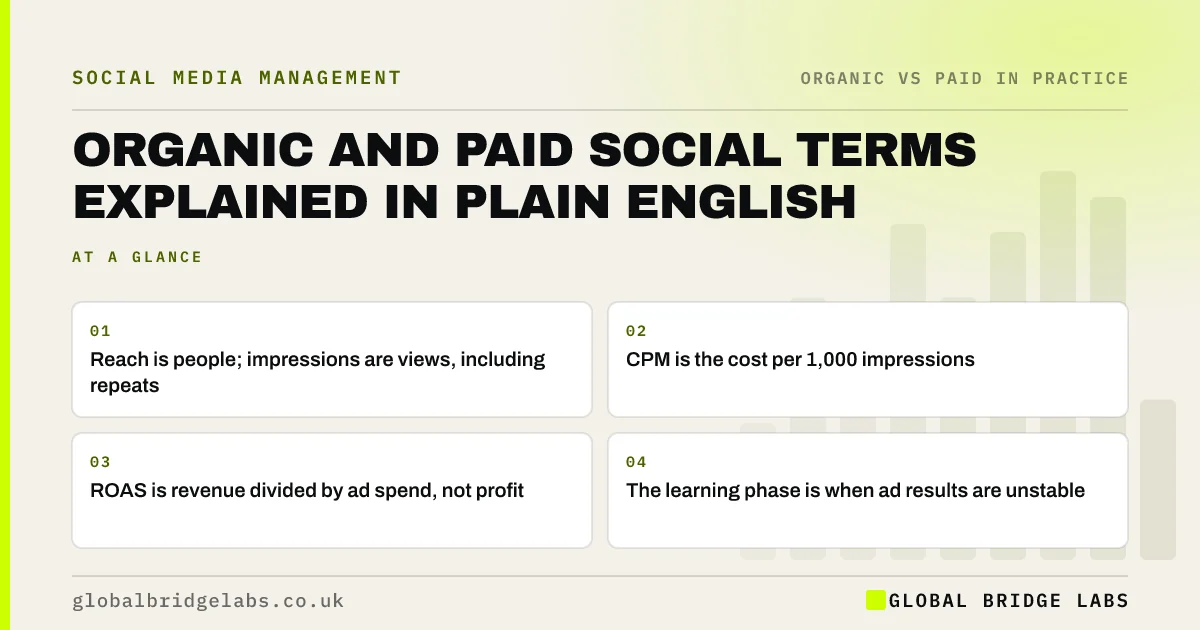
- Reach is people; impressions are views, including repeats.
- CPM is the cost per 1,000 impressions.
- ROAS is revenue divided by ad spend, not profit.
- The learning phase is when ad results are unstable.
Got a term you are not sure about? Ask us on WhatsApp.
Chat on WhatsApp →What are the main organic social terms?
These terms appear in organic insights.
- Organic reach: people who saw a post without paid promotion.
- Engagement: likes, comments, shares, saves and clicks.
- Engagement rate: engagement divided by reach or followers.
- Algorithm: the system ranking which posts people see.
- Saves: people bookmarking a post for later.
What are the main paid social terms?
These terms appear in ad managers and agency reports.
- Impressions: total times an ad was shown, including repeats.
- CPM: cost per 1,000 impressions.
- CPC: cost per click.
- Objective: what the platform optimises for.
- Boosting: paying to promote an existing post.
What are the main targeting terms?
These terms describe who sees ads.
- Custom audience: people you choose, such as engagers or a customer list.
- Retargeting: ads to people who already interacted with you.
- Lookalike audience: new people similar to an existing audience.
- Frequency: average times each person saw an ad.
What are the main results terms?
These terms describe whether ads worked. GA4 key events are the actions you mark as important, such as enquiries.
- Conversion: a valuable action, such as an enquiry.
- Cost per result: spend divided by results.
- ROAS: revenue divided by ad spend.
- Attribution: how credit for a sale is shared.
What is the learning phase?
The learning phase is the period after a campaign starts or changes significantly, when the platform is working out who to show ads to. Meta explains that results are less stable during it, so avoid judging or editing campaigns too early.
What does this look like in practice?
A pattern we see: a business owner compared an agency's 'impressions' with their own page 'reach' and thought the agency was exaggerating. Once the difference was clear, impressions counting repeat views and reach counting people, the reports made sense and the conversation moved on to cost per enquiry.
Glossary checklist
- Know reach vs impressions.
- Know CPM and CPC.
- Know your campaign objective.
- Know what a custom audience is.
- Know ROAS is not profit.
- Know why the learning phase matters.
Next step
Open your last social media report and highlight any term you are unsure of. Look it up here, then ask your agency or team to explain anything still unclear.
Message us on WhatsApp for the printable glossary, or book a 30-minute consultation.
Chat on WhatsApp →Sources and further reading
- Meta Business Help Centre · Meta
- About the learning phase · Meta
- About key events · Google Analytics Help
Frequently asked questions
What is the difference between reach and impressions?
Reach is the number of different people who saw your content. Impressions are the total number of times it was shown, including repeat views by the same person. Impressions are always equal to or higher than reach. Frequency is impressions divided by reach.
What does CPM mean in social media advertising?
CPM means cost per mille, or cost per 1,000 impressions. It shows how much you pay for your ad to be shown 1,000 times. CPM varies by platform, audience, season and ad quality, and usually rises in competitive periods such as the run-up to Christmas.
What is the difference between ROAS and ROI?
ROAS, return on ad spend, is revenue from ads divided by ad spend. ROI, return on investment, uses profit and includes all costs, such as management fees and content. A campaign can show a good ROAS but a poor ROI once margins and fees are included.
Written by

Global Bridge Labs (GBL) is a UK–Sri Lanka partner for social media, websites and BPO. Everything here comes from client delivery, not theory.