On this page
- 01Key takeaways
- 02Should an online shop use organic or paid social?
- 03What organic content works for e-commerce?
- 04How should e-commerce use paid social?
- 05How does organic lower paid costs?
- 06What rules apply to online selling ads?
- 07What does this look like in practice?
- 08E-commerce checklist
- 09Next step
- 10Sources and further reading
- 11Frequently asked questions
Key takeaways
Most e-commerce businesses need paid social to scale sales, because ads can reach shoppers who have never heard of the brand and track purchases directly. Organic social makes those ads cheaper: it supplies tested creative, builds a credible profile and brings repeat customers back. Online shops that run ads with no organic presence usually pay more per sale.
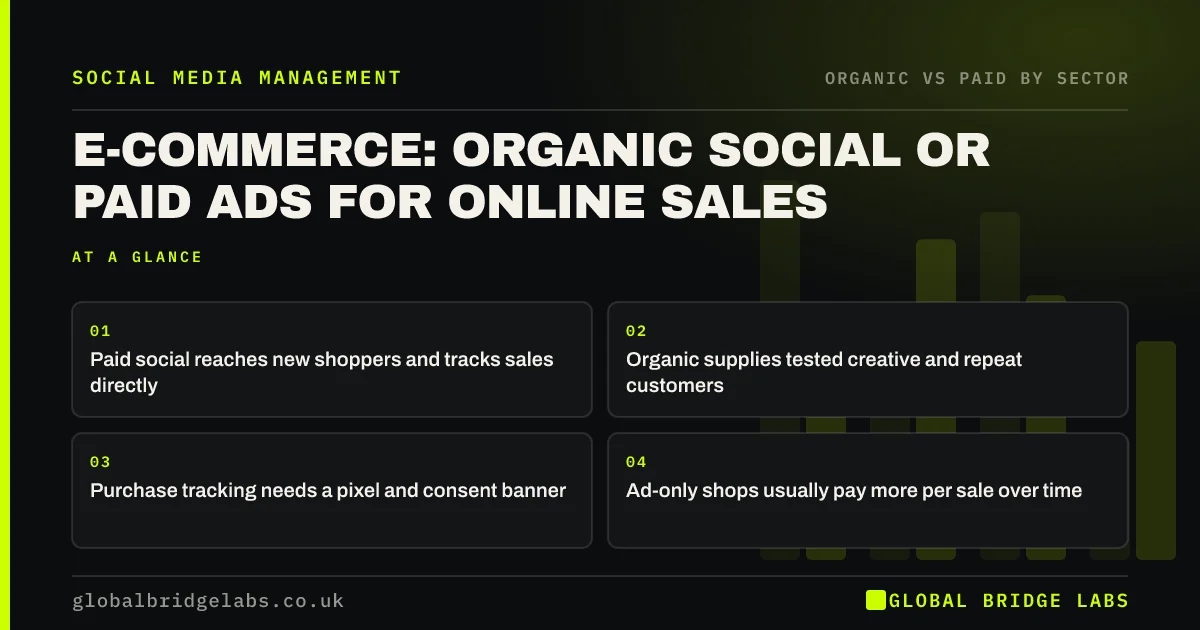
- Paid social reaches new shoppers and tracks sales directly.
- Organic supplies tested creative and repeat customers.
- Purchase tracking needs a pixel and consent banner.
- Ad-only shops usually pay more per sale over time.
Running an online shop? Tell us your products on WhatsApp.
Chat on WhatsApp →Should an online shop use organic or paid social?
Most online shops need both. Paid social is usually the main driver of new sales, because it reaches people who would never find the shop otherwise. Organic keeps the brand credible, tests content and brings past customers back. ONS data shows online sales are a large share of UK retail, so competition for attention is high.
What organic content works for e-commerce?
What works is content that shows products in use and real customers.
- Short videos of products in use.
- Customer photos and reviews, with permission.
- Behind the scenes of making or packing.
- How-to and styling content.
How should e-commerce use paid social?
Use paid for prospecting to new audiences, retargeting visitors who did not buy and dynamic product ads for catalogue retargeting. Purchase tracking through the Meta pixel and Conversions API is essential, with a consent banner that meets UK rules.
Want an e-commerce plan with organic and paid working together? Message us on WhatsApp and we will discuss your requirements.
Chat on WhatsApp →How does organic lower paid costs?
Organic lowers paid costs by finding creative that already resonates, building familiarity so ads convert better and growing a customer base you can reach again without paying. Repeat customers cost far less to win than new ones.
What rules apply to online selling ads?
Prices and offers in ads must be accurate, and online sales carry cancellation rights under the Consumer Contracts Regulations. Discounts and urgency claims must be genuine under the CAP Code.
What does this look like in practice?
A pattern we see: an online jewellery shop spent heavily on ads using studio photos. Adding organic Reels of pieces being made and worn, then running the best as ads, lowered its cost per purchase noticeably and increased repeat orders from followers.
E-commerce checklist
- Set up pixel, Conversions API and consent.
- Post product-in-use videos organically.
- Use top organic videos as ads.
- Retarget visitors who did not buy.
- Bring past customers back through organic and email.
- Track cost per purchase and repeat rate.
Next step
Check that purchase tracking works end to end, then run your two best organic product videos as ads against your current ads for two weeks.
Message us on WhatsApp for an e-commerce social plan, or book a 30-minute consultation.
Chat on WhatsApp →Sources and further reading
- Internet sales as a percentage of total retail sales · Office for National Statistics
- Learn about Meta pixel · Meta
- Consumer Contracts (Information, Cancellation and Additional Charges) Regulations 2013 · legislation.gov.uk
Frequently asked questions
Can an online shop grow without paid ads?
Some do, through strong organic content, creator partnerships, search and marketplaces, but it is usually slower. Most online shops find paid social is the most reliable way to reach new customers at scale, with organic making those ads cheaper and bringing customers back.
What is a good return on ad spend for e-commerce?
It depends on your margins. A shop with high margins can be profitable at a lower ROAS than one with thin margins. Work out your break-even ROAS from gross margin first, then judge campaigns against it, including management and creative costs.
Should e-commerce brands use TikTok or Instagram?
Both can work. Instagram suits visual products and has mature shopping and ad tools through Meta. TikTok can bring strong organic reach and has its own shop features. Choose based on where your buyers spend time and test one properly before adding the other.
Written by

Global Bridge Labs (GBL) is a UK–Sri Lanka partner for social media, websites and BPO. Everything here comes from client delivery, not theory.