On this page
Key takeaways
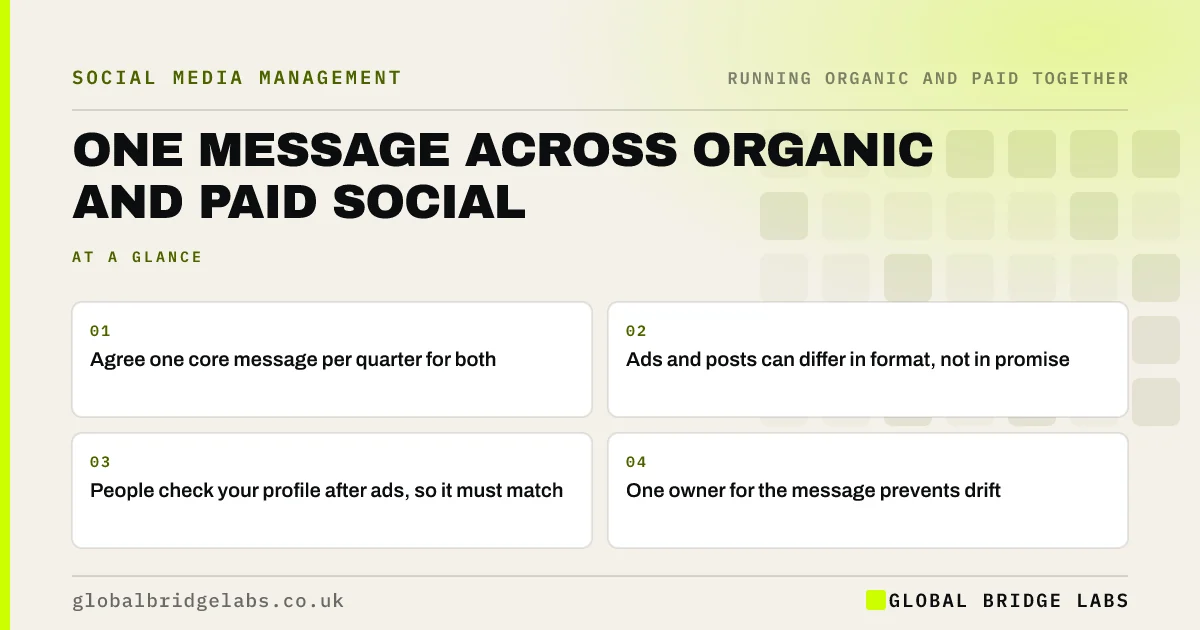
Organic and paid social should share one core message each quarter: the same promise, proof and tone. When ads say one thing and posts another, people who click through to your profile get confused and leave. A shared message makes each impression reinforce the last and makes your ads more credible.
- Agree one core message per quarter for both.
- Ads and posts can differ in format, not in promise.
- People check your profile after ads, so it must match.
- One owner for the message prevents drift.
Want your posts and ads saying the same thing? Message us on WhatsApp.
Chat on WhatsApp →Why does one message matter?
One message matters because people see you several times before acting. If each impression says something different, nothing sticks. The IPA's research shows consistent brand building improves later response. Nielsen Norman Group's work on consistency shows people trust what behaves predictably.
What should stay the same?
Keep the core promise, main proof points, tone and visual identity the same across posts and ads.
- Core promise: what you help people do.
- Proof: results, reviews, examples.
- Tone: how you sound.
- Look: colours, fonts, faces.
What can differ between organic and paid?
Format, depth and call to action can differ. Organic can go deeper, share behind the scenes and start conversations. Ads should be shorter, sharper and end with one clear action. The underlying message stays the same.
How do you keep them aligned?
Write a one-page message brief each quarter covering promise, proof, audience and tone. Share it with everyone making posts or ads. Review both together monthly.
What about claims?
Claims must match across both and be provable. The ASA's guidance on brand-owned and paid social treats both your ads and your own marketing posts as marketing communications under the CAP Code.
What does this look like in practice?
A pattern we see: an accountancy firm's ads promised low fixed fees while its organic posts talked about premium advisory services. Prospects who clicked through were confused. Agreeing one message, clear fixed fees with expert advice included, aligned both and improved enquiries from ads.
One message checklist
- Write a one-page message brief each quarter.
- Share it with everyone making content.
- Keep promise, proof, tone and look consistent.
- Let format and depth differ.
- Check claims match and are provable.
- Review posts and ads together monthly.
Next step
Lay your last month's ads next to your organic posts. Write down the promise each makes. If they differ, agree one message for next quarter.
Message us on WhatsApp for a quarterly message brief template, or book a 30-minute consultation.
Chat on WhatsApp →Sources and further reading
Frequently asked questions
Should ads and organic posts look the same?
They should look like the same business, with consistent tone, colours and faces, but they need not be identical. Ads are usually shorter with a clear call to action; organic posts can be longer and more conversational. Consistency of message matters more than identical design.
How do I keep messaging consistent with an agency?
Share a written message brief each quarter covering promise, proof, audience and tone, and review ads and posts together monthly. If different providers handle organic and paid, make sure both work from the same brief and see each other's work.
Do organic posts need to follow advertising rules?
Your own posts promoting your business are marketing communications, so the CAP Code applies to claims in them, even though they do not need an ad label. Paid ads and paid partnerships must also be clearly identifiable as advertising, which platform labels and an upfront 'Ad' tag handle.
Written by

Global Bridge Labs (GBL) is a UK–Sri Lanka partner for social media, websites and BPO. Everything here comes from client delivery, not theory.