On this page
- 01Key takeaways
- 02When does an organic post become an ad?
- 03Do your own organic posts follow advertising rules?
- 04What about creators and influencers?
- 05What about boosted posts and dark posts?
- 06What about staff posts?
- 07What does this look like in practice?
- 08Ad labelling checklist
- 09Next step
- 10Sources and further reading
- 11Frequently asked questions
Key takeaways
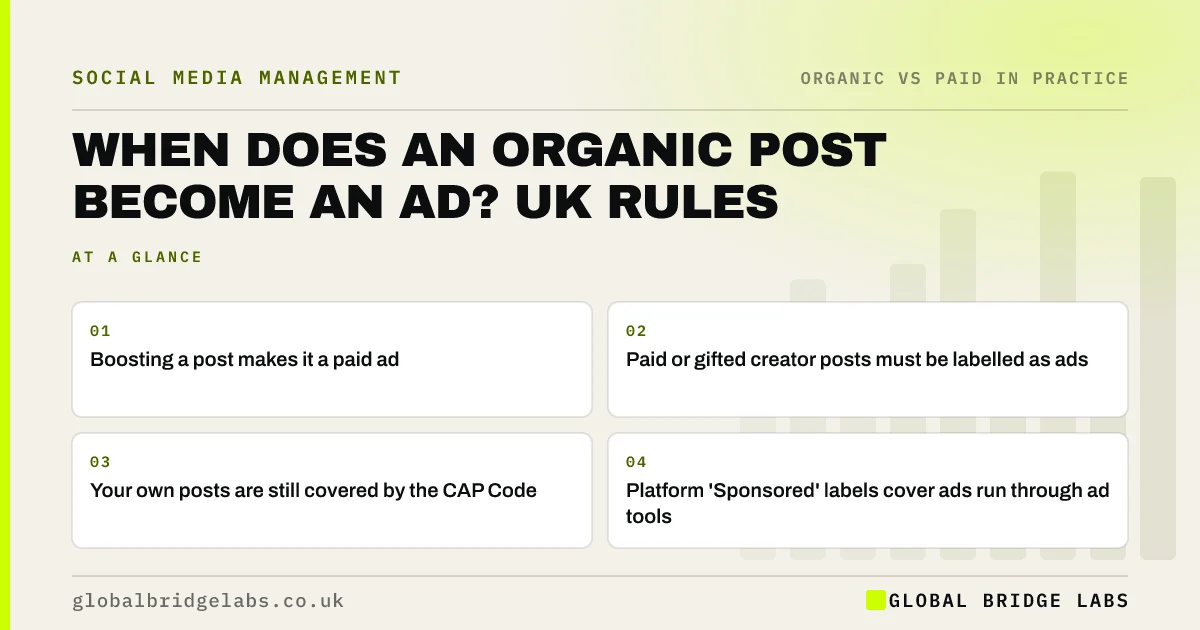
An organic post becomes an ad when money or other value is involved in its distribution or creation: boosting it, paying or gifting a creator to post it, or running it through ad tools. The ASA treats your own brand posts as marketing communications under the CAP Code too, so claims must be accurate even when nothing is paid.
- Boosting a post makes it a paid ad.
- Paid or gifted creator posts must be labelled as ads.
- Your own posts are still covered by the CAP Code.
- Platform 'Sponsored' labels cover ads run through ad tools.
Unsure whether a post needs an ad label? Ask us on WhatsApp.
Chat on WhatsApp →When does an organic post become an ad?
A post becomes an ad when you pay to distribute it, such as boosting, or when you pay or give something of value to someone else to post it. The ASA's guidance on brand-owned and paid social media explains how these situations are treated.
Do your own organic posts follow advertising rules?
Yes. Posts on your own business accounts that promote what you sell are marketing communications, so the CAP Code's rules on misleading claims, prices and evidence apply. They do not need an 'ad' label, because it is clear they come from the business.
- Claims must be accurate and provable.
- Prices must be clear.
- Testimonials must be genuine.
- Sector rules, such as health or finance, still apply.
What about creators and influencers?
If you pay a creator, give free products or have any control over their post, it is an ad and must be obviously identifiable, usually with 'Ad' at the start. The ASA's influencer guide sets out what counts.
- Partnership ads vs organic creator posts: which to pay for?
- Influencer marketing for UK small businesses
Want a quick compliance check on your posts and ads? Message us on WhatsApp.
Chat on WhatsApp →What about boosted posts and dark posts?
Boosted posts and dark posts run through ad tools are labelled as sponsored by the platform, which usually meets the requirement to be identifiable. The content must still meet the CAP Code and the platform's ad policies.
What about staff posts?
Staff posting about your business on their own accounts can blur the line. If you pay or direct them to post, or reward posting, consider labelling and give clear guidance. Genuine, unprompted staff posts usually do not need an ad label.
What does this look like in practice?
A pattern we see: a beauty brand gifted products to local creators and reposted their content without labels. A complaint led to a review of the brand's process. It now asks creators to label gifted posts 'Ad', keeps a record of each arrangement and checks claims before reposting.
Ad labelling checklist
- Treat boosted posts as ads.
- Label paid or gifted creator posts 'Ad'.
- Keep claims in your own posts accurate.
- Check sector rules for health or finance.
- Brief staff on posting about the business.
- Keep records of creator arrangements.
Next step
Review your last month of posts: mark any that were boosted, gifted or paid. Check each is clearly identifiable as an ad and that every claim is backed up.
Message us on WhatsApp for a social compliance checklist, or book a 30-minute consultation.
Chat on WhatsApp →Sources and further reading
Frequently asked questions
Is a boosted post an advert?
Yes. Boosting means paying the platform to distribute the post, so it becomes a paid ad. The platform labels it as sponsored, and it must meet the CAP Code and the platform's advertising policies, including accurate claims and clear pricing.
Do I need to put 'ad' on my own business posts?
No. Posts on your own business account are clearly from your business, so an 'ad' label is not needed. But they are still marketing communications, so the CAP Code applies to them: claims must be accurate and provable, prices must be clear and any testimonials must be genuine.
Do gifted products count as payment for influencers?
Yes. If you give a creator free products and have any control over the post, or it is part of an arrangement, the ASA treats the post as an ad. It must be clearly labelled, usually with 'Ad' at the start. Agree this with creators in writing.
Written by

Global Bridge Labs (GBL) is a UK–Sri Lanka partner for social media, websites and BPO. Everything here comes from client delivery, not theory.