On this page
- 01Key takeaways
- 02Should you recruit with organic or paid social?
- 03What should organic recruitment posts show?
- 04What limits apply to paid job ads?
- 05Which platforms work for recruitment?
- 06How do you combine them for hiring?
- 07What does this look like in practice?
- 08Recruitment checklist
- 09Next step
- 10Sources and further reading
- 11Frequently asked questions
Key takeaways
For recruitment, organic social shows what it is like to work for you and reaches people who already know your business. Paid job ads reach active and passive candidates beyond your followers, but employment ads have restricted targeting on Meta. Use organic for employer reputation and paid when you need applicants quickly.
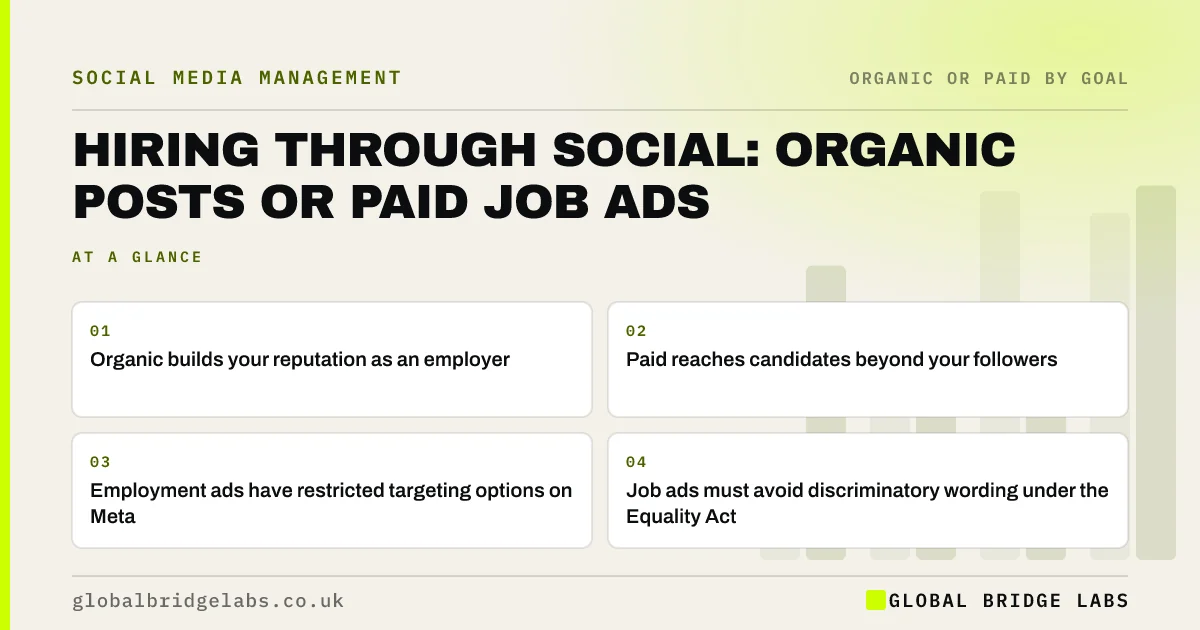
- Organic builds your reputation as an employer.
- Paid reaches candidates beyond your followers.
- Employment ads have restricted targeting options on Meta.
- Job ads must avoid discriminatory wording under the Equality Act.
Hiring soon? Tell us the role on WhatsApp.
Chat on WhatsApp →Should you recruit with organic or paid social?
Use organic social to show your workplace, team and culture so candidates trust you, and paid social when you need to reach more applicants than your followers can supply. Small firms often fill roles through staff sharing organic posts; urgent or hard-to-fill roles usually need paid.
What should organic recruitment posts show?
Organic recruitment posts should show real people, a typical day, what the role involves, pay and benefits where possible, and how to apply. Ask staff to share them: personal networks often reach better candidates than company pages.
- The team and workplace.
- A day in the role.
- Pay range and benefits.
- A simple way to apply.
What limits apply to paid job ads?
Job ads on Meta fall under its Special Ad Category for employment, which restricts targeting by age, gender and detailed demographics, and limits postcode targeting. This protects against discrimination. Your wording must also comply with the Equality Act 2010.
Want help with a recruitment campaign? Message us on WhatsApp and we will discuss your requirements.
Chat on WhatsApp →Which platforms work for recruitment?
LinkedIn suits professional and office roles; Facebook and Instagram suit local, hourly and trade roles; TikTok can reach younger candidates. Match the platform to where your candidates spend time, not where your customers are.
How do you combine them for hiring?
Post the role organically first and ask staff to share. If applications are thin after a week, run a paid ad using the best-performing organic post, within the employment category rules. Keep employer content running between roles so the next hire is easier.
What does this look like in practice?
A pattern we see: a care provider struggled to fill carer roles from job boards. Organic videos of staff talking about their work, shared by the team, brought some applicants; a local paid campaign using the same videos, set up under the employment category, brought enough to fill three roles in a month.
Recruitment checklist
- Post roles organically and ask staff to share.
- Show real people and pay where possible.
- Check wording against the Equality Act.
- Use the employment ad category for paid job ads.
- Pick the platform your candidates use.
- Keep employer content running between roles.
Next step
Post your next role organically with a short staff video and ask the team to share it. If applications are low after seven days, run it as a paid employment ad for two weeks.
Message us on WhatsApp for a social recruitment plan, or book a 30-minute consultation.
Chat on WhatsApp →Sources and further reading
- How to choose a Special Ad Category · Meta
- Equality Act 2010 · legislation.gov.uk
- LinkedIn Pages best practices · LinkedIn
Frequently asked questions
Can I target job ads by age on Facebook?
No. Meta's Special Ad Category for employment restricts targeting by age, gender and some detailed demographics, and limits location targeting to a wider radius. These rules help prevent discriminatory advertising. You can still target by broad location and use creative that appeals to your ideal candidates.
Is LinkedIn or Facebook better for recruiting?
LinkedIn usually works better for professional, office and senior roles. Facebook and Instagram often work better for local, hourly, care, hospitality and trade roles. Many small businesses get good results from staff sharing organic posts on their own profiles, whichever platform they use.
Do I need to include salary in social job ads?
It is not a legal requirement in the UK, but job posts with a salary range usually attract more applications and save time on mismatched candidates. Whatever you include, make sure the wording is accurate and does not discriminate under the Equality Act 2010.
Written by

Global Bridge Labs (GBL) is a UK–Sri Lanka partner for social media, websites and BPO. Everything here comes from client delivery, not theory.