On this page
- 01Key takeaways
- 02What is payback in social media?
- 03How quickly does paid social pay back?
- 04How quickly does organic social pay back?
- 05How do you work out your payback period?
- 06What payback period is acceptable?
- 07What does this look like in practice?
- 08Payback checklist
- 09Next step
- 10Sources and further reading
- 11Frequently asked questions
Key takeaways
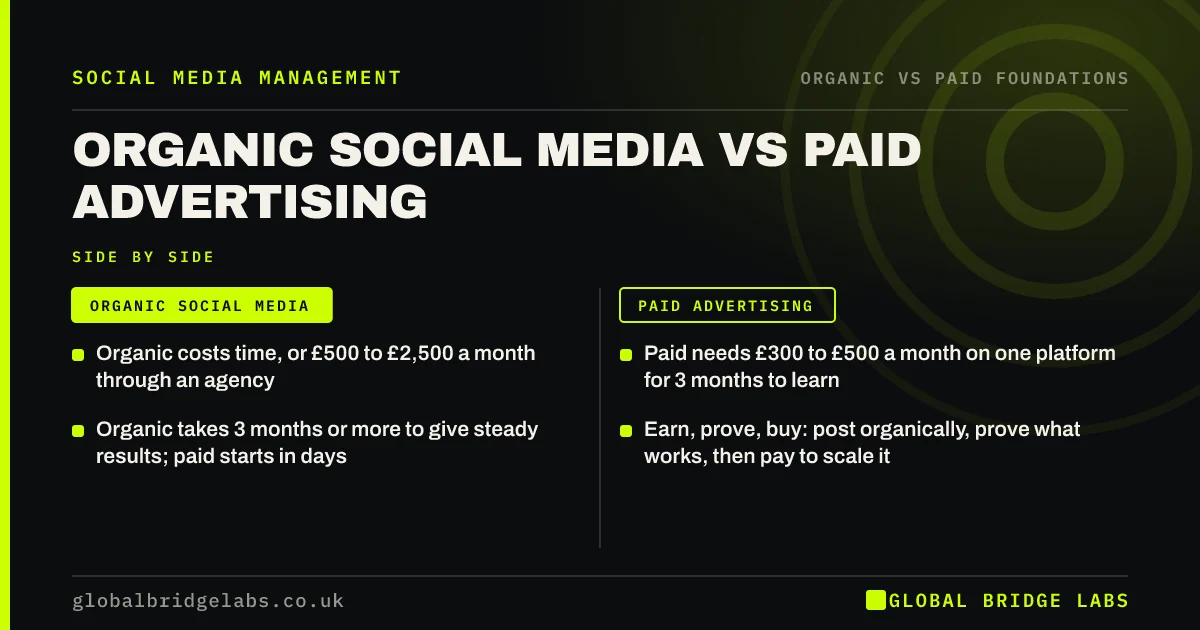
Paid social can pay back its cost within weeks if the offer, audience and creative are right, because results start immediately. Organic social usually takes three to six months to pay back, because audience and trust build slowly, but it keeps returning afterwards. Payback is the month cumulative profit from a channel exceeds its cumulative cost.
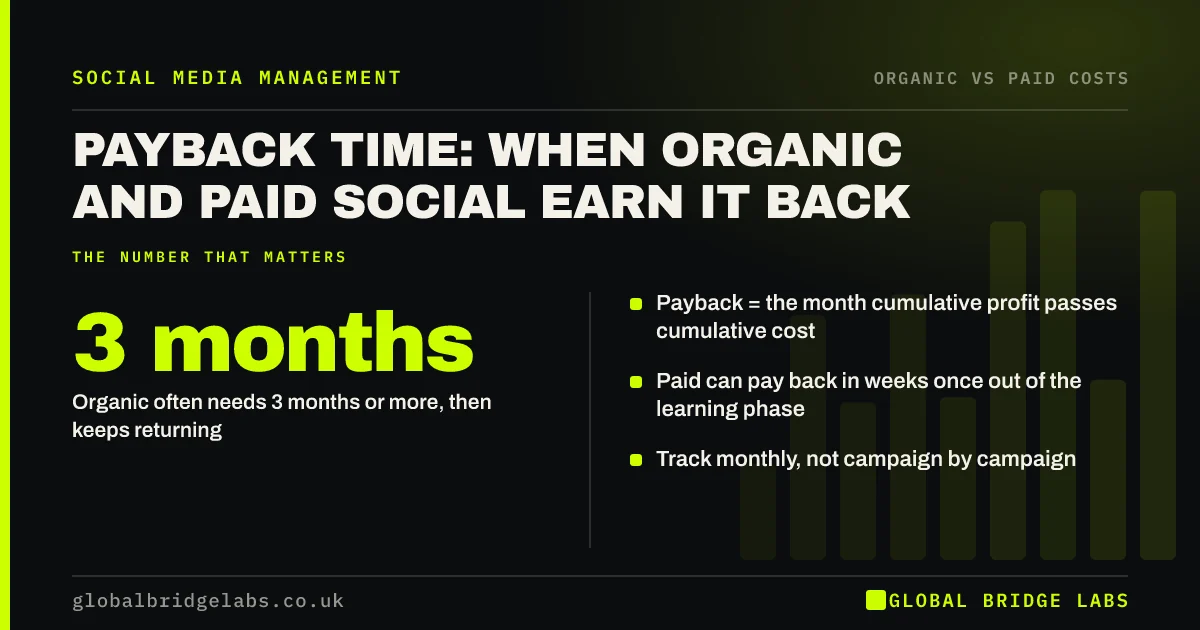
- Payback = the month cumulative profit passes cumulative cost.
- Paid can pay back in weeks once out of the learning phase.
- Organic often needs 3 months or more, then keeps returning.
- Track monthly, not campaign by campaign.
Want your payback period estimated? Message us on WhatsApp.
Chat on WhatsApp →What is payback in social media?
Payback is the point at which the profit from customers won through a channel equals everything you have spent on it. Before that, the channel is an investment; after it, a source of profit. It is a useful way to compare organic and paid, which earn back on different timescales.
How quickly does paid social pay back?
Paid social can pay back within one or two months when it is built on proven content and a clear offer. Meta's learning phase means the first weeks are less efficient. If a paid campaign has not paid back within three months, the offer, audience or creative usually needs changing.
How quickly does organic social pay back?
Organic social typically pays back over three to six months, because early posting builds audience and trust before enquiries become steady. Once established, its monthly cost stays fairly flat while results grow, so cumulative profit keeps rising.
Want a payback tracker set up for both channels? Message us on WhatsApp.
Chat on WhatsApp →How do you work out your payback period?
Track monthly cost and monthly profit from each channel, then add them up month by month.
- List monthly cost: time, fees, tools, ad spend.
- Record customers and gross profit by source.
- Add both cumulatively each month.
- Payback is the month profit passes cost.
What payback period is acceptable?
An acceptable payback period depends on cash flow. A business with tight cash may need paid campaigns that pay back within a month. A business planning for growth can accept organic's longer payback because returns continue. The IPA's research supports investing in both horizons.
What does this look like in practice?
A pattern we see: a home tutoring company tracked cumulative cost and profit monthly. Paid campaigns for exam season paid back within six weeks. Organic posting took five months to pass its cumulative cost, then produced more profit per month than paid at a fraction of the running cost.
Payback checklist
- Record monthly cost for each channel.
- Tag every customer's source.
- Use gross profit, not revenue.
- Add cost and profit cumulatively.
- Expect paid payback in weeks, organic in months.
- Change paid campaigns that miss three months.
Next step
Set up a simple monthly table for organic and paid with cumulative cost and cumulative profit. Fill in the last three months to see where each channel stands today.
Message us on WhatsApp for the payback tracker, or book a 30-minute consultation.
Chat on WhatsApp →Sources and further reading
- About the learning phase · Meta
- The Long and the Short of It: balancing short and long-term marketing strategies · IPA
- About key events · Google Analytics Help
Frequently asked questions
How long does it take for social media marketing to pay off?
Paid social can pay off within weeks if the content and offer are right. Organic social usually takes three to six months of consistent posting. The exact time depends on your prices, margins and sales cycle. Tracking cumulative cost and profit by month shows when each pays back.
Why does organic take longer to pay back?
Organic takes longer because audiences grow and trust builds gradually. Early months involve testing and learning with few enquiries. Once established, organic costs stay flat while enquiries rise, so its payback is slower but its later returns are often higher per pound than paid.
What if my ads never pay back?
If ads have not paid back after three months, review the offer, audience, creative and landing page. Try ads built from posts that brought enquiries organically. If nothing changes, pause paid and put the budget into organic until you have something proven to amplify.
Written by

Global Bridge Labs (GBL) is a UK–Sri Lanka partner for social media, websites and BPO. Everything here comes from client delivery, not theory.