On this page
- 01Key takeaways
- 02What jobs does running organic and paid involve?
- 03Who should own each job in a small team?
- 04Which jobs fall through the gaps?
- 05How do agencies fit in?
- 06Who should own the overall result?
- 07What does this look like in practice?
- 08Roles checklist
- 09Next step
- 10Sources and further reading
- 11Frequently asked questions
Key takeaways
Running organic and paid together involves five jobs: setting the message, making content, posting and replying, running ads, and reviewing results. In a small team one or two people may cover all five, but each needs a named owner. Most problems come from gaps between jobs, such as ad comments nobody answers or ads that ignore organic results.
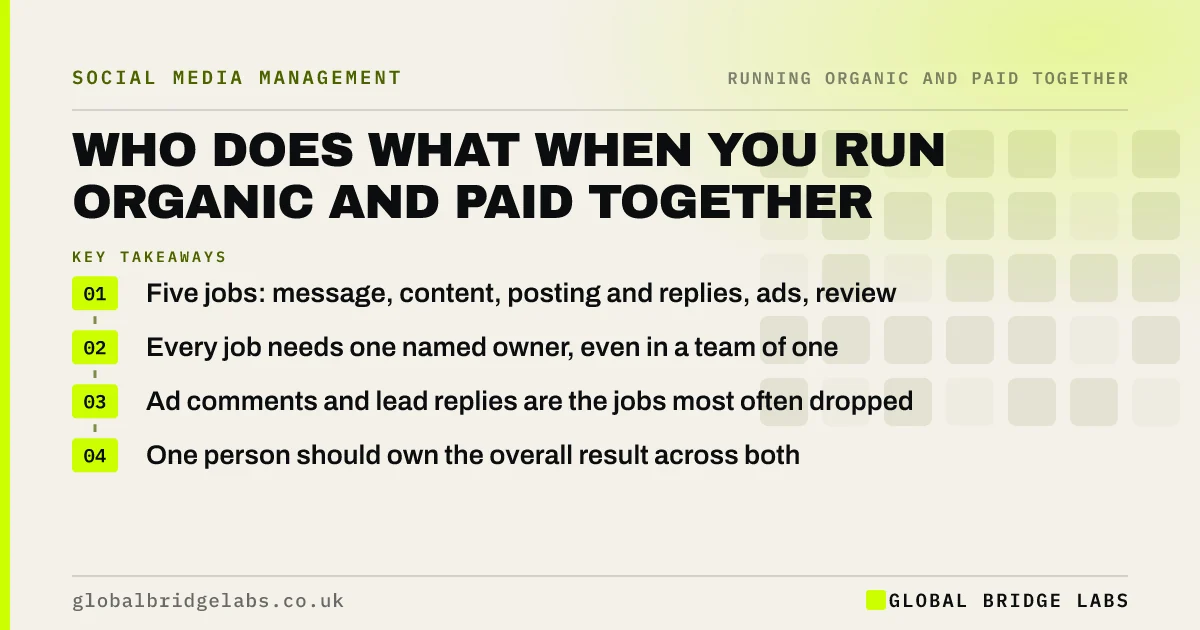
- Five jobs: message, content, posting and replies, ads, review.
- Every job needs one named owner, even in a team of one.
- Ad comments and lead replies are the jobs most often dropped.
- One person should own the overall result across both.
Want help deciding who does what? Message us on WhatsApp.
Chat on WhatsApp →What jobs does running organic and paid involve?
Running both involves five distinct jobs, whoever does them.
- Message: what you say this quarter and to whom.
- Content: photos, video and copy for posts and ads.
- Posting and replies: publishing and answering comments and messages.
- Ads: campaigns, budgets, tracking and ad comments.
- Review: results by source and decisions.
Who should own each job in a small team?
In a small team, the owner or manager usually owns the message and the review, a staff member or freelancer owns content and posting, and an agency or specialist owns ads. What matters is that each job has one named person, so nothing is assumed to be someone else's.
Which jobs fall through the gaps?
The jobs most often dropped are replying to comments on ads, following up leads quickly and feeding organic results into ad choices. Meta's learning phase also means someone must resist editing ads constantly, which needs one clear decision-maker.
How do agencies fit in?
If an agency runs ads or organic, write down which of the five jobs it owns and which stay with you. If it handles customer data, such as lead form details, the ICO's guidance on controller and processor contracts applies.
Who should own the overall result?
One person should own the overall result across organic and paid: enquiries by source and cost per enquiry. Without that, organic and paid compete for credit and nobody acts on the whole picture.
What does this look like in practice?
A pattern we see: a dental practice had a receptionist posting organically, an agency running ads and the practice manager reading reports. Nobody answered comments on ads, and the agency never saw which organic posts brought bookings. Naming an owner for each job and holding one monthly review fixed both within weeks.
Roles checklist
- List the five jobs.
- Name one owner for each.
- Give ad comments and lead replies a clear owner.
- Write down what any agency owns.
- Name one person for the overall result.
- Review roles every quarter.
Next step
Write the five jobs down and put one name against each. Share the list with everyone involved, including any agency, and check it at your next monthly review.
Message us on WhatsApp for a roles template for organic and paid social, or book a 30-minute consultation.
Chat on WhatsApp →Sources and further reading
- Meta Business Help Centre · Meta
- About the learning phase · Meta
- Contracts and liabilities between controllers and processors · Information Commissioner's Office
Frequently asked questions
Can one person run organic and paid social?
Yes, at a basic level and with modest budgets. One person can post, reply and run simple campaigns if the jobs are planned. As content volume and ad spend grow, the skills diverge, and splitting content and ads between two people or an agency usually works better.
Who should reply to comments on ads?
Whoever handles organic comments should usually handle ad comments too, using the same tone, so replies are consistent and quick. If an agency runs ads, agree in writing who replies, how fast and what gets escalated. Ad comments are often missed, so give them a named owner.
Should the agency or the business own the social media results?
The business should own the overall result, enquiries and customers by source, even if an agency does much of the work. Agencies own delivery of their agreed jobs. One person in the business reviewing organic and paid together keeps both working towards the same goal.
Written by

Global Bridge Labs (GBL) is a UK–Sri Lanka partner for social media, websites and BPO. Everything here comes from client delivery, not theory.