On this page
- 01Key takeaways
- 02Should you test an idea with organic or paid social?
- 03How do you run an organic test?
- 04How do you run a paid test?
- 05What counts as a good result?
- 06What rules apply to testing demand?
- 07What does this look like in practice?
- 08Demand test checklist
- 09Next step
- 10Sources and further reading
- 11Frequently asked questions
Key takeaways
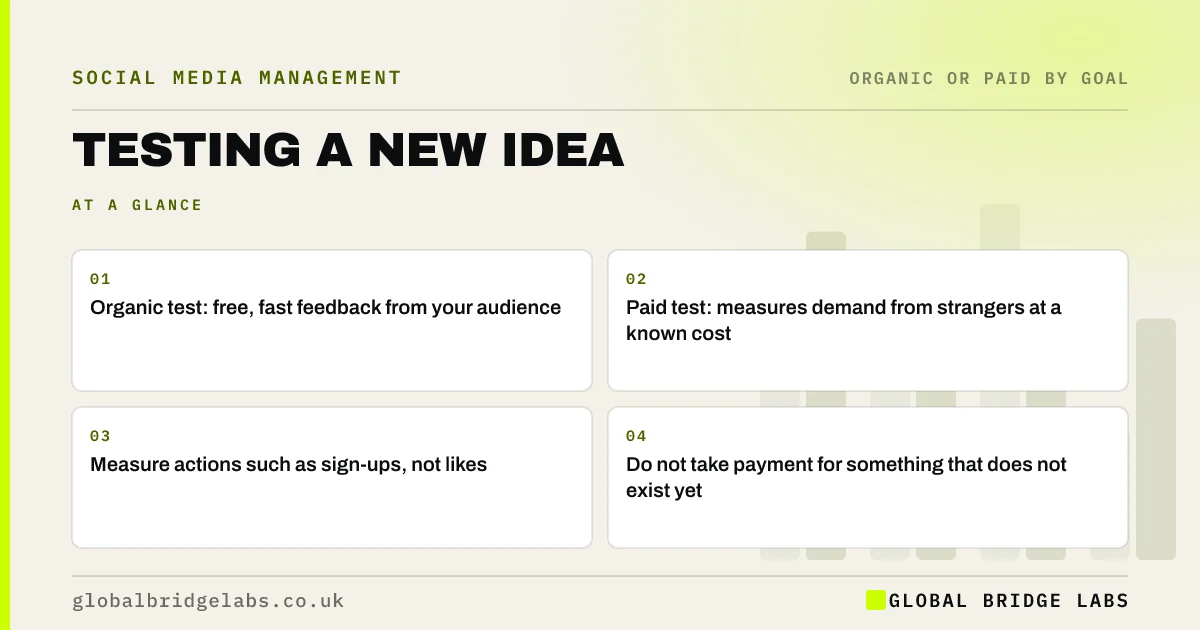
To test a new product or service idea, start with organic posts to see how your existing audience reacts: comments, messages and sign-ups are free signals. Then run a small paid test to measure demand from people who do not know you, using a waitlist or enquiry form. Organic shows interest; paid shows whether strangers will act.
- Organic test: free, fast feedback from your audience.
- Paid test: measures demand from strangers at a known cost.
- Measure actions such as sign-ups, not likes.
- Do not take payment for something that does not exist yet.
Got an idea to test? Tell us about it on WhatsApp.
Chat on WhatsApp →Should you test an idea with organic or paid social?
Use both, in order. Organic first: post about the idea and see who responds. Your audience is biased in your favour, so treat it as a positive signal, not proof. Then run a small paid test to strangers, which shows whether the idea has demand beyond people who already like you.
How do you run an organic test?
Run an organic test by posting about the problem the idea solves, asking questions, sharing a mock-up and inviting people to register interest. Count messages, comments with real questions and sign-ups.
- Post about the problem, not the product.
- Share a mock-up or sample.
- Ask direct questions.
- Invite people to register interest.
How do you run a paid test?
Run a paid test with a small, fixed budget, a clear audience and a waitlist or enquiry form, such as Meta lead ads. Compare cost per sign-up against what a customer would be worth. Run two versions of the offer to see which wins.
Want a test plan for your idea? Message us on WhatsApp and we will discuss your requirements.
Chat on WhatsApp →What counts as a good result?
A good result is people taking an action that costs them something: their email, a call booking, a deposit for something that exists. Likes and positive comments are encouraging but weak. Set a target cost per sign-up before you start.
What rules apply to testing demand?
Be honest. Ads must not mislead under the CAP Code, so describe the product as coming soon or invite people to register interest. Do not take payment for something you cannot deliver.
What does this look like in practice?
A pattern we see: an accountancy practice wondered whether to launch a bookkeeping service for tradespeople. Organic LinkedIn posts drew interest from existing contacts. A small Facebook test to local trades businesses with a 'register interest' form brought enough sign-ups at a reasonable cost to justify launching.
Demand test checklist
- Write down the idea and the problem it solves.
- Post about it organically and count responses.
- Set a target cost per sign-up.
- Run a small, fixed paid test to strangers.
- Use honest 'coming soon' wording.
- Decide in advance what result means go.
Next step
Post about your idea's problem organically this week and count genuine responses. If there is interest, run a two-week paid test with a fixed budget and a target cost per sign-up.
Message us on WhatsApp for a demand test template, or book a 30-minute consultation.
Chat on WhatsApp →Sources and further reading
Frequently asked questions
How much should I spend testing a business idea with ads?
Enough to get a meaningful number of sign-ups, which for many small tests is a few hundred pounds over two to four weeks. Set the budget and target cost per sign-up in advance. Treat it as research: the money buys an answer, whichever way it goes.
Is it ethical to advertise a product that does not exist yet?
It is acceptable if you are honest, describing it as coming soon and inviting people to register interest. It is not acceptable to take payment or imply it is available now. Ads must not mislead under the CAP Code, so wording matters.
Can my followers' reaction tell me if an idea will sell?
Partly. Followers already like you, so their reaction is a positive but biased signal. It is useful for refining the idea and wording. To judge real demand, test with people who do not know you, ideally through a small paid campaign asking for a sign-up.
Written by

Global Bridge Labs (GBL) is a UK–Sri Lanka partner for social media, websites and BPO. Everything here comes from client delivery, not theory.