On this page
- 01Key takeaways
- 02What is the difference between creator posts and partnership ads?
- 03When do organic creator posts work best?
- 04When do partnership ads work best?
- 05What rules apply?
- 06How should you combine them?
- 07What does this look like in practice?
- 08Creator content checklist
- 09Next step
- 10Sources and further reading
- 11Frequently asked questions
Key takeaways
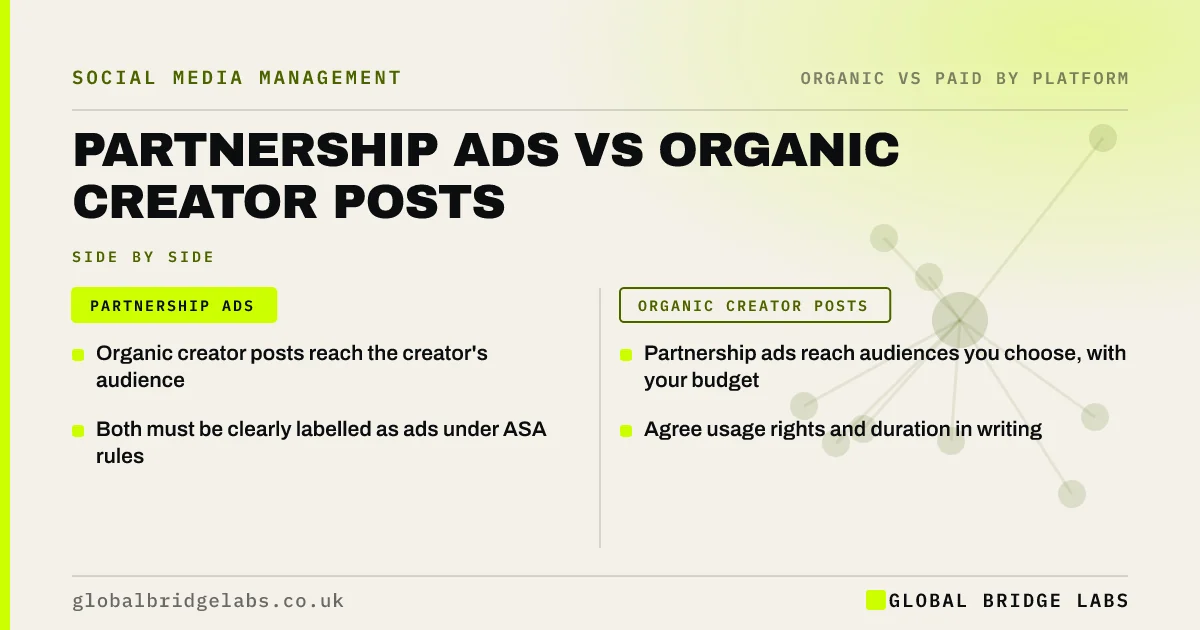
An organic creator post reaches that creator's audience once, labelled as an ad. A partnership ad lets you put your own budget behind the creator's content, targeting new audiences for longer. Partnership ads usually give more reach and control; organic creator posts give authenticity within the creator's community. Many campaigns use both.
- Organic creator posts reach the creator's audience.
- Partnership ads reach audiences you choose, with your budget.
- Both must be clearly labelled as ads under ASA rules.
- Agree usage rights and duration in writing.
Working with creators? Talk it through with us on WhatsApp.
Chat on WhatsApp →What is the difference between creator posts and partnership ads?
A creator post is published by the creator to their followers, usually paid with a fee or free product. A partnership ad, called Spark Ads on TikTok and partnership ads on Instagram and Facebook, uses the creator's content as an ad from their handle, funded and targeted by you.
When do organic creator posts work best?
Organic creator posts work best when the creator's audience closely matches your buyers and trusts their recommendations. Micro creators in a niche or local area often give the best fit. The post's reach depends on the platform's ranking, so results vary.
When do partnership ads work best?
Partnership ads work best when creator content has performed well and you want it seen by more people, for longer, with targeting. They often perform better than brand-made ads because they look native.
- Extend reach beyond the creator's followers.
- Target your own audiences.
- Run for weeks rather than one post.
- Track results in your own ad account.
Want help structuring a creator deal with ad rights? Message us on WhatsApp and we will discuss your requirements.
Chat on WhatsApp →What rules apply?
The ASA's influencer guide says paid or gifted content must be obviously identifiable as an ad, usually with 'Ad' upfront. Copyright stays with the creator unless agreed otherwise, so contracts must set out usage rights, platforms and duration.
How should you combine them?
Commission organic posts from well-matched creators, see which content performs, then pay for partnership ad rights to the best pieces. Agree that possibility in the original contract to avoid renegotiating.
What does this look like in practice?
A pattern we see: a skincare brand paid five micro creators for organic posts. Two clearly outperformed. The brand had agreed ad usage rights upfront, so it ran those two as partnership ads to similar audiences for six weeks, which produced more sales than all five organic posts together.
Creator content checklist
- Match creators to your buyers, not follower counts.
- Agree labelling and ad usage rights in writing.
- Measure each creator post's results.
- Run the best as partnership ads.
- Target audiences beyond the creator's followers.
- Refresh creator ads every few weeks.
Next step
In your next creator agreement, include the option to run the content as a partnership ad for a set period. Then pick the best performers and test them with a modest ad budget.
Message us on WhatsApp for a creator campaign plan, or book a 30-minute consultation.
Chat on WhatsApp →Sources and further reading
- Influencers' guide to making clear that ads are ads · ASA / CAP
- How copyright protects your work · GOV.UK
- Meta Business Help Centre · Meta
Frequently asked questions
What are partnership ads on Instagram?
Partnership ads let a brand run ads using a creator's content and handle, with the creator's permission. The ad appears from the creator's account and is labelled as a paid partnership. The brand controls budget and targeting, extending the content's reach beyond the creator's followers.
Do I need permission to use a creator's post as an ad?
Yes. The creator owns the copyright in their content unless your contract says otherwise. Agree in writing which platforms, how long and in what formats you can use it as an ad. Platforms also require the creator to grant access through their partnership tools.
Are creator posts or partnership ads better value?
It depends. Organic creator posts can be good value for niche audiences that trust the creator. Partnership ads often give more reach and measurable results for the money, especially behind content already proven organically. Many brands get the best value by combining both.
Written by

Global Bridge Labs (GBL) is a UK–Sri Lanka partner for social media, websites and BPO. Everything here comes from client delivery, not theory.