On this page
- 01Key takeaways
- 02What does organic social teach you?
- 03What does paid social teach you?
- 04How do the two insights differ?
- 05How do you turn insights into decisions?
- 06What are the limits of social data?
- 07What does this look like in practice?
- 08Insight checklist
- 09Next step
- 10Sources and further reading
- 11Frequently asked questions
Key takeaways
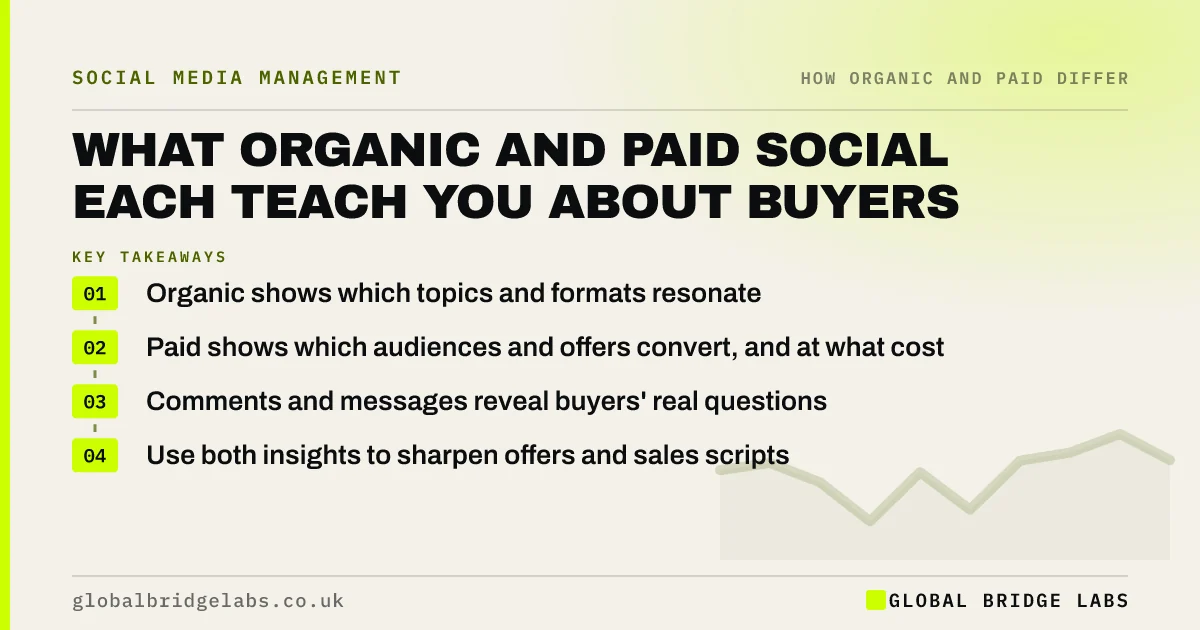
Organic social teaches you what your audience cares about: which topics get saved, shared and discussed. Paid social teaches you who acts and what it costs: which audiences, messages and offers bring enquiries at what price. Used together, they give a small business low-cost market research that improves products, messages and sales conversations.
- Organic shows which topics and formats resonate.
- Paid shows which audiences and offers convert, and at what cost.
- Comments and messages reveal buyers' real questions.
- Use both insights to sharpen offers and sales scripts.
Want help reading what your social data says? Message us on WhatsApp.
Chat on WhatsApp →What does organic social teach you?
Organic social teaches you what people find useful or interesting, in their own words. Saves suggest lasting value; shares suggest something worth passing on; comments and messages show real questions and objections. These are free signals about what to say and how.
- Topics that get saved and shared.
- Formats people watch to the end.
- Questions in comments and messages.
- Objections people raise publicly.
What does paid social teach you?
Paid social teaches you which defined audiences respond and how much a result costs. Testing two offers or two audiences with equal budgets shows which wins on cost per enquiry. Platform and GA4 data show what people did after clicking.
How do the two insights differ?
Organic insight is broad and qualitative: what interests your existing audience. Paid insight is narrow and quantitative: what converts among a chosen audience at a measurable cost. Organic suggests hypotheses; paid tests them with money.
How do you turn insights into decisions?
Turn insights into decisions by keeping a simple log: what you tested, what happened and what you will change. Feed winning organic topics into ads, and winning ad messages into organic posts, website copy and sales conversations.
What are the limits of social data?
Social data reflects people active on that platform, not your whole market. Small samples mislead; a single viral post or a week of ads proves little. Look for patterns over several weeks and confirm with direct conversations with customers.
What does this look like in practice?
A pattern we see: a B2B software firm noticed organic posts about data migration got far more comments than feature posts. A small LinkedIn ad test confirmed a migration-focused offer brought demo requests at a much lower cost. The firm rewrote its homepage and sales deck around migration.
Insight checklist
- Log saves, shares and comments by topic monthly.
- Record recurring questions from messages.
- Test two offers with equal ad budgets.
- Compare cost per enquiry by audience.
- Feed winners into website and sales copy.
- Confirm patterns with real customer conversations.
Next step
Start a one-page insight log this week: top three organic topics by saves, top three questions from messages, and the cost per enquiry of any ad you run.
Message us on WhatsApp for the insight log template, or book a 30-minute consultation.
Chat on WhatsApp →Sources and further reading
- Meta Business Help Centre · Meta
- About key events · Google Analytics Help
- LinkedIn Pages best practices · LinkedIn
Frequently asked questions
Can social media replace market research?
Not entirely, but it is a cheap starting point. Organic engagement and ad tests show what interests people and what they act on. Because social audiences are not your whole market, confirm important findings with customer conversations, sales data or a small survey before making big decisions.
Which social metric shows what customers care about most?
Saves and shares are often the best organic signals, because they show content people value enough to keep or pass on. Direct messages and comments with questions are even better. On paid, cost per enquiry by message or offer shows what customers care enough to act on.
How much ad spend do I need to test a message?
Enough for each version to get a meaningful number of results, which depends on your typical cost per enquiry. For many small businesses, a few hundred pounds split evenly across two versions over two to four weeks gives a usable answer. Keep everything else identical.
Written by

Global Bridge Labs (GBL) is a UK–Sri Lanka partner for social media, websites and BPO. Everything here comes from client delivery, not theory.