On this page
- 01Key takeaways
- 02What are the risks of relying only on paid social?
- 03Why do paid-only businesses see rising costs?
- 04What happens if your ad account is restricted?
- 05Why does organic make paid cheaper?
- 06How do you reduce reliance on paid?
- 07What does this look like in practice?
- 08Paid only risk checklist
- 09Next step
- 10Sources and further reading
- 11Frequently asked questions
Key takeaways
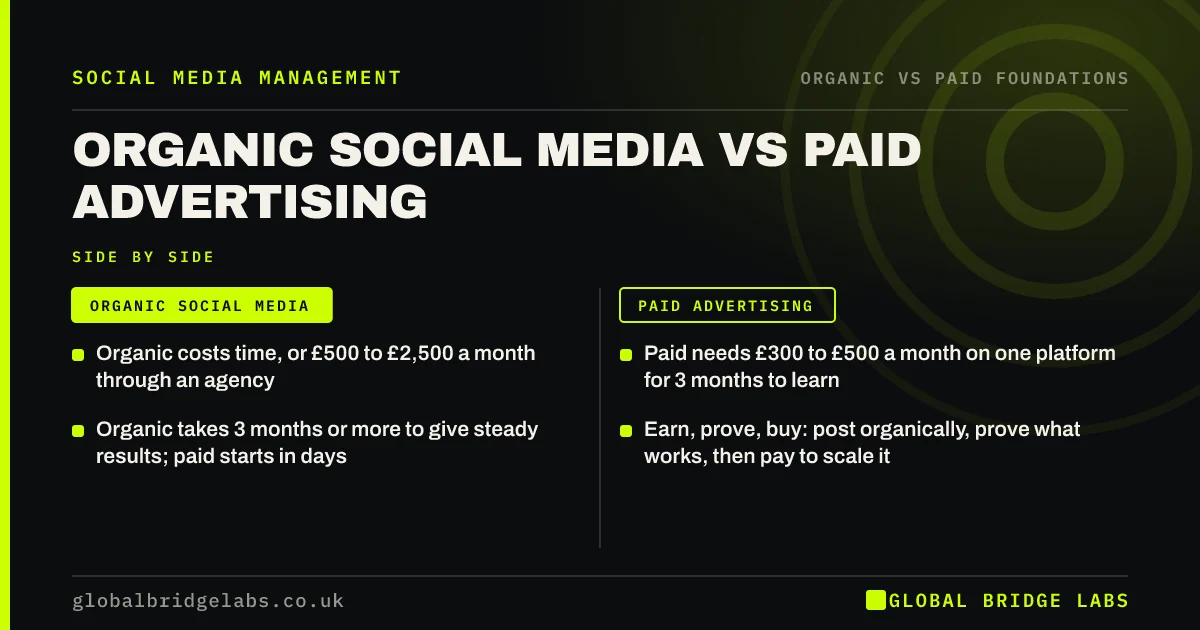
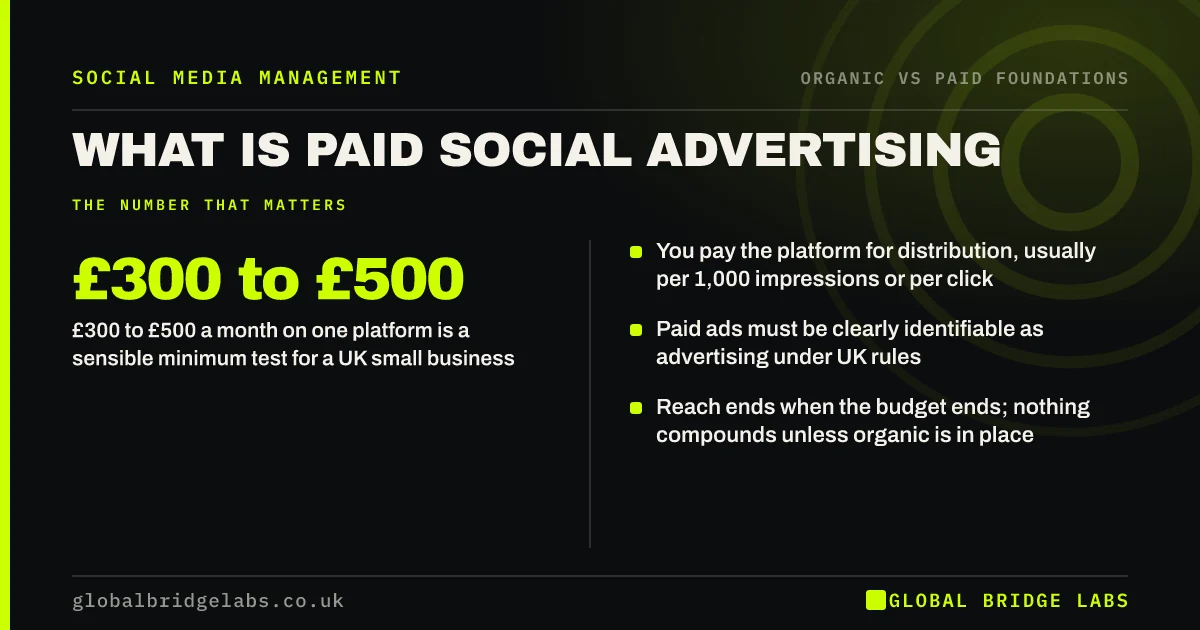
Relying on paid social alone risks four things: costs rising with auction prices, results that stop the day spending stops, a weak profile that loses ad clicks, and an account that can be restricted without warning. Paid works best on top of an active organic presence, which keeps your brand credible and cuts the cost of each result.
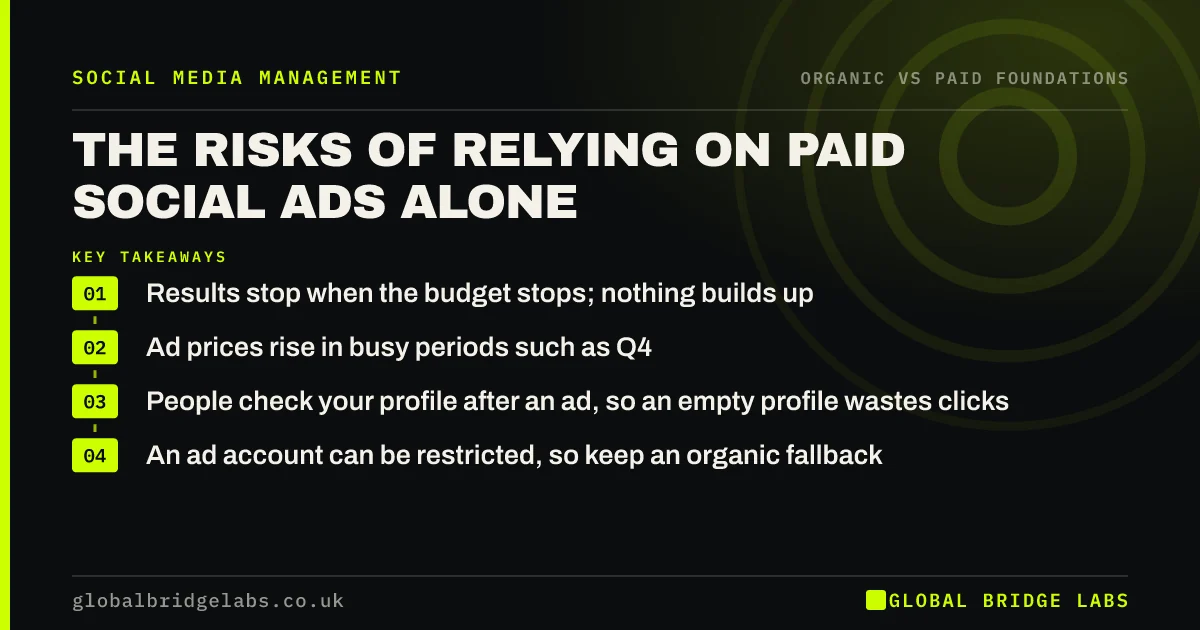
- Results stop when the budget stops; nothing builds up.
- Ad prices rise in busy periods such as Q4.
- People check your profile after an ad, so an empty profile wastes clicks.
- An ad account can be restricted, so keep an organic fallback.
Worried you are too reliant on ads? Message us on WhatsApp.
Chat on WhatsApp →What are the risks of relying only on paid social?
The main risks are cost, fragility and credibility. You pay for every result, prices change with demand, and an account restriction can stop everything overnight. Without organic content, people who click an ad and check your profile find little reason to trust you.
- Every result costs money, with no compounding.
- Auction prices rise in competitive periods.
- Account or ad rejections can halt delivery.
- Thin profiles undermine the ads.
Why do paid-only businesses see rising costs?
Costs rise because the same audiences see the same ads repeatedly and respond less, and because more advertisers compete at certain times of year. Without organic testing, there is no steady supply of fresh, proven content to rotate into ads, so creative fatigue sets in faster.
What happens if your ad account is restricted?
If an ad account is restricted, delivery stops until the issue is resolved, which can take days or weeks. Meta's Advertising Standards set out what can trigger rejections and restrictions. A business with an active organic presence keeps some visibility during that time; a paid-only business goes quiet.
Why does organic make paid cheaper?
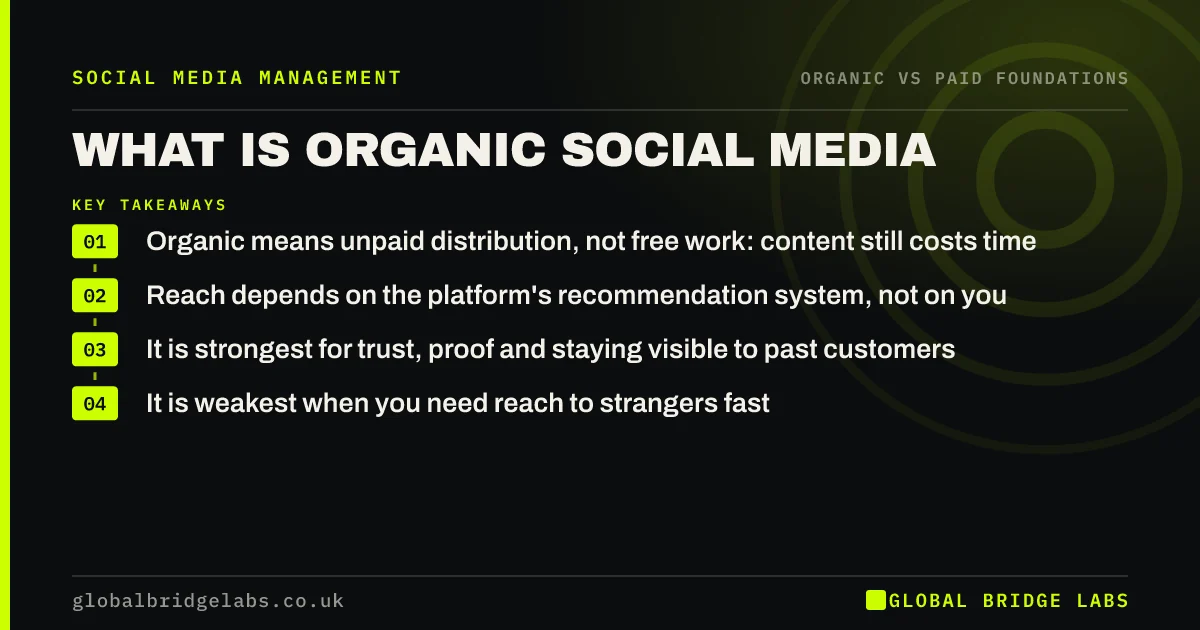
Organic content gives paid two advantages: tested messages that people already respond to, and warm audiences of engagers and followers to retarget. The IPA's research also shows brand familiarity improves the response to activation ads. Both lower the cost per result over time.
How do you reduce reliance on paid?
Reduce reliance by posting organically on the platform where your ads perform best, building a list of customers you can contact directly, and turning ad content into organic posts. Shift gradually and track enquiries from each source so you do not lose volume.
What does this look like in practice?
A pattern we see: an online supplement retailer ran ads only, with a profile of old product shots. When costs rose in the run-up to Christmas, sales fell sharply. Adding weekly customer stories and how-to videos to the profile, then using the best as ads, improved conversion from ad clicks and reduced dependence on peak-season spend.
Paid only risk checklist
- Check what share of enquiries depend on ads.
- Review your profile as a stranger clicking an ad would.
- Post organically on your main ad platform weekly.
- Build a direct contact list from customers.
- Keep a backup admin on your ad account.
- Rotate in fresh, proven creative monthly.
Next step
Click one of your own ads and look at your profile with a stranger's eyes. If there is nothing recent, real or reassuring, start posting weekly before you raise ad spend again.
Message us on WhatsApp for a paid reliance review, or book a 30-minute consultation.
Chat on WhatsApp →Sources and further reading
- Meta Business Help Centre · Meta
- Meta Advertising Standards · Meta Transparency Center
- The Long and the Short of It: balancing short and long-term marketing strategies · IPA
Frequently asked questions
Can a business rely only on paid social?
Some do, especially e-commerce brands with strong margins, but it is fragile. Every sale has an ad cost, prices change with competition, and results stop when spending stops. An organic presence makes ads more credible and supplies tested creative, which usually lowers the cost per result.
What happens when you stop paying for social ads?
Reach from ads stops almost immediately. Enquiries from paid fall away within days, and retargeting audiences shrink over the following weeks. What remains is whatever organic presence and direct customer relationships you have built. That is why paid-only businesses feel a budget cut much more sharply.
Why are my social ads getting more expensive?
Common reasons are ad fatigue, where the same audience sees the same creative too often, seasonal competition such as the run-up to Christmas, narrow audiences, and weak landing pages. Refreshing creative with posts that worked organically and broadening targeting often helps more than raising the budget.
Written by

Global Bridge Labs (GBL) is a UK–Sri Lanka partner for social media, websites and BPO. Everything here comes from client delivery, not theory.