On this page
- 01Key takeaways
- 02Why do ads get less engagement than organic posts?
- 03Does engagement on ads matter?
- 04What should you measure on ads instead?
- 05What does organic engagement tell you?
- 06Should you boost posts to get more engagement?
- 07What does this look like in practice?
- 08Engagement checklist
- 09Next step
- 10Sources and further reading
- 11Frequently asked questions
Key takeaways
Social ads usually get a lower engagement rate than organic posts, because they reach people who do not know you yet. That is normal and not a sign of failure. Organic posts are seen by people already interested. Judge ads on the action they were bought for, such as enquiries or sales, rather than on likes and comments.
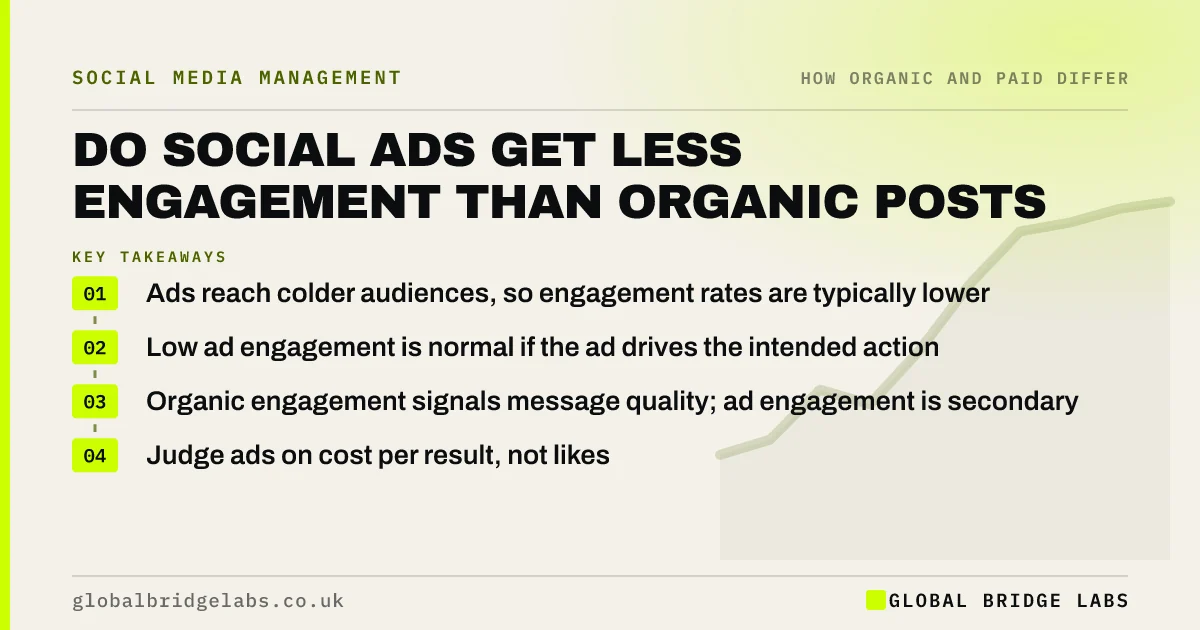
- Ads reach colder audiences, so engagement rates are typically lower.
- Low ad engagement is normal if the ad drives the intended action.
- Organic engagement signals message quality; ad engagement is secondary.
- Judge ads on cost per result, not likes.
Unsure whether your ad numbers are good? Send them to us on WhatsApp.
Chat on WhatsApp →Why do ads get less engagement than organic posts?
Ads get less engagement because they are shown to people who did not choose to follow you and are mid-scroll through other content. Organic posts reach followers and people the platform predicts are interested. Lower engagement on ads is expected and does not mean the ad is failing.
Does engagement on ads matter?
Engagement on ads matters a little: comments and shares can lower costs and add social proof. But if you chose a leads or sales objective, the platform optimises for that, not for likes. An ad with few likes and steady enquiries is doing its job.
What should you measure on ads instead?
Measure ads on the objective you paid for. GA4 key events and platform conversion tracking show what people did after clicking.
- Cost per enquiry or booking.
- Cost per sale and return on ad spend.
- Click-through rate to your landing page.
- Conversion rate on the landing page.
What does organic engagement tell you?
Organic engagement tells you whether your message resonates with people who know you. Saves, shares and comments are useful early signals of which content to turn into ads. Posts with strong organic engagement often make the best ad creative.
Should you boost posts to get more engagement?
Boosting for engagement buys likes, often from people unlikely to buy. Meta's boost tools offer goals such as messages or website visits; choose those over engagement unless social proof on a key post is the goal.
What does this look like in practice?
A pattern we see: a garden centre was disappointed that its ads got a handful of likes while organic posts got hundreds. Checking GA4 showed the ads had brought a steady stream of visits to its plant sale page and in-store vouchers redeemed. Switching the comparison from likes to vouchers changed the decision.
Engagement checklist
- Separate organic and paid engagement in reports.
- Set every ad objective to a business action.
- Track ad results in GA4 or the ad platform.
- Use high-engagement organic posts as ad creative.
- Avoid engagement objectives unless proof is the goal.
- Reply to comments on ads promptly.
Next step
For your current ads, replace engagement in your report with cost per enquiry or sale. If you cannot measure that yet, set up tracking before spending more.
Message us on WhatsApp for an ad reporting check, or book a 30-minute consultation.
Chat on WhatsApp →Sources and further reading
- Meta Business Help Centre · Meta
- About key events · Google Analytics Help
- How to boost a post from your Facebook Page · Meta
Frequently asked questions
What is a good engagement rate for social ads?
There is no reliable universal figure, and engagement is rarely the right measure for ads. Compare ads against each other on the same objective, and focus on cost per enquiry or sale. Engagement rate is more useful for organic posts, where it shows how well content suits your audience.
Why do boosted posts get fewer comments?
Boosted posts reach people outside your usual audience who have less reason to comment. They may also be shown in placements where comments are less common. If a boosted post was meant to drive messages or website visits, judge it on those results instead.
Do likes on ads help?
Likes and comments on ads add some social proof and can slightly improve delivery, because platforms favour ads people respond to. But they matter far less than the action the ad was bought for. Do not optimise ads for likes unless social proof is the specific goal.
Written by

Global Bridge Labs (GBL) is a UK–Sri Lanka partner for social media, websites and BPO. Everything here comes from client delivery, not theory.