On this page
- 01Key takeaways
- 02Should a logistics firm use organic or paid social?
- 03What organic content works for logistics?
- 04When are paid ads worth it for logistics?
- 05Why does consistency matter in logistics?
- 06How should a logistics firm combine both?
- 07What does this look like in practice?
- 08Logistics checklist
- 09Next step
- 10Sources and further reading
- 11Frequently asked questions
Key takeaways
For logistics firms chasing B2B contracts, organic LinkedIn presence does steady work: case studies, operational updates and leaders' expertise keep you in mind through long buying cycles. Paid social adds precise reach to operations and supply chain managers when you want to enter a sector or region. Organic builds credibility; paid targets decision-makers.
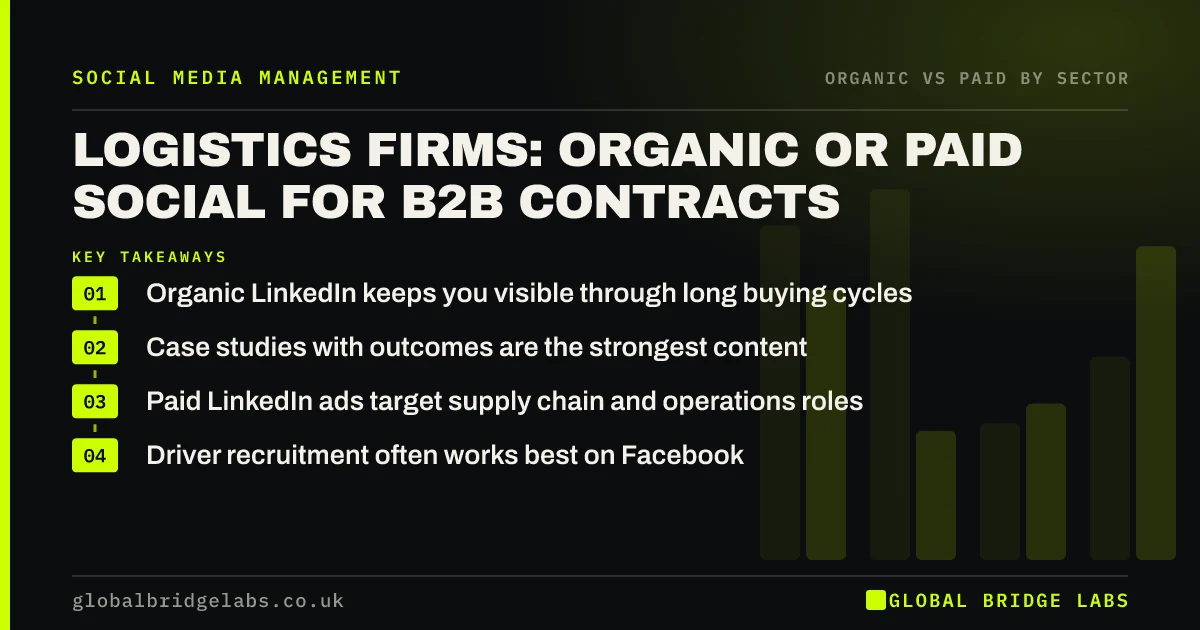
- Organic LinkedIn keeps you visible through long buying cycles.
- Case studies with outcomes are the strongest content.
- Paid LinkedIn ads target supply chain and operations roles.
- Driver recruitment often works best on Facebook.
Logistics firm chasing new contracts? Message us on WhatsApp.
Chat on WhatsApp →Should a logistics firm use organic or paid social?
A logistics firm should keep a steady organic presence, mainly on LinkedIn, because contracts are won over months and buyers check suppliers carefully. Paid makes sense for entering a new sector or region, promoting a new service and recruiting drivers.
What organic content works for logistics?
What works is proof of reliability and capability.
- Case studies with measurable outcomes.
- Fleet, depot and team updates.
- Leaders commenting on industry changes.
- Accreditations and service milestones.
When are paid ads worth it for logistics?
Paid LinkedIn ads are worth it for reaching operations, procurement and supply chain managers in target sectors, especially with case study content or Lead Gen Forms. Facebook ads often work better for driver recruitment.
Why does consistency matter in logistics?
Logistics contracts often run for years, so buyers are rarely in market. The LinkedIn B2B Institute's 95-5 rule suggests most buyers are not ready at any time. Consistent organic posting keeps you remembered when contracts come up for renewal.
How should a logistics firm combine both?
Post weekly on LinkedIn from the company page and leaders' profiles, publish a case study each quarter and use paid to put the best case studies in front of target job titles in chosen sectors.
What does this look like in practice?
A pattern we see: a regional haulier posted mainly truck photos and won no new contracts from social. Publishing quarterly case studies showing on-time delivery improvements, and running them as LinkedIn ads to operations managers in food and drink manufacturing, led to tender invitations within a year.
Logistics checklist
- Post weekly on LinkedIn.
- Publish a case study each quarter.
- Get leaders posting expertise.
- Target ops and supply chain roles with ads.
- Use Facebook ads for driver recruitment.
- Track tender invitations and enquiries.
Next step
Write one case study this month with a measurable outcome and post it on LinkedIn. If it performs well, run it as a LinkedIn ad to operations managers in your target sector.
Message us on WhatsApp for a logistics social plan, or book a 30-minute consultation.
Chat on WhatsApp →Sources and further reading
- The 95-5 rule: most B2B buyers are out of market · LinkedIn B2B Institute
- LinkedIn Pages best practices · LinkedIn
- Lead Gen Forms · LinkedIn
Frequently asked questions
Is social media useful for logistics companies?
Yes, mainly for credibility and recruitment. Buyers check suppliers before shortlisting them, and an active LinkedIn presence with case studies helps. Social media rarely wins contracts on its own but supports sales conversations and tenders. Facebook is often useful for recruiting drivers.
Are LinkedIn ads worth it for logistics?
They can be for reaching operations, procurement and supply chain managers, because contracts are valuable enough to justify higher click costs. Use case studies or useful guides as the ad content rather than generic company adverts, and track enquiries and tender invitations.
What should a haulage company post on social media?
Post case studies with outcomes, fleet and depot updates, team stories, safety and accreditation news, and commentary on industry changes. Real photos and specific results build more credibility than generic truck images. Keep posting consistently, since contracts come up irregularly.
Written by

Global Bridge Labs (GBL) is a UK–Sri Lanka partner for social media, websites and BPO. Everything here comes from client delivery, not theory.