On this page
- 01Key takeaways
- 02How do you test ad creative with organic posts?
- 03Which organic signals predict ad success?
- 04How do you turn a winning post into an ad?
- 05What are the limits of organic testing?
- 06How often should you refresh ad creative?
- 07What does this look like in practice?
- 08Organic testing checklist
- 09Next step
- 10Sources and further reading
- 11Frequently asked questions
Key takeaways
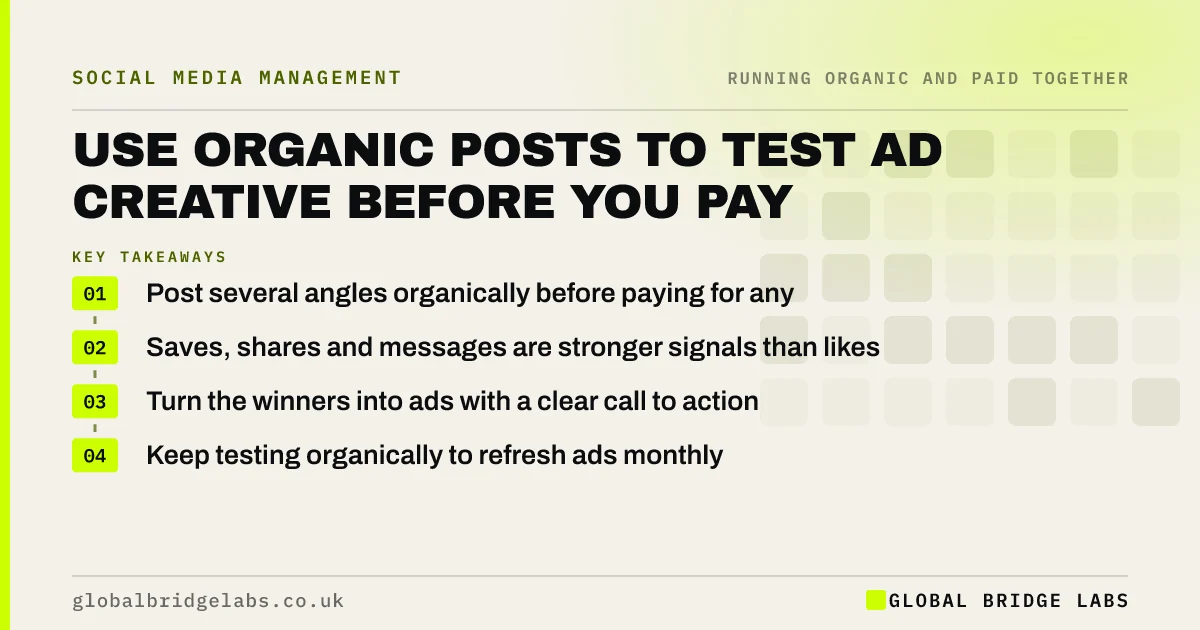
Organic posts are a free way to test ad creative. Post several versions of a message organically, watch which get the most saves, shares, comments and messages, and use the winners as ads. This cuts wasted ad spend, because you only pay to amplify content people have already responded to.
- Post several angles organically before paying for any.
- Saves, shares and messages are stronger signals than likes.
- Turn the winners into ads with a clear call to action.
- Keep testing organically to refresh ads monthly.
Want to know which of your posts would make good ads? Ask us on WhatsApp.
Chat on WhatsApp →How do you test ad creative with organic posts?
Post different angles of the same message organically over a few weeks: different hooks, formats and proof points. Compare results on the same platform and similar posting times. The posts that get the strongest response become ad candidates.
- Write three or four hooks for one message.
- Post each as a separate organic post.
- Compare saves, shares, comments and messages.
- Pick the winner for paid.
Which organic signals predict ad success?
Saves, shares, comments with questions, profile visits and direct messages are the best predictors, because they show genuine interest. Likes are weak signals. On video, watch time and completion rate matter, since platforms like TikTok rank on viewer behaviour.
How do you turn a winning post into an ad?
Keep what worked, such as the hook, visuals and message, and add a clear call to action and a matching landing page or form. Meta lets you boost the original post or use it in Ads Manager, keeping its social proof.
What are the limits of organic testing?
Organic audiences are mostly followers, who may respond differently from cold audiences. A post that wins organically is a strong candidate, not a guarantee. Run the paid version as a test, too, before scaling.
How often should you refresh ad creative?
Refresh roughly monthly, or when results drop. A steady organic testing routine keeps a pipeline of proven posts ready to replace tired ads.
What does this look like in practice?
A pattern we see: a pest control firm posted four versions of the same message about wasps: a fact, a customer story, a quick video and a price explainer. The price explainer got the most messages organically. As an ad, it outperformed the firm's previous ad by a wide margin.
Organic testing checklist
- Pick one message to test.
- Write three or four different hooks.
- Post each organically.
- Compare saves, shares and messages.
- Turn the winner into an ad.
- Keep testing to refresh ads monthly.
Next step
Choose your main offer and write four different opening lines for it. Post one a week organically for a month, then run the best as an ad.
Message us on WhatsApp for an organic testing plan, or book a 30-minute consultation.
Chat on WhatsApp →Sources and further reading
- Meta Business Help Centre · Meta
- How to boost a post from your Facebook Page · Meta
- How TikTok recommends videos #ForYou · TikTok Newsroom
Frequently asked questions
Is organic performance a good predictor of ad performance?
It is a useful predictor, especially for saves, shares and messages, but not a guarantee. Followers may respond differently from cold audiences. Use organic results to shortlist ad creative, then confirm with a small paid test before increasing the budget.
Should I boost a post that did well organically?
Often, yes, if it brought enquiries or strong engagement and fits your goal. Choose a boost goal like messages or website visits rather than engagement, and target a relevant audience. For lead or sales campaigns, use the post in Ads Manager for more control.
How many versions should I test?
Three or four versions of one message is manageable for most small businesses. Change one main element at a time, such as the hook or format, so you can tell what made the difference. Testing too many things at once makes results hard to read.
Written by

Global Bridge Labs (GBL) is a UK–Sri Lanka partner for social media, websites and BPO. Everything here comes from client delivery, not theory.