On this page
- 01Key takeaways
- 02What are the example's assumptions?
- 03How do organic results build over the year?
- 04How do paid results look over the year?
- 05What happens when both run together?
- 06What should you take from the example?
- 07How does the example compare with real accounts?
- 08Worked example checklist
- 09Next step
- 10Sources and further reading
- 11Frequently asked questions
Key takeaways
In our worked 12-month example for a UK service business, organic social costs about £9,600 in time and support and paid social about £10,800 in spend and management. Paid brings enquiries from month one; organic overtakes it from month seven. Combined, enquiries are highest and cost per enquiry is lowest by month twelve. The figures are illustrative.
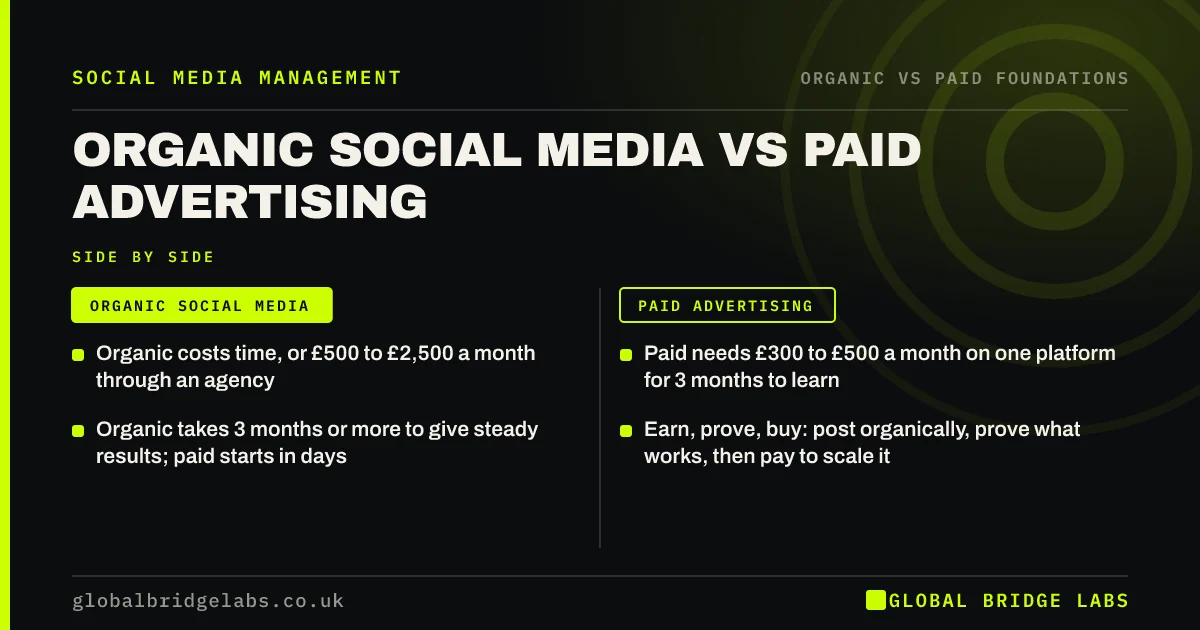
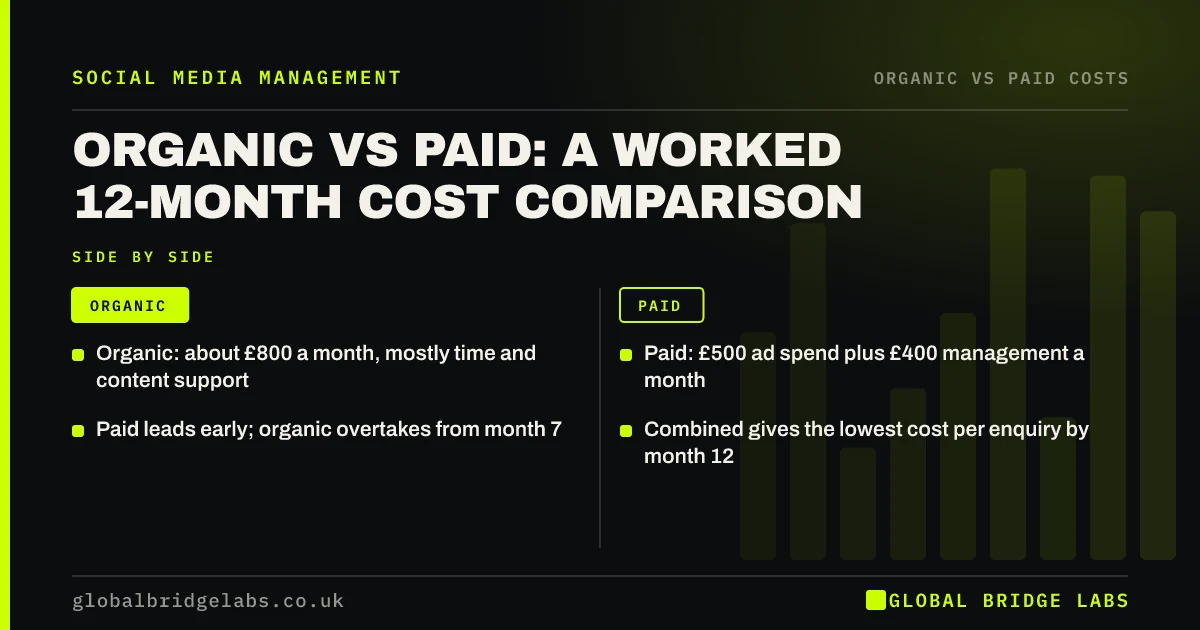
- Organic: about £800 a month, mostly time and content support.
- Paid: £500 ad spend plus £400 management a month.
- Paid leads early; organic overtakes from month 7.
- Combined gives the lowest cost per enquiry by month 12.
Want this example rebuilt with your numbers? Message us on WhatsApp.
Chat on WhatsApp →What are the example's assumptions?
The example is a fictional UK home services business with an average job worth £1,200 and gross margin of 40%. Time is valued using typical UK earnings from ONS ASHE data. All figures are illustrative, built to show the shape of the comparison, not a forecast for any business.
- Organic: 5 hours a week of staff time plus monthly content support.
- Paid: £500 a month ad spend, £400 a month management.
- One in four enquiries becomes a customer.
- No seasonality, to keep it simple.
How do organic results build over the year?
In the example, organic produces two or three enquiries a month in the first quarter, rising to about ten a month by month twelve, as the audience grows and content builds up. Its cost stays flat at about £800 a month, so cost per enquiry falls steadily.
How do paid results look over the year?
Paid produces about six enquiries in month one, rising to around nine once the campaign settles after the learning phase. Cost stays at £900 a month. Cost per enquiry improves early and then levels off, and enquiries stop if spend stops.
Want your own 12-month comparison built? Message us on WhatsApp and we will discuss your requirements.
Chat on WhatsApp →What happens when both run together?
Run together, paid uses the best organic posts as ads and retargets organic engagers. In the example this lifts paid results by about a fifth from month four and adds followers who boost organic. Total enquiries by month twelve exceed either alone, at the lowest cost per enquiry.
What should you take from the example?
The lesson is the shape, not the numbers: paid buys early results, organic builds later ones, and together they are stronger. Rebuild the model with your own costs, job values and conversion rates before deciding anything.
How does the example compare with real accounts?
The shape matches what we see in UK service businesses: paid gives quick early enquiries, organic takes several months to build and then keeps rising, and the two together outperform either alone. Real accounts have seasonal swings and slower or faster starts, so treat the example as a template for your own numbers.
Worked example checklist
- Set your average job value and margin.
- Estimate your conversion rate from enquiry to customer.
- Value your organic time realistically.
- Set a paid budget you can hold for 12 months.
- Model organic as slow to start, then rising.
- Compare cumulative cost per enquiry at month 12.
Next step
Copy the example's structure into a spreadsheet with your own costs, job value and conversion rate. Use it to decide a 12-month split before committing any ad budget.
Message us on WhatsApp for the 12-month comparison template, or book a 30-minute consultation.
Chat on WhatsApp →Sources and further reading
- Employee earnings in the UK (Annual Survey of Hours and Earnings) · Office for National Statistics
- About budgets · Meta
- Business population estimates for the UK and regions 2025 · Department for Business and Trade
Frequently asked questions
Is this example typical for UK small businesses?
The shape is typical: paid produces results earlier, organic builds over several months, and combining them works best. The exact figures are illustrative and will differ for your business. Rebuild the model with your own job values, costs and conversion rates before making decisions.
Why does organic overtake paid in the example?
Organic overtakes paid because its cost stays flat while results grow as content and audience accumulate. Paid results grow less once a campaign has settled, because reaching more people costs more. Over a year, organic's falling cost per enquiry catches up with paid's steady one.
Should I always run both organic and paid?
Not always. If you are fully booked, organic alone may be enough. If you need results this month and have no organic presence, paid may lead. For most growing small businesses, though, running both, with paid built on proven organic content, gives the best results over a year.
Written by

Global Bridge Labs (GBL) is a UK–Sri Lanka partner for social media, websites and BPO. Everything here comes from client delivery, not theory.