On this page
- 01Key takeaways
- 02How do organic and paid social support each other?
- 03What should organic do in a combined plan?
- 04What should paid do in a combined plan?
- 05How should budget and time be split?
- 06What goes wrong when they are run separately?
- 07What does this look like in practice?
- 08Combined plan checklist
- 09Next step
- 10Sources and further reading
- 11Frequently asked questions
Key takeaways
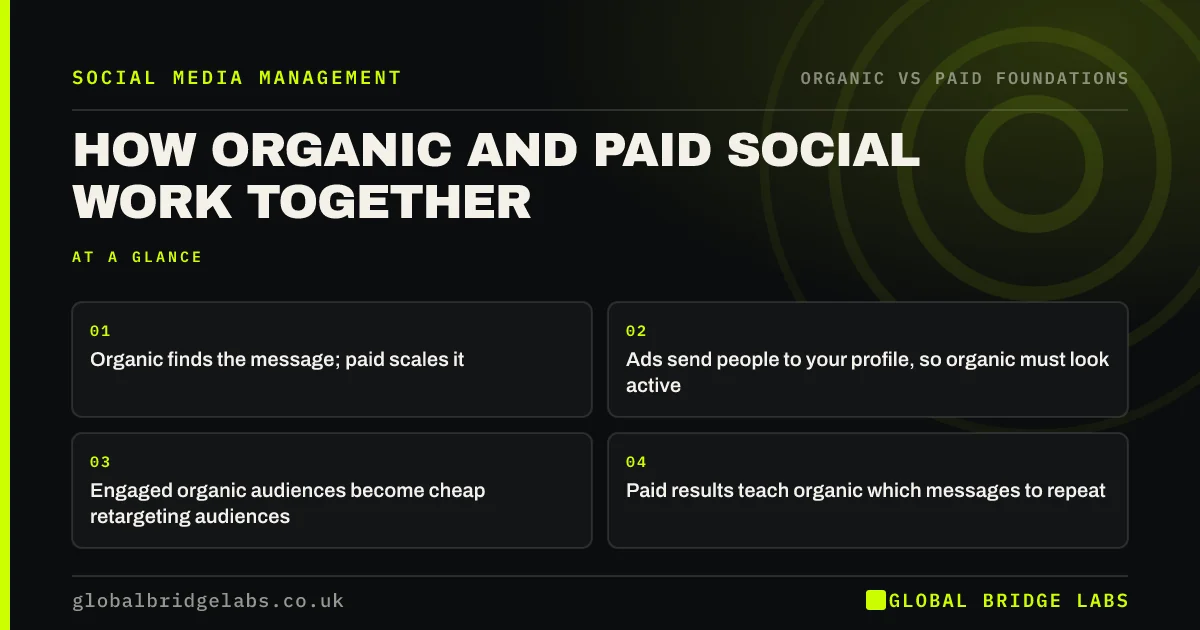
Organic and paid social work together when each does a separate job. Organic posts find and prove the message, build a credible profile and keep past customers close. Paid ads take proven content to new people and retarget those who engaged. Together they usually cost less per result than either alone.
- Organic finds the message; paid scales it.
- Ads send people to your profile, so organic must look active.
- Engaged organic audiences become cheap retargeting audiences.
- Paid results teach organic which messages to repeat.
Want a plan that joins up your organic and paid social? Message us on WhatsApp.
Chat on WhatsApp →How do organic and paid social support each other?
Organic content supplies tested messages and a credible profile; paid supplies reach. When someone sees an ad, many check the business profile before acting. An active profile with real work and reviews helps them act. In return, ads bring new people who may follow and engage with future organic posts.
What should organic do in a combined plan?
In a combined plan, organic should test topics and formats, show proof and personality, answer questions, and keep the profile active. Its job is not maximum reach; it is credibility and learning. Posts that perform best organically become candidates for paid.
- Test new messages and formats weekly.
- Show proof: reviews, results, behind the scenes.
- Answer common questions buyers ask.
- Keep past customers engaged for repeat work.
What should paid do in a combined plan?
Paid should do the jobs organic cannot: reach new people at a set pace, support time-bound offers, and retarget people who engaged with organic posts or visited your site. Meta's engagement custom audiences let you show ads to people who interacted with your page, often at lower cost than cold audiences.
Want your organic and paid social planned as one? Send us your current set-up on WhatsApp.
Chat on WhatsApp →How should budget and time be split?
Split by job, not by formula. While you are still finding what works, most effort and money should go into content. Once several posts reliably bring enquiries, a larger share can move to ad spend. The IPA's long and short-term research supports keeping brand building running alongside activation.
What goes wrong when they are run separately?
Run separately, organic and paid often send mixed messages, compete for credit and waste budget. A paid team may run ads that contradict organic posts, or organic may ignore what ads have proved. One plan, one message and one report avoid this.
What does this look like in practice?
A pattern we see: an online homeware shop ran ads through one freelancer and organic through a staff member, with no contact between them. Joining them up, with ads built only from the best organic posts and retargeting to people who engaged, lowered cost per sale noticeably within two months.
Combined plan checklist
- Agree one message for the quarter across both.
- Give organic the job of testing and proof.
- Give paid the job of reach and retargeting.
- Build ads from the best organic posts.
- Retarget organic engagers.
- Report both in one monthly review.
Next step
Map your current organic posts and ads side by side for the last month. Where they say different things or ignore each other's results, agree one message and one owner for next month.
Message us on WhatsApp for a joined-up organic and paid plan, or book a 30-minute consultation.
Chat on WhatsApp →Sources and further reading
Frequently asked questions
Should organic and paid social have the same content?
They should share the same message, but not always the same posts. Organic can carry a wider range of content, from behind the scenes to answers to questions. Paid should use the posts that performed best, adapted with a clear call to action. Consistency of message matters more than identical posts.
Does running ads help organic posts?
Indirectly, yes. Ads can bring new followers and profile visitors who then see future organic posts. Platforms do not say ads boost organic ranking directly, so do not expect that. The main benefit is that more people know your business, which helps organic content perform better over time.
Who should manage organic and paid social?
Ideally one person or team owns both plans, even if different specialists do the work. That keeps the message consistent and makes it easier to see which content works. If you use separate providers, set up a monthly joint review so both see the same results.
Written by

Global Bridge Labs (GBL) is a UK–Sri Lanka partner for social media, websites and BPO. Everything here comes from client delivery, not theory.