On this page
- 01Key takeaways
- 02What counts as a social media marketing mistake?
- 03Why do small businesses keep making the same mistakes?
- 04What are the most common social media marketing mistakes?
- 05Which strategy mistakes waste the most effort?
- 06Which profile mistakes lose enquiries?
- 07Which posting mistakes make content invisible?
- 08Which engagement mistakes damage trust?
- 09Which paid social mistakes waste budget?
- 10Which measurement mistakes hide what is working?
- 11Which social media mistakes break UK rules?
- 12Which resourcing mistakes keep the problems coming back?
- 13What do social media mistakes cost a small business?
- 14When is a social media mistake not worth fixing?
- 15How do you score your own social media for mistakes?
- 16What does this look like in practice?
- 17Which mistakes are specific to your sector?
- 18How does this guide relate to our other mistakes guides?
- 19More guides on social media mistakes
- 20Your social media mistakes checklist
- 21Next step
- 22Sources and further reading
- 23Frequently asked questions
Key takeaways
The most common social media marketing mistakes small businesses make are posting without a goal, trying to reach everyone, leaving the profile with no clear next step, ignoring comments and messages, and judging results on likes. None of them is about the algorithm. Most cost time rather than money, and most can be fixed within 90 days.
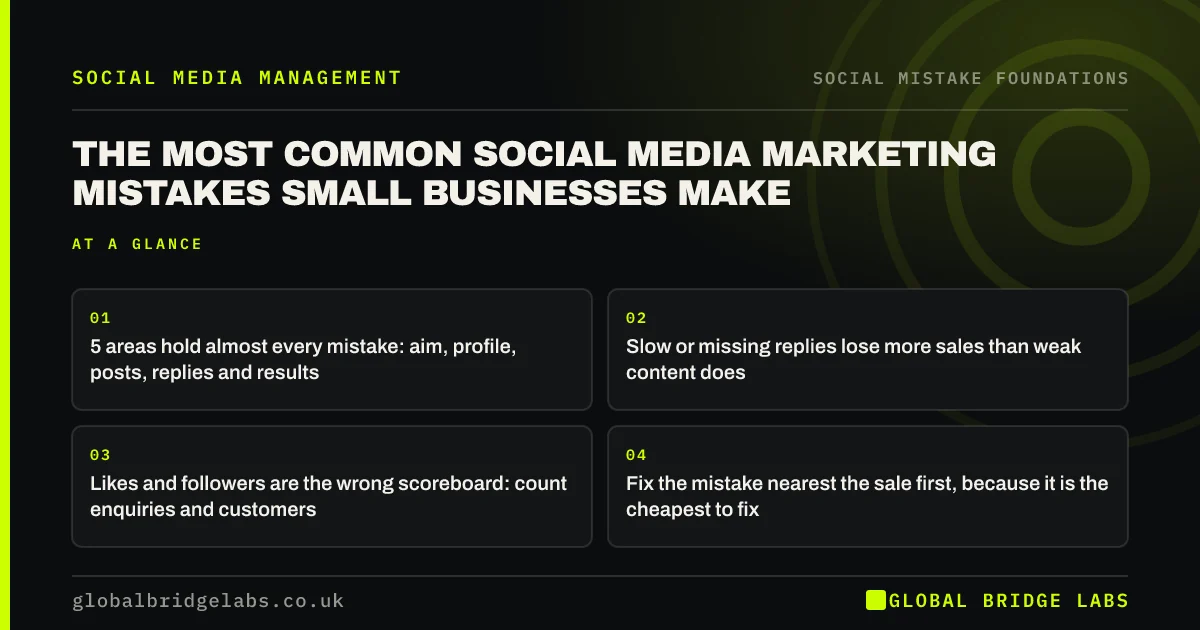
- 5 areas hold almost every mistake: aim, profile, posts, replies and results.
- Slow or missing replies lose more sales than weak content does.
- Likes and followers are the wrong scoreboard: count enquiries and customers.
- Fix the mistake nearest the sale first, because it is the cheapest to fix.
- Score your accounts out of 10 and fix the lowest area before posting more.
Want to know which mistakes your accounts are making? Message us on WhatsApp with your handle and what you sell.
Chat on WhatsApp →What counts as a social media marketing mistake?
A social media marketing mistake is any habit, set-up choice or decision that makes a business's social media cost more time or money than it returns in enquiries, sales or trust. A typo is rarely a mistake in this sense. Posting for a year with no way for buyers to get in touch is.
This guide is written by Global Bridge Labs (GBL), a UK–Sri Lanka delivery partner, for owners, managing directors and marketing leads at UK small and medium-sized enterprises (SMEs) who run their own social media, or pay someone to, and suspect it is not working as hard as it should.
Why do small businesses keep making the same mistakes?
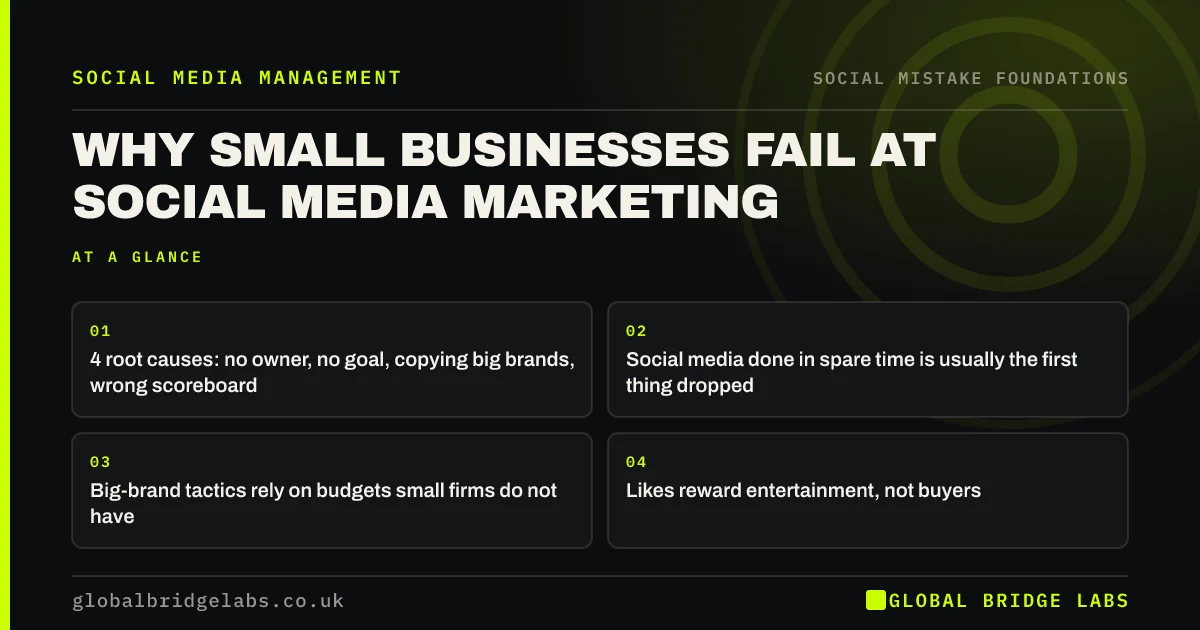
Small businesses repeat the same social media mistakes because social media is usually nobody's main job. It is done in gaps between other work, copied from large brands with different goals, and judged by numbers the platforms put in front of you rather than by sales. The Department for Business and Trade counted 5.7 million private sector businesses in the UK in 2025, and the vast majority employ fewer than ten people, so the owner is often the marketer too.
Reach is rarely the problem. Ofcom's 2026 research found that 89% of adult internet users use at least one social media platform. The audience is there; the mistakes happen in what a business says to it and what happens after someone shows interest.
What are the most common social media marketing mistakes?
The twelve mistakes below account for most of the wasted effort we see on small business accounts. They are grouped by the five areas of the GBL Social Media Mistake Scorecard, so you can see which part of your social media each one damages.
- 1. Aim: posting without a goal anyone could measure.
- 2. Aim: writing for everyone instead of one type of buyer.
- 3. Aim: being on the platform you like rather than the one your buyers use.
- 4. Profile: a bio that does not say what you do, where, or how to get in touch.
- 5. Profile: a link in bio that goes to the home page or nowhere.
- 6. Posts: selling in every post, or never asking for anything.
- 7. Posts: copying the same post across every platform unchanged.
- 8. Replies: ignoring comments, or deleting the critical ones.
- 9. Replies: answering messages the next evening, if at all.
- 10. Results: counting likes and followers instead of enquiries.
- 11. Rules: unlabelled ads, borrowed music and photos used without consent.
- 12. Resourcing: handing social media to whoever has a spare hour.
Which strategy mistakes waste the most effort?
The strategy mistakes that waste the most effort are posting without a goal, trying to reach everyone and choosing the wrong platform. Each one means every later post, however good, is aimed at the wrong target. A business that fixes these three usually posts less and gets more enquiries.
A goal does not need to be complicated. 'Ten quote requests a month from homeowners within 15 miles' is a goal. 'Raise awareness' is not, because nobody can tell whether it happened.
Which profile mistakes lose enquiries?
The profile mistakes that lose the most enquiries are a bio that does not say what the business does and where, a link that goes to a generic home page, and no visible way to message or book. People who reach your profile are interested. If they cannot see what to do next within a few seconds, most leave.
Account access is the profile mistake with the biggest downside. If the only admin is a former employee or an agency, a business can lose its page entirely.
Which posting mistakes make content invisible?
The posting mistakes that make content invisible are selling in every post, copying one post across every platform, and publishing without a hook or a reason to stop scrolling. Platforms show posts to more people when early viewers watch, save, share or reply. Content that gives viewers nothing to do gets shown to fewer people each time.
Posting more does not fix this. Two useful posts a week usually beat seven filler posts, because filler trains your audience to scroll past.
Which engagement mistakes damage trust?
The engagement mistakes that damage trust are ignoring comments, deleting fair criticism, arguing in public and replying to messages a day or more later. Every reply is public proof of how you treat customers. A visible, calm answer to a complaint often wins more business than the complaint loses.
Shortcuts make it worse. Bought followers, engagement pods and 'comment YES' posts inflate numbers without adding a single buyer, and platforms actively demote them.
Which paid social mistakes waste budget?
The paid social mistakes that waste the most budget are boosting posts without a clear objective, targeting too broadly or too narrowly, sending clicks to the home page and switching ads off before the platform has learned who to show them to. Each one means paying for attention that cannot turn into an enquiry.
Tracking is the quiet one. Ads run without a working pixel or tagged links cannot show which ones produce customers, so budgets drift to whichever ad gets the most likes.
Which measurement mistakes hide what is working?
The measurement mistakes that hide what is working are counting likes instead of enquiries, never tagging links, and relying on last-click reports that give social media no credit for sales it started. A business that cannot see which posts bring customers keeps making more of the posts that do not.
Four numbers are enough for most small firms: profile or link clicks, enquiries, customers and revenue from social media. Ask every new customer how they found you, because many social journeys never show in analytics.
Which social media mistakes break UK rules?
The social media mistakes that break UK rules are unlabelled paid or gifted posts, prize draws without clear terms, fake or edited reviews, photos of customers posted without consent and music or images used without a licence. The Advertising Standards Authority (ASA) expects ads to be obviously identifiable, and the Digital Markets, Competition and Consumers Act 2024 bans fake reviews and lets the Competition and Markets Authority (CMA) fine firms directly.
Most breaches are accidental. A short written policy and one person who checks posts before they go out prevent nearly all of them.
Which resourcing mistakes keep the problems coming back?
The resourcing mistakes that keep problems coming back are giving social media to whoever has a spare hour, hiring an agency or freelancer on price alone, briefing them badly and then either micromanaging or disappearing. Mistakes repeat when nobody owns the account and nobody is measured on enquiries.
The fix is ownership before headcount: one named person responsible for posting and replies, a one-page brief, and a monthly review against the goal. That person can be in-house or outsourced.
What do social media mistakes cost a small business?
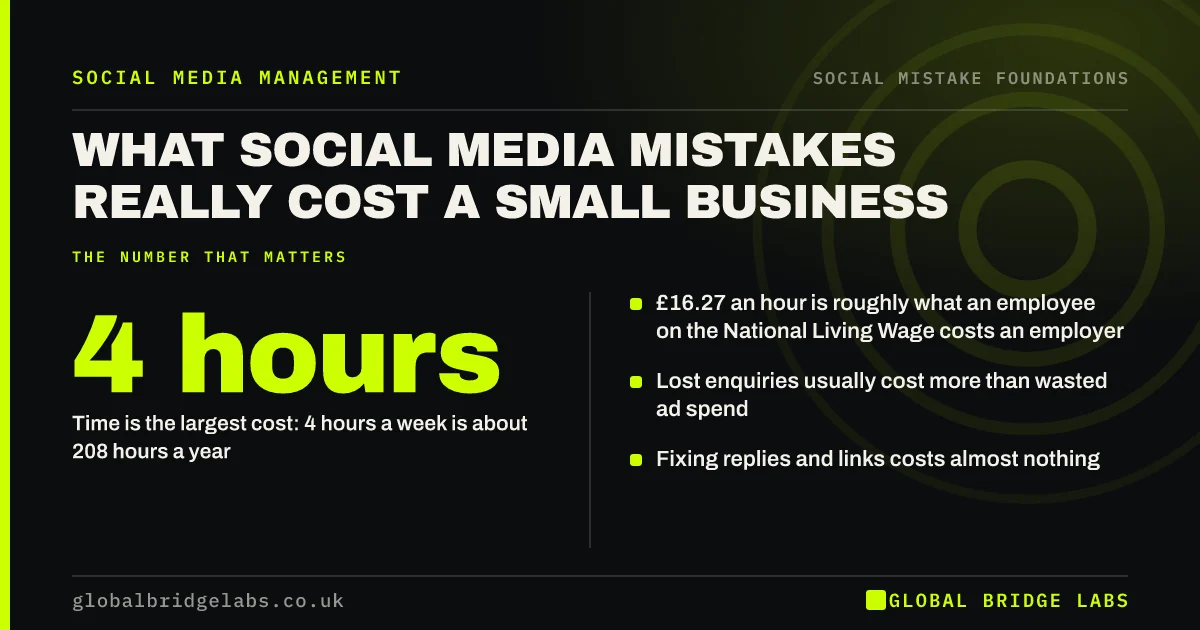
Social media mistakes cost a small business mainly in wasted time, then in wasted ad spend and lost enquiries. Here is an illustrative sum. An owner spends 4 hours a week on social media, about 208 hours a year. At the April 2026 National Living Wage of £12.71, an employee hour costs an employer about £16.27 once National Insurance, pension and holiday are added, so that is about £3,380 a year; valued at £50 an hour of owner time it is about £10,400. Add £200 a month of boosted posts and the annual cost is roughly £5,800 to £12,800. If fixable mistakes mean it produces few enquiries, most of that is lost.
As indicative UK market ranges, most SMEs using an agency for managed social media pay £950–£2,500 a month, starter packages run £500–£950, and paid social tests usually need £300–£500 a month in ad spend. Global Bridge Labs (GBL) does not publish a rate card; we scope each piece of work to the requirement.
- What social media mistakes really cost a small business
- Social media agency pricing in the UK: what SMEs pay
- Social media budget mistakes small businesses make
Want a costed plan to stop paying for mistakes? Message us on WhatsApp and we will discuss your requirements.
Chat on WhatsApp →When is a social media mistake not worth fixing?
A social media mistake is not worth fixing when the channel it sits on does not matter to your sales. If almost all your work comes from referrals, repeat customers or search, a perfect Instagram grid will not change much. Fix the mistakes that touch buyers, such as an unanswered message or a broken contact link, and leave cosmetic ones.
Some 'mistakes' are also choices. Posting once a week is not a mistake if that is what you can sustain. Not being on TikTok is not a mistake if your buyers are procurement managers. A good audit separates faults from deliberate trade-offs.
How do you score your own social media for mistakes?
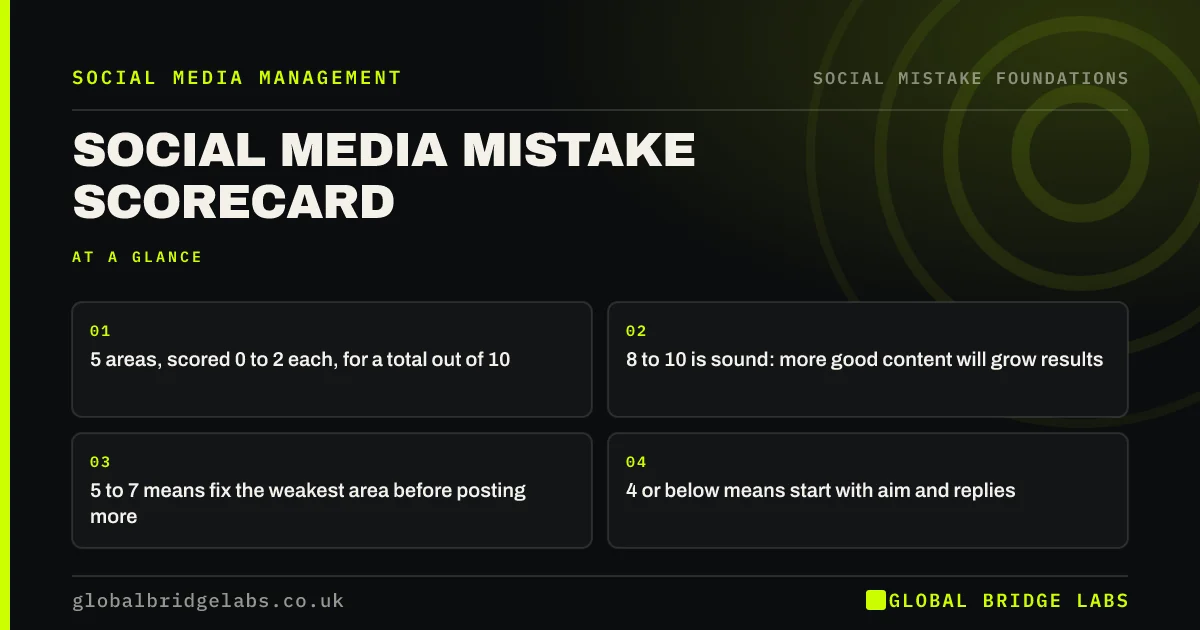
Score it with the GBL Social Media Mistake Scorecard: five areas, each scored 0, 1 or 2, where 2 means the area works well. Aim: is there one goal, one buyer and the right platform? Profile: can a new visitor see what you do and how to get in touch within five seconds? Posts: do posts give buyers a reason to stop and a next step? Replies: are comments and messages answered within the working day? Results: do you know how many enquiries social media produced last month?
A total of 8 to 10 means your social media is sound and more good content will grow it. A total of 5 to 7 means fix the weakest area before adding anything. A total of 4 or below means start with aim and replies, because they decide whether anything else can work.
What does this look like in practice?
A pattern we see often with UK service businesses: three platforms, posts most weeks, a reasonable following, and almost no enquiries. On inspection the bio does not mention the area served, the link goes to the home page, half the comments are unanswered and the only number reviewed is follower count. The owner's plan is to start posting video.
The changes that move enquiries are usually smaller: drop to the one platform buyers use, rewrite the bio, link to a page about one offer, answer every comment and message the same working day, and count enquiries monthly. Across our client work, the average reach lift in the first 90 days is +184%, qualified leads rise by an average of +62% a month, and the first measurable result usually arrives within 3 to 4 weeks. Treat those as context for what is possible, not a promise for any single business.
Which mistakes are specific to your sector?
Each sector has its own version of these mistakes. Trades firms hide finished work, restaurants post food with no booking link, clinics break advertising rules on treatments, and B2B firms post company news nobody asked for. Start with the sector guide closest to your business.
- Social media mistakes tradespeople make
- Restaurant social media mistakes that lose bookings
- E-commerce social media mistakes that cost sales
- Social media mistakes professional services firms make
- Clinic social media mistakes: rules and trust
- Logistics social media mistakes that lose contracts
- B2B social media mistakes that cost UK firms leads
How does this guide relate to our other mistakes guides?
This guide is the hub for social media marketing mistakes as a whole. Four existing Global Bridge Labs (GBL) guides go deeper on one layer each: strategy, content that attracts the wrong people, converting followers into customers, and advertising across all media. Use them once you know which layer scored lowest.
More guides on social media mistakes
Every guide in this 100-article series from Global Bridge Labs (GBL) covers one mistake or one group of mistakes, what it costs and how to fix it.
- Social media mistake scorecard: check your accounts in 30 minutes
- What social media mistakes really cost a small business
- Why small businesses fail at social media marketing
- Social media mistakes by platform, from Facebook to TikTok
- Social media mistakes examples: what they look like
- B2B social media mistakes that cost UK firms leads
- Social media mistakes new businesses make in year one
- Which social media mistakes should you fix first?
- Outdated social media tactics small businesses still use
- Posting without a goal: the mistake behind wasted effort
- Trying to reach everyone on social media
- Being on the wrong social media platform for your buyers
- Posting on the fly: the cost of having no social media plan
- Giving up on social media too soon
- Social media budget mistakes small businesses make
- An inconsistent brand voice on social media
- Social media disconnected from sales: the silo mistake
- Seasonal social media mistakes: peaks and quiet months
- Local business social media mistakes that lose nearby buyers
- Business social media profile mistakes that lose enquiries
- Running your business from a personal profile
- Instagram bio mistakes that stop people enquiring
- Social media account access mistakes: who holds the keys?
- Social media security mistakes that get accounts hacked
- Duplicate business pages: merge, close or keep?
- Inconsistent business details across social profiles
- Link in bio mistakes that waste profile visits
- Facebook business page mistakes small firms make
- LinkedIn company page mistakes B2B firms make
- Selling in every post: the too-promotional mistake
- Posting too often: when more posts bring fewer results
- Posting the same thing on every platform
- Hashtag mistakes that make business posts look spammy
- Social media caption mistakes that lose readers
- Social media video mistakes small businesses make
- Poor-quality images on social media: what they cost you
- Typos and tone slips on business social media
- Mistakes businesses make with AI-written social posts
- Posts with no call to action: interest with nowhere to go
- Ignoring comments on social media: why silence costs
- Deleting negative comments: why it usually backfires
- Arguing with customers online: the reply you regret
- Broadcasting without engaging on social media
- Engagement bait: why 'comment YES' posts get demoted
- Engagement pods: why swapping likes does not help
- Fake followers on a business account: why buying backfires
- The follow-unfollow tactic: why it hurts a business
- Cold DM mistakes: outreach that reads as spam
- Spam and scam comments on your page: moderation mistakes
- Paid social mistakes that waste small business budgets
- Boosted post mistakes: why boosting often wastes money
- Facebook ads targeting mistakes small businesses make
- Social media ad creative mistakes that lower results
- Social ads that land on the wrong page
- Switching ads off too soon: the learning phase mistake
- Meta pixel mistakes: tracking ads without breaking the law
- LinkedIn ads mistakes that burn B2B budgets
- TikTok ads mistakes small businesses make
- Ad account set-up mistakes in Meta Business Manager
- Social media measurement mistakes that hide what works
- Social media reporting mistakes: reports that prove nothing
- Not knowing which enquiries came from social media
- UTM tracking mistakes that scramble your social data
- Misreading engagement rate: when the number misleads
- Social media benchmark mistakes: comparing the wrong things
- Judging a social post in its first hour
- Never opening your social media insights
- Social media attribution mistakes: why last click undersells
- Social media ROI mistakes: getting the sum wrong
- Social media legal mistakes UK businesses make
- Not labelling ads on social media: the ASA mistake
- Using popular music on business social media
- Using other people's photos on business social media
- Social media giveaway mistakes that break the rules
- GDPR mistakes on social media small firms make
- Posting customer photos without consent
- Fake or edited testimonials on social media: the law
- Employee social media mistakes that affect your business
- Social media crisis mistakes that make things worse
- Doing your own social media: the mistakes owners make
- Handing social media to the intern or junior
- Mistakes to avoid when hiring a social media agency
- Mistakes when hiring a social media freelancer
- A bad social media brief: why work misses the mark
- Micromanaging your social media agency
- Social media approval mistakes that stall posting
- Social media agency onboarding mistakes clients make
- Switching social media agency: mistakes to avoid
- Social media tools mistakes: buying software first
- Social media mistakes tradespeople make
- Restaurant social media mistakes that lose bookings
- E-commerce social media mistakes that cost sales
- Social media mistakes professional services firms make
- Clinic social media mistakes: rules and trust
- Logistics social media mistakes that lose contracts
- Salon social media mistakes that empty the diary
- Posted something by mistake? What a business should do
- A 90-day plan to fix your social media mistakes
- Social media mistakes checklist: 20 checks
Your social media mistakes checklist
- Write one goal you could measure next month.
- Name one type of buyer and the platform they use most.
- Rewrite your bio to say what you do, where and how to get in touch.
- Point your link at a page about one offer, not the home page.
- Give every post a reason to stop and a next step.
- Answer every comment and message within the working day.
- Stop boosting posts without an objective and a tracked link.
- Label any paid or gifted content as an ad.
- Count enquiries and customers from social media each month.
- Score yourself on the GBL Social Media Mistake Scorecard every quarter.
Next step
Open your main business profile on your phone as if you were a customer. Note what you do, where you are and how to get in touch. If any of the three takes more than five seconds to find, that is your first fix.
Message us on WhatsApp with your handle and we will score it on the GBL Social Media Mistake Scorecard, or book a 30-minute consultation.
Chat on WhatsApp →Sources and further reading
- Adults' media use and attitudes · Ofcom
- Business population estimates for the UK and regions 2025 · Department for Business and Trade
- Recognising ads: social media and influencer marketing · ASA / CAP
- Digital Markets, Competition and Consumers Act 2024 · legislation.gov.uk
- Publishing consumer reviews and complying with consumer protection law · Competition and Markets Authority
- National Minimum Wage and National Living Wage rates · GOV.UK
- Electronic and telephone marketing under PECR · Information Commissioner's Office
Frequently asked questions
What is the biggest social media mistake small businesses make?
Posting without a measurable goal is the biggest, because every other choice depends on it. Without a goal, a business cannot choose a platform, a buyer, an offer or a way to measure success, so it posts by habit. The most expensive single symptom is usually slow or missing replies to people who were ready to buy.
Why is my social media marketing not getting results?
Usually because of one of five things: no clear goal or buyer, a profile with no obvious next step, posts that give people no reason to act, slow replies, or measuring likes instead of enquiries. Score each area from 0 to 2 and fix the lowest first. Posting more rarely helps on its own.
How do I know if my social media is making mistakes?
Look at your own profile on a phone, read your last ten posts and check your messages. If a stranger cannot tell what you do and how to contact you, if posts have no next step, or if messages wait more than a day, you have found mistakes. The GBL Social Media Mistake Scorecard turns this into a 30-minute check.
How many times a week should a small business post?
As often as you can keep up with useful posts and same-day replies, which for most small UK businesses is two to four times a week on one main platform. Consistency and quality matter more than volume. Posting daily while ignoring comments is a worse mistake than posting twice a week and answering everyone.
Is it worth paying someone to fix social media mistakes?
It is worth it when social media is a real route to customers for you and nobody in the business has the time to own it. Indicative UK agency fees run from about £500 a month for starter packages to £950–£2,500 for most managed SME accounts. If social media barely affects your sales, fix the few buyer-facing mistakes yourself.
How long does it take to fix social media mistakes?
Profile, link and reply fixes take days and often show more enquiries within a few weeks. Strategy and content changes take two to three months to show in results, because the audience and the algorithm need time to respond. A 90-day plan with a monthly review is a realistic frame for most small businesses.
Written by

Global Bridge Labs (GBL) is a UK–Sri Lanka partner for social media, websites and BPO. Everything here comes from client delivery, not theory.