On this page
- 01Key takeaways
- 02Why do so many reports prove nothing?
- 03What should a social media report include?
- 04What if your agency's report is all vanity metrics?
- 05Are reach and engagement worth reporting at all?
- 06How do you spot a report that proves nothing?
- 07What does this look like in practice?
- 08Report checklist
- 09Next step
- 10Sources and further reading
- 11Frequently asked questions
Key takeaways
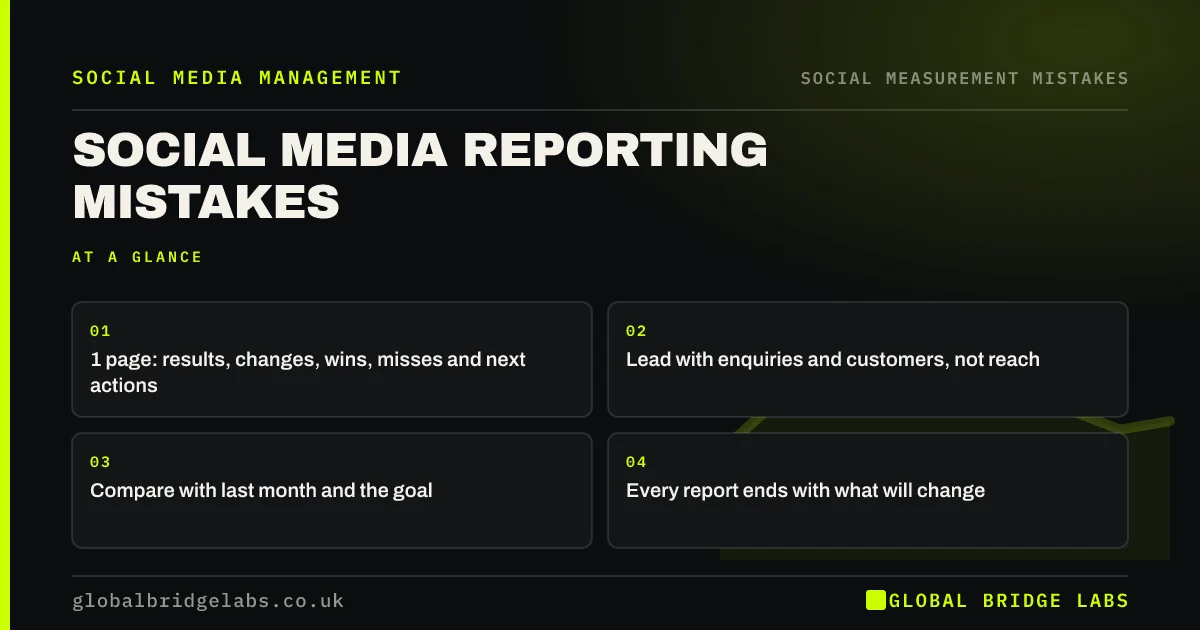
Social media reporting mistakes produce reports that prove nothing: pages of reach and engagement charts, no enquiries, no comparison with last month and no actions. A useful report fits on one page: results against the goal, what changed, what worked, what did not and what happens next month.
- 1 page: results, changes, wins, misses and next actions.
- Lead with enquiries and customers, not reach.
- Compare with last month and the goal.
- Every report ends with what will change.
Want a one-page report template? Message us on WhatsApp.
Chat on WhatsApp →Why do so many reports prove nothing?
Many reports prove nothing because they are exports of platform insights, which report what the platform measures rather than what the business needs. Reach went up and engagement went down, but did anyone enquire? Reports become evidence of activity rather than results.
What should a social media report include?
A useful report includes five parts, in this order, and fits on one page.
- 1. Results: enquiries, customers and revenue against the goal.
- 2. Signals: clicks, profile visits and reach trends.
- 3. What worked: the best posts or ads and why.
- 4. What did not: the weakest and what we learned.
- 5. Next month: specific changes.
Want reports that answer 'is it working?' Message us on WhatsApp and we will discuss your requirements.
Chat on WhatsApp →What if your agency's report is all vanity metrics?
Ask for enquiries and customers to be added at the top, and agree how they will be counted: tagged links, form submissions, message logs and your own sales records. A good agency welcomes this. One that resists may be measuring what flatters the work.
Are reach and engagement worth reporting at all?
Yes, as context. They show whether content is being seen and whether people respond, which helps explain changes in enquiries. The mistake is reporting them instead of results, not alongside them.
How do you spot a report that proves nothing?
Spot it by reading the first page and asking: did social media bring enquiries or customers this month, and what will change next month? If the report cannot answer either question, it reports activity rather than results, however many charts it contains.
- No enquiry or customer line.
- No comparison with last month.
- No link to the goal.
- No actions for next month.
What does this look like in practice?
A pattern we see: a 20-page monthly report the owner stops opening by month three. Cutting it to one page with enquiries at the top, three insights and three actions makes the monthly review a ten-minute conversation that changes what happens next.
Report checklist
- Fit it on one page.
- Start with enquiries and customers.
- Compare with last month and the goal.
- Name what worked and what did not.
- End with next month's changes.
Next step
Look at your last social media report. If it does not say how many enquiries came in, ask for that line first.
Message us on WhatsApp for a template, or book a 30-minute consultation.
Chat on WhatsApp →Sources and further reading
- About key events · Google Analytics Help
- URL builders: collect campaign data with custom URLs · Google Analytics Help
- Engagement rate and bounce rate · Google Analytics Help
Frequently asked questions
What should be in a monthly social media report?
Enquiries, customers and revenue against the goal, a few supporting signals such as clicks and reach, what worked, what did not and what will change next month. One page is enough for most small businesses.
How do I know if my social media agency is working?
Ask for enquiries and customers in every report, agree how they are counted, and compare against the goal set at the start. Reach and engagement alone do not show whether the work is paying back.
Are engagement metrics useless?
No. They help explain why results change. They are a mistake only when reported instead of enquiries and customers rather than alongside them.
Written by

Global Bridge Labs (GBL) is a UK–Sri Lanka partner for social media, websites and BPO. Everything here comes from client delivery, not theory.