On this page
- 01Key takeaways
- 02What is social media ROI?
- 03Which costs do businesses leave out?
- 04Why is revenue the wrong number?
- 05Should repeat customers count?
- 06When is ROI the wrong measure?
- 07How do you check your ROI sum?
- 08What does this look like in practice?
- 09ROI checklist
- 10Next step
- 11Sources and further reading
- 12Frequently asked questions
Key takeaways
The common social media ROI mistakes are leaving staff and owner time out of the cost, counting revenue instead of profit, ignoring repeat customers and judging after a month. Return on investment (ROI) is profit from social media customers minus the full cost, divided by that cost. Get both halves right before deciding.
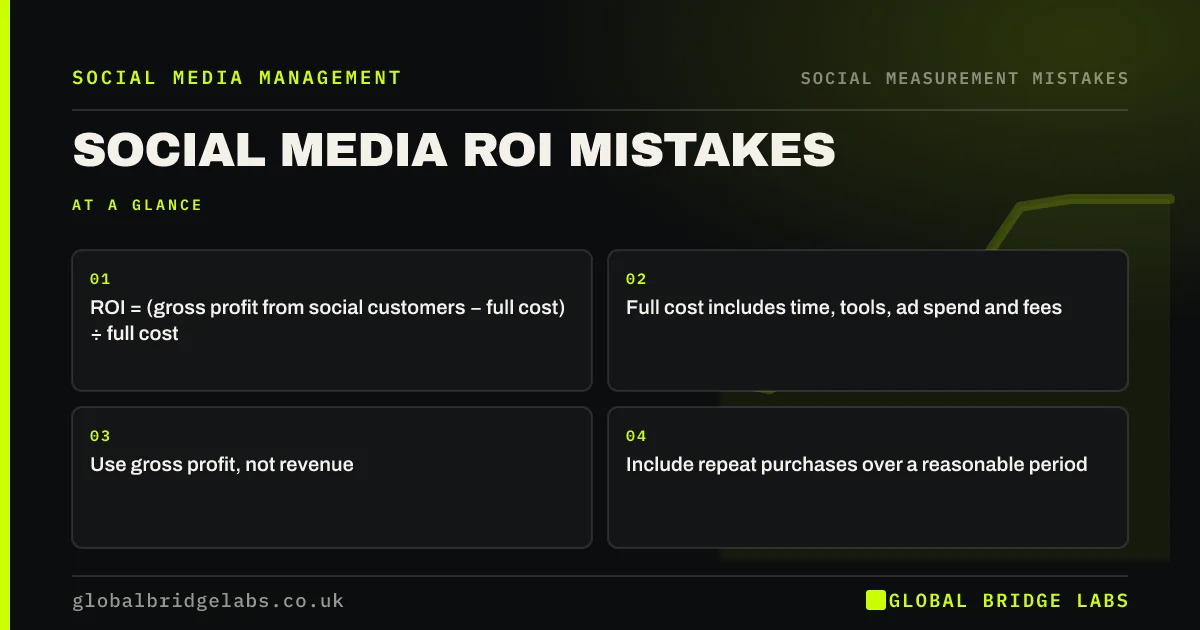
- ROI = (gross profit from social customers − full cost) ÷ full cost.
- Full cost includes time, tools, ad spend and fees.
- Use gross profit, not revenue.
- Include repeat purchases over a reasonable period.
Want your social media ROI worked out? Message us on WhatsApp.
Chat on WhatsApp →What is social media ROI?
Social media ROI is the profit a business makes from customers won through social media, after subtracting the full cost of the social media activity, expressed as a ratio or percentage of that cost. A positive ROI means social media earned back more than it cost.
Which costs do businesses leave out?
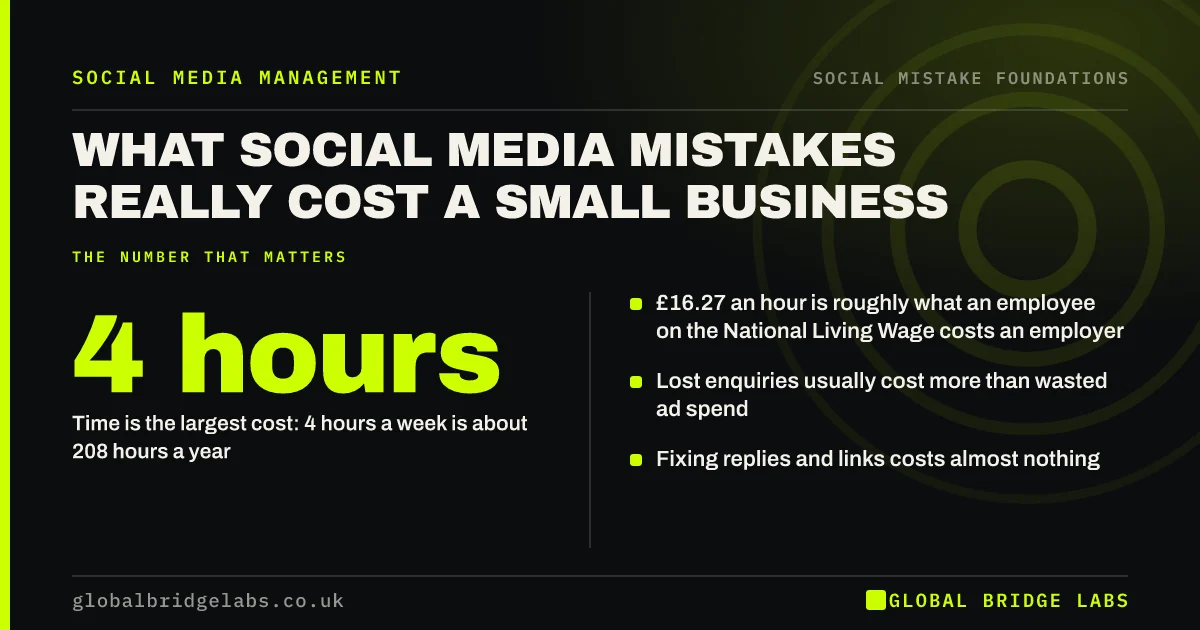
Businesses often leave out time, which is usually the biggest cost. Four hours a week at about £16.27 an hour, the approximate employer cost of an employee on the April 2026 National Living Wage, is about £3,380 a year. Add tools, ad spend, agency fees and content costs such as photography.
Why is revenue the wrong number?
Revenue is the wrong number because it ignores what it cost to deliver the sale. £10,000 of revenue at a 30% gross margin is £3,000 of profit. As an illustration: £3,000 of profit from social customers against £2,000 of full cost gives an ROI of 50%, not the 400% a revenue sum would suggest.
Want a costed ROI view for your business? Message us on WhatsApp and we will discuss your requirements.
Chat on WhatsApp →Should repeat customers count?
Yes, over a sensible period such as 12 months, because social media often wins customers who come back. Ignoring repeat value undersells social for businesses such as salons, restaurants and retailers. Be consistent about the period you use.
When is ROI the wrong measure?
ROI is a poor measure in the first months, when audiences are still building, and for brand activity whose effect shows over longer periods. Use leading indicators early and judge ROI over at least a quarter.
How do you check your ROI sum?
Check it by listing every cost line and every revenue assumption. Ask whether hours are included, whether profit or revenue was used, which customers were counted and over what period. A sum that leaves out hours or uses revenue will look far better than the reality.
- Hours missing from costs.
- Revenue used instead of profit.
- Repeat purchases ignored.
- Results judged after one month.
What does this look like in practice?
A pattern we see: an ROI figure that looks excellent because it uses revenue and leaves out the owner's ten hours a week. Recalculating with profit and full cost gives a less flattering but more useful number, and shows where time can be cut.
ROI checklist
- Include time, tools, ads and fees.
- Use gross profit, not revenue.
- Count repeat purchases over 12 months.
- Judge over at least a quarter.
- Use consistent tracking.
Next step
Work out last quarter's full social media cost, including hours. Then estimate profit from customers who came through social.
Message us on WhatsApp for help, or book a 30-minute consultation.
Chat on WhatsApp →Sources and further reading
- National Minimum Wage and National Living Wage rates · GOV.UK
- About key events · Google Analytics Help
- The Long and the Short of It: balancing short and long-term marketing strategies · IPA
Frequently asked questions
How do I calculate social media ROI?
Subtract the full cost of social media (time, tools, ad spend, fees) from the gross profit made from customers it brought in, then divide by the full cost. Use a consistent period and tracking method.
What is a good social media ROI?
Any consistently positive ROI after full costs is a good start, and it should compare well with your other channels. Expect lower figures in the first months while the audience builds.
Should I include my own time in social media ROI?
Yes. Owner time is often the largest cost, even if no money changes hands. Value it at what an hour of your time is worth to the business.
Written by

Global Bridge Labs (GBL) is a UK–Sri Lanka partner for social media, websites and BPO. Everything here comes from client delivery, not theory.