On this page
- 01Key takeaways
- 02Why is the first hour misleading?
- 03Should you delete posts that do badly?
- 04When should you review posts?
- 05Is checking early ever useful?
- 06How do you spot that you judge too early?
- 07What does this look like in practice?
- 08Review checklist
- 09Next step
- 10Sources and further reading
- 11Frequently asked questions
Key takeaways
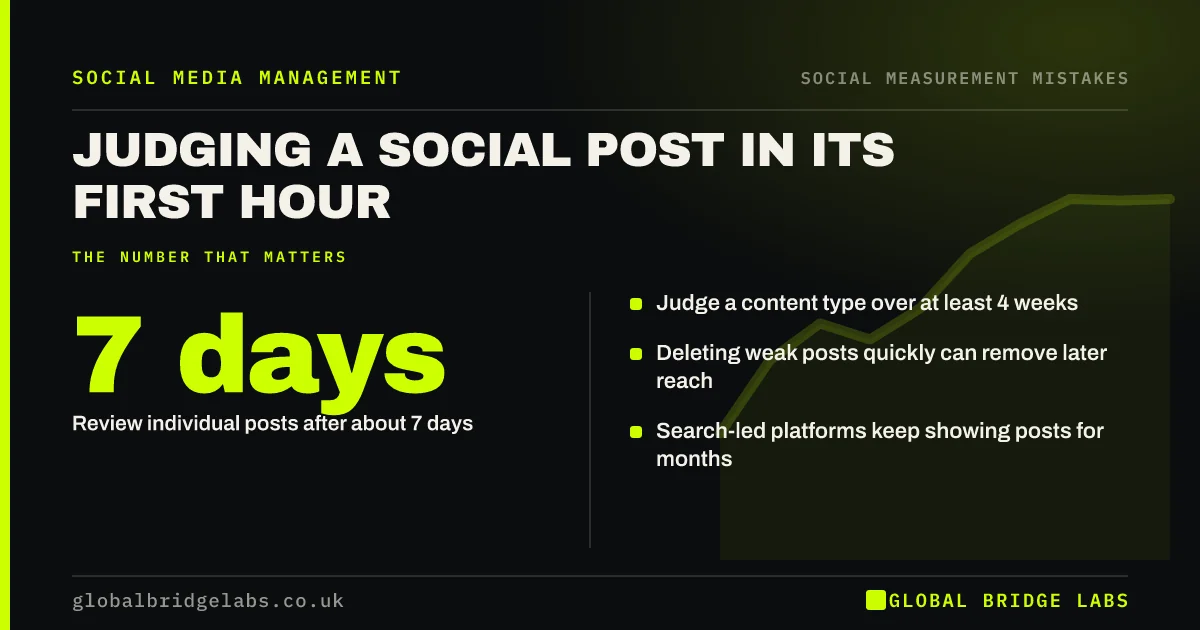
Judging social media post performance in the first hour leads to bad decisions, such as deleting posts that would have done well. Posts keep being shown for days on most platforms, and YouTube and Pinterest content can keep working for months. Review posts after about a week and judge content types over a month.
- Review individual posts after about 7 days.
- Judge a content type over at least 4 weeks.
- Deleting weak posts quickly can remove later reach.
- Search-led platforms keep showing posts for months.
Want a review routine that suits your platforms? Message us on WhatsApp.
Chat on WhatsApp →Why is the first hour misleading?
The first hour is misleading because platforms often test a post with a small group first, then widen distribution if people respond. Timing, the day of the week and what else is in the feed all affect early numbers. A slow first hour says little about the final result.
Should you delete posts that do badly?
Usually not. Deleting removes any later reach, any comments that would have come and the record of what did not work. Delete only posts with errors or that cause harm. Learn from weak posts instead.
When should you review posts?
Review posts once a week for the previous week, and content types once a month. On Instagram, Facebook, LinkedIn and TikTok, most reach comes in the first few days. On YouTube and Pinterest, search can bring views for months, so review those quarterly.
Want a monthly review done with you? Message us on WhatsApp and we will discuss your requirements.
Chat on WhatsApp →Is checking early ever useful?
Checking early is useful for replying to comments, which helps the post, and for spotting errors. It is not useful for deciding whether a post worked. Separate the two jobs: reply in the first hour, judge after a week.
How do you spot that you judge too early?
You judge too early if you check insights within the first hour or two, delete posts that start slowly or change your plan based on a single day. Another sign is posts that seem to flop but later bring saves or messages. Compare day-one and day-seven figures for a few posts to see the gap.
- Checking insights in the first hour.
- Deleting slow-starting posts.
- Plans changed on one day's numbers.
- Messages arriving days after posting.
What does this look like in practice?
A pattern we see: an owner who refreshes insights after every post and deletes anything under a certain number of likes. Some of the deleted posts were the ones getting saves and messages a few days later. A weekly review stops the cycle.
Review checklist
- Reply in the first hour.
- Review posts after a week.
- Judge content types monthly.
- Review search-led platforms quarterly.
- Delete only errors and harmful posts.
Next step
Turn off insight notifications and set one weekly review slot in your diary.
Message us on WhatsApp for help, or book a 30-minute consultation.
Chat on WhatsApp →Sources and further reading
- Meta Business Help Centre · Meta
- How TikTok recommends videos #ForYou · TikTok Newsroom
- How YouTube works: recommendations · YouTube
Frequently asked questions
How long does it take for a social media post to perform?
Most reach on Instagram, Facebook, LinkedIn and TikTok arrives within the first few days, though some posts pick up later. YouTube and Pinterest content can keep getting views for months through search.
Should I delete posts with low engagement?
Usually no. Low early engagement does not mean a post failed, and deleting removes later reach and the learning. Delete only posts with mistakes or that cause harm.
When is the best time to check post analytics?
Weekly for individual posts and monthly for content types. Use the first hour after posting to reply to comments, not to judge results.
Written by

Global Bridge Labs (GBL) is a UK–Sri Lanka partner for social media, websites and BPO. Everything here comes from client delivery, not theory.