On this page
- 01Key takeaways
- 02Why do approvals stall?
- 03What are the common approval mistakes?
- 04How do you approve quickly without losing control?
- 05When is a stricter process right?
- 06How do you measure whether approvals are slowing you down?
- 07What does this look like in practice?
- 08Approval checklist
- 09Next step
- 10Sources and further reading
- 11Frequently asked questions
Key takeaways
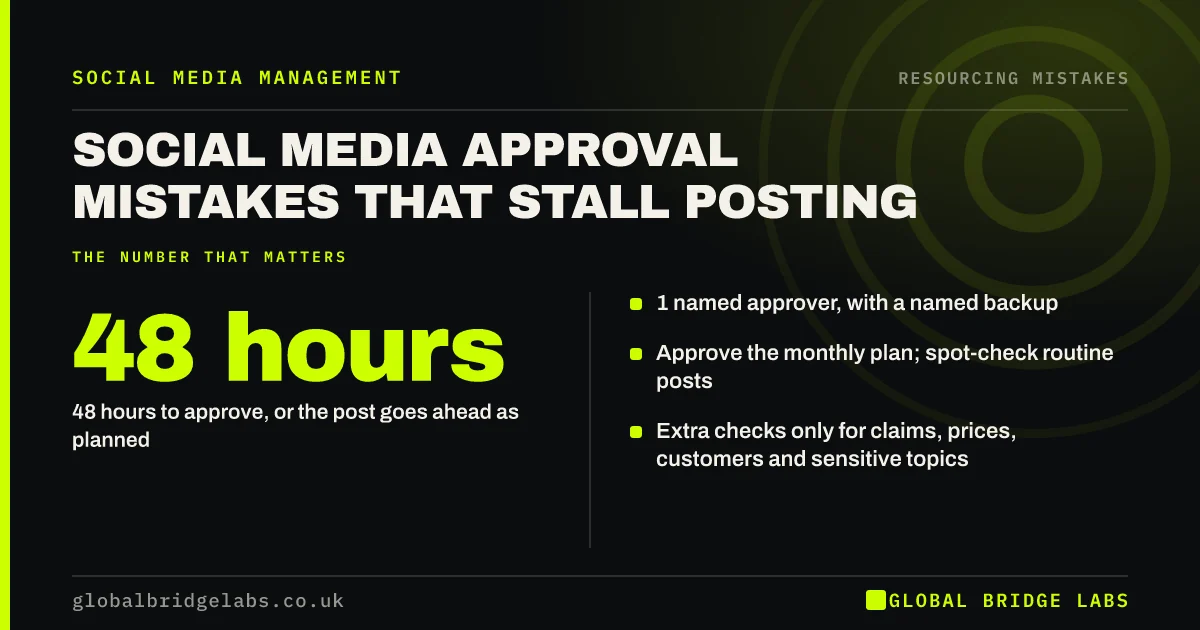
The common social media approval mistakes are too many approvers, no deadline, feedback scattered across email and chat, and every post treated as high risk. Posts go out late or not at all. Name one approver, set a 48-hour deadline, approve plans rather than single posts, and reserve extra checks for sensitive content.
- 1 named approver, with a named backup.
- 48 hours to approve, or the post goes ahead as planned.
- Approve the monthly plan; spot-check routine posts.
- Extra checks only for claims, prices, customers and sensitive topics.
Want a faster approval process? Message us on WhatsApp.
Chat on WhatsApp →Why do approvals stall?
Approvals stall because nobody knows whose job it is, everyone has an opinion, and approval sits behind other work. By the time three people have commented, the moment has passed. In small firms, the owner is often the bottleneck.
What are the common approval mistakes?
The common mistakes are well known to anyone who has waited for sign-off.
- Several approvers with equal say.
- No deadline for feedback.
- Comments spread across email, chat and calls.
- Every post treated as high risk.
- No backup when the approver is away.
Want an approval routine designed for your team? Message us on WhatsApp and we will discuss your requirements.
Chat on WhatsApp →How do you approve quickly without losing control?
Approve quickly by splitting posts into routine and sensitive. Routine posts follow the approved monthly plan and go out unless flagged. Sensitive posts, about prices, claims, customers, complaints or regulated topics, need a named approver's yes. Keep all feedback in one place.
When is a stricter process right?
A stricter process is right in regulated sectors, such as financial services, healthcare and legal services, where posts can be promotions subject to rules. Even then, pre-approved templates and a clear checklist keep it moving.
How do you measure whether approvals are slowing you down?
Measure it by recording, for one month, when each post was ready and when it was approved. If the average wait is more than two working days, or if posts miss their planned date, approvals are the bottleneck. Count the number of people who comment on each post too.
- Average wait over 2 working days.
- Posts missing planned dates.
- Three or more people commenting.
- Feedback spread across channels.
What does this look like in practice?
A pattern we see: posts waiting a week for the owner and two partners to agree, with timely posts going out stale. One approver, a 48-hour rule and pre-approved monthly themes usually keep the calendar on track.
Approval checklist
- Name one approver and a backup.
- Set a 48-hour deadline.
- Approve monthly plans.
- Check sensitive posts individually.
- Keep feedback in one place.
Next step
Agree today who approves social posts and how long they have. Write it down and share it.
Message us on WhatsApp for help, or book a 30-minute consultation.
Chat on WhatsApp →Sources and further reading
- Financial promotions and adverts · Financial Conduct Authority
- UK Code of Non-broadcast Advertising and Direct & Promotional Marketing (CAP Code) · ASA / CAP
- Meta Business Help Centre · Meta
Frequently asked questions
Who should approve social media posts in a small business?
One named person, usually the owner or marketing lead, with a backup for holidays. Others can give input on the monthly plan, but not on every post.
How long should social media approval take?
No more than 48 hours for routine posts. Agree that routine posts on an approved plan go ahead if there is no reply by the deadline.
Which posts need extra approval?
Posts about prices, claims, customers, complaints, regulated products or sensitive topics. Routine posts on the approved plan can usually go ahead with a spot-check.
Written by

Global Bridge Labs (GBL) is a UK–Sri Lanka partner for social media, websites and BPO. Everything here comes from client delivery, not theory.