On this page
- 01Key takeaways
- 02What makes a brief bad?
- 03What should a good brief include?
- 04Why do examples help so much?
- 05Can a brief be too detailed?
- 06How do you test whether a brief is good enough?
- 07What does this look like in practice?
- 08Brief checklist
- 09Next step
- 10Sources and further reading
- 11Frequently asked questions
Key takeaways
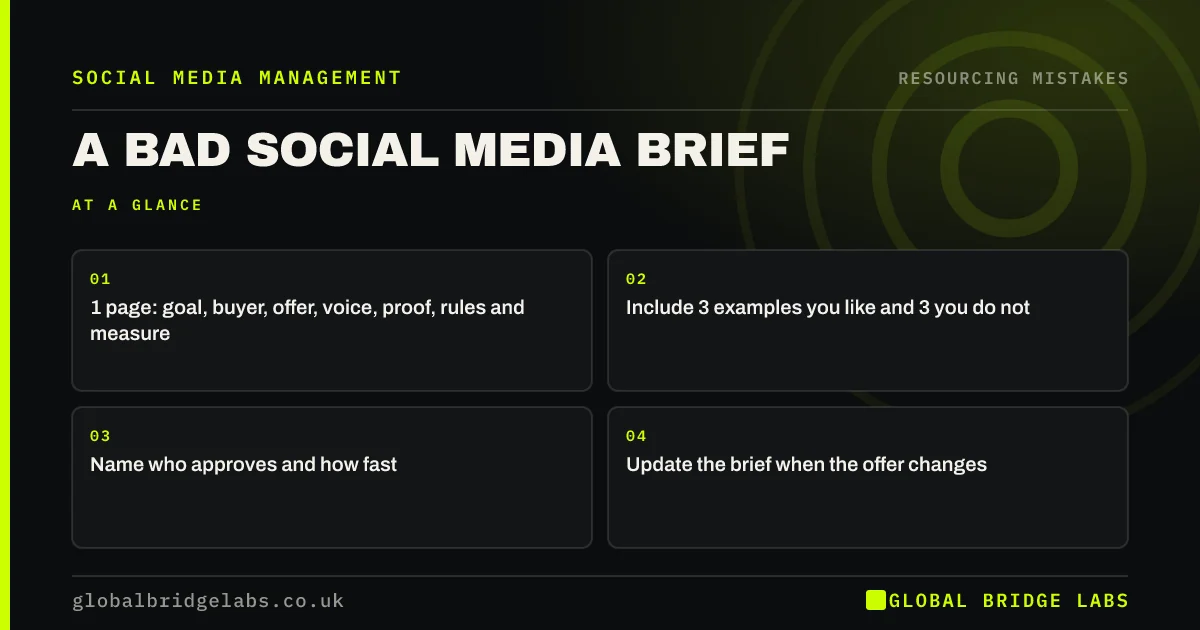
A bad social media brief is vague about the goal, the buyer, the offer and what good looks like, so agencies and freelancers fill gaps with guesses. Work misses the mark and rounds of changes follow. A one-page brief with goal, buyer, offer, voice, proof, rules and measures gets work much closer first time.
- 1 page: goal, buyer, offer, voice, proof, rules and measure.
- Include 3 examples you like and 3 you do not.
- Name who approves and how fast.
- Update the brief when the offer changes.
Want your brief written with you? Message us on WhatsApp.
Chat on WhatsApp →What makes a brief bad?
A brief is bad when it says things like 'raise awareness', 'make us look professional' or 'go viral' without saying who for, what to sell or how success is measured. It leaves out what makes the business different and what buyers worry about.
What should a good brief include?
A good brief fits on one page and covers seven things.
- Goal: result, number and month.
- Buyer: who, where and what problem.
- Offer: what to sell or promote now.
- Voice: three words and examples.
- Proof: reviews, results and photos to use.
- Rules: what never to say or show.
- Measure: how success is counted.
Want a brief template? Message us on WhatsApp and we will discuss your requirements.
Chat on WhatsApp →Why do examples help so much?
Examples help because words such as 'modern' or 'friendly' mean different things to different people. Three posts you like and three you dislike, from any account, show tone, style and level of polish faster than any description.
Can a brief be too detailed?
Yes. A brief that dictates every caption leaves no room for the skills you are paying for. Be firm on goal, buyer, offer and rules; be open on ideas and formats.
How do you test whether a brief is good enough?
Test a brief by giving it to someone who does not know the business and asking them to describe the buyer, the offer and what success looks like. If they cannot, the brief is not good enough. Another test is the number of revision rounds: more than two usually means the brief was unclear.
- A stranger cannot describe the buyer.
- No offer named.
- No measure of success.
- Repeated revision rounds.
What does this look like in practice?
A pattern we see: a brief that says 'we want more engagement and a professional look', followed by three months of polished posts the owner feels are 'not us'. A one-page brief with examples and a clear goal usually fixes it within one round.
Brief checklist
- State a goal with a number.
- Describe the buyer.
- Name the current offer.
- Add examples you like and dislike.
- List rules and approvers.
Next step
Draft your one-page brief using the seven headings above before your next agency or freelancer conversation.
Message us on WhatsApp for help, or book a 30-minute consultation.
Chat on WhatsApp →Sources and further reading
- Writing to GOV.UK standards: writing guidelines · GOV.UK
- Meta Business Help Centre · Meta
- About key events · Google Analytics Help
Frequently asked questions
What should be in a social media brief?
Goal, buyer, current offer, brand voice, proof to use, rules on what not to say or show, and how success will be measured. Add examples you like and dislike, and who approves work.
How long should a social media brief be?
One page is enough for most small businesses. Longer briefs often bury the important points. Update it when the offer, goal or buyer changes.
Why does my agency's work not feel like us?
Usually because the brief did not describe the voice, buyer and examples clearly. Share posts you like and dislike, and three words for your voice, and review the first few posts together.
Written by

Global Bridge Labs (GBL) is a UK–Sri Lanka partner for social media, websites and BPO. Everything here comes from client delivery, not theory.