On this page
- 01Key takeaways
- 02Which UK rules apply to business social media?
- 03What are the most common legal mistakes?
- 04What can happen if you get it wrong?
- 05How do you prevent legal mistakes?
- 06Do regulated sectors need extra care?
- 07How do you spot legal risk in your recent posts?
- 08What does this look like in practice?
- 09Legal checklist
- 10Next step
- 11Sources and further reading
- 12Frequently asked questions
Key takeaways
The social media legal mistakes UK businesses make most are unlabelled paid or gifted posts, claims they cannot prove, fake or selectively shown reviews, prize draws without clear terms, music and images used without a licence, and customer data or photos posted without consent. Most are accidental. A one-page policy and a second reader prevent nearly all of them.
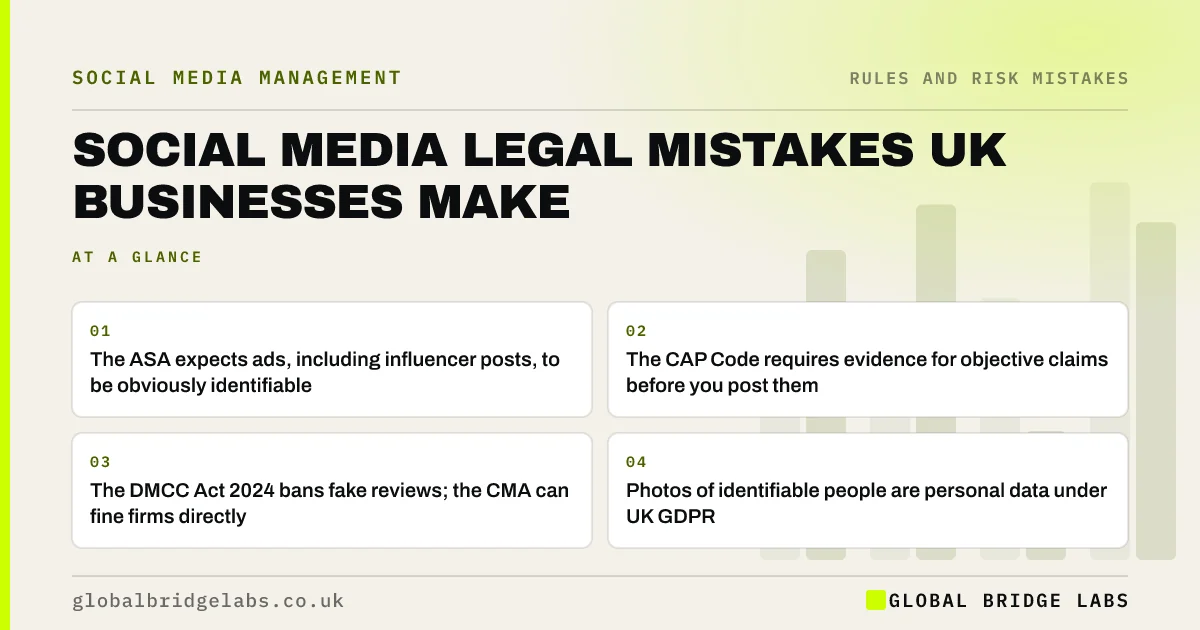
- The ASA expects ads, including influencer posts, to be obviously identifiable.
- The CAP Code requires evidence for objective claims before you post them.
- The DMCC Act 2024 bans fake reviews; the CMA can fine firms directly.
- Photos of identifiable people are personal data under UK GDPR.
Want your posts checked against UK rules? Message us on WhatsApp.
Chat on WhatsApp →Which UK rules apply to business social media?
Business social media in the UK is covered by the same rules as other marketing: the CAP Code enforced by the Advertising Standards Authority (ASA), consumer protection law including the Digital Markets, Competition and Consumers Act 2024, UK GDPR and the Privacy and Electronic Communications Regulations (PECR), copyright law, defamation law and any sector rules, such as FCA rules for financial promotions.
What are the most common legal mistakes?
The most common legal mistakes fall into five groups, and each has its own guide in this series.
- Advertising: unlabelled ads and unproven claims.
- Reviews: fake, bought or selectively shown testimonials.
- Promotions: giveaways without clear terms.
- Copyright: music, photos and video you have no licence for.
- Data: customer details and photos shared without consent.
- Not labelling ads on social media: the ASA mistake
- Fake or edited testimonials on social media: the law
- Using popular music on business social media
Want a compliance check of your accounts? Message us on WhatsApp and we will discuss your requirements.
Chat on WhatsApp →What can happen if you get it wrong?
Consequences range from an ASA ruling published with your name on it, to posts removed by the platform, copyright claims, complaints to the Information Commissioner's Office (ICO) and, for serious consumer law breaches, CMA enforcement. For small businesses the reputational damage and lost account are usually the bigger risk.
How do you prevent legal mistakes?
Prevent them with a short social media policy covering ads, claims, reviews, promotions, copyright, data and staff posts, and a rule that anything paid, gifted, promotional or about a customer is read by a second person before it goes out.
Do regulated sectors need extra care?
Yes. Financial services, healthcare, legal services, alcohol, gambling and products for children all have extra advertising rules. A financial adviser's post can be a financial promotion; a clinic must not advertise prescription-only medicines to the public. Check your regulator's guidance before posting.
How do you spot legal risk in your recent posts?
Spot legal risk by scanning your last 30 posts for five things: paid or gifted content, objective claims, reviews or testimonials, promotions and images of people or other people's work. Each one is a point where a rule applies. Check those posts against the relevant guide in this series.
- Paid or gifted content.
- Claims such as 'best' or 'cheapest'.
- Reviews and testimonials.
- Images of people or others' work.
What does this look like in practice?
A pattern we see: a small business that has never read the CAP Code running a giveaway with no terms, posting a customer's photo from a WhatsApp message and claiming to be 'the best in the county'. None was deliberate. A one-page policy and a second reader fix all three.
Legal checklist
- Label paid and gifted posts as ads.
- Hold evidence for every objective claim.
- Use only genuine, fairly shown reviews.
- Publish terms for every promotion.
- Use only licensed music and images.
- Get consent before posting people or data.
Next step
Write a one-page social media policy this month and agree who reads promotional posts before they go out.
Message us on WhatsApp for a policy template, or book a 30-minute consultation.
Chat on WhatsApp →Sources and further reading
- UK Code of Non-broadcast Advertising and Direct & Promotional Marketing (CAP Code) · ASA / CAP
- Recognising ads: brand-owned and paid social media · ASA / CAP
- Digital Markets, Competition and Consumers Act 2024 · legislation.gov.uk
- Publishing consumer reviews and complying with consumer protection law · Competition and Markets Authority
- Advice for small organisations · Information Commissioner's Office
Frequently asked questions
What laws apply to business social media in the UK?
The CAP Code (enforced by the ASA), consumer protection law including the DMCC Act 2024, UK GDPR and PECR, copyright and defamation law, and sector rules such as FCA financial promotion rules. Platform terms also apply.
Can a small business be fined for a social media post?
It can, in serious cases. The CMA can fine businesses for consumer law breaches such as fake reviews, and the ICO can act on data breaches. More often, the ASA publishes a ruling and the post must be changed or removed.
Do ASA rules apply to organic posts?
The CAP Code applies to marketing communications, which can include a business's own posts about its products, not only paid ads. Claims in organic posts still need to be truthful and backed by evidence.
Written by

Global Bridge Labs (GBL) is a UK–Sri Lanka partner for social media, websites and BPO. Everything here comes from client delivery, not theory.