On this page
- 01Key takeaways
- 02Why do engagement rates differ between tools?
- 03When does a high rate mislead?
- 04How should you use engagement rate?
- 05Does low engagement always matter?
- 06How do you check what your engagement rate really means?
- 07What does this look like in practice?
- 08Engagement rate checklist
- 09Next step
- 10Sources and further reading
- 11Frequently asked questions
Key takeaways
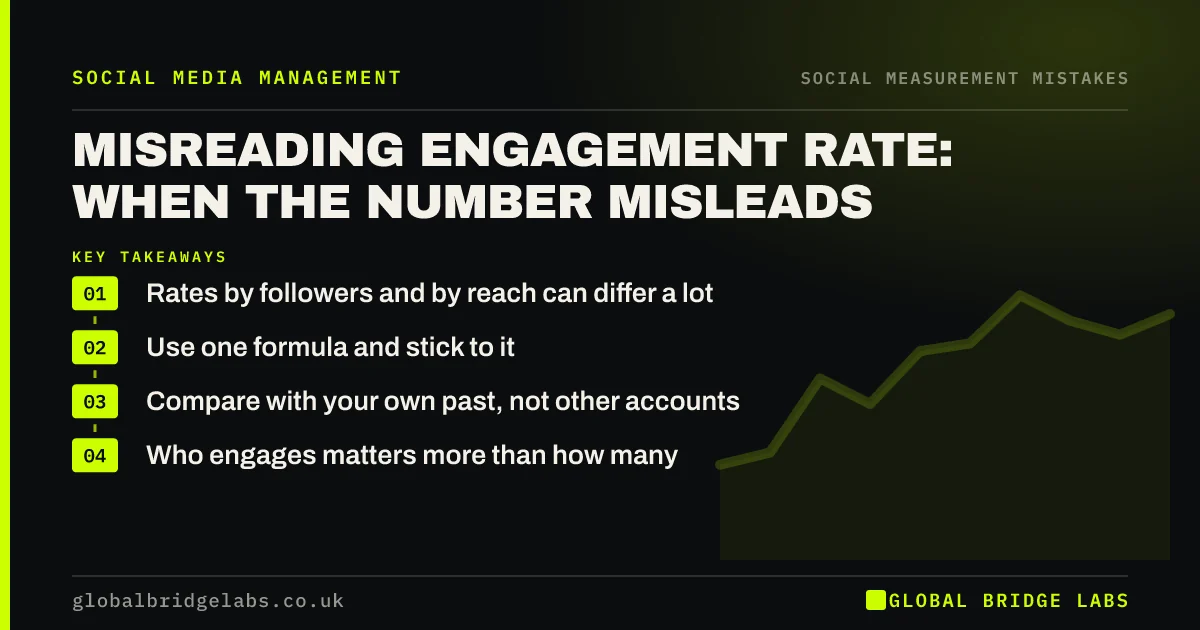
Engagement rate becomes misleading when it is calculated differently between tools, measured on a few posts, or driven by people who will never buy. A 10% rate from friends and other businesses is worth less than 2% from local buyers. Use one formula consistently, compare with your own past, and check who is engaging.
- Rates by followers and by reach can differ a lot.
- Use one formula and stick to it.
- Compare with your own past, not other accounts.
- Who engages matters more than how many.
Want your engagement read properly? Message us on WhatsApp.
Chat on WhatsApp →Why do engagement rates differ between tools?
Engagement rates differ because tools divide by different things: followers, reach or impressions, and count different actions: likes, comments, shares, saves or clicks. The same post can show 3% in one tool and 8% in another. Neither is wrong; they measure different things.
When does a high rate mislead?
A high rate misleads when it comes from engagement bait, pods, giveaways or people outside your market. It also misleads on small accounts, where a few friends liking every post produces a high rate with no buyers.
- High engagement but no sales? You have the wrong fans
- Engagement bait: why 'comment YES' posts get demoted
Want to know who is really engaging? Message us on WhatsApp and we will discuss your requirements.
Chat on WhatsApp →How should you use engagement rate?
Use engagement rate as a trend, measured the same way monthly, to see whether content is getting more or less interesting to your audience. Weigh comments, shares and saves above likes, and check that people engaging look like buyers.
Does low engagement always matter?
Not always. B2B and high-value accounts often have low engagement but steady enquiries, because buyers read without reacting. If the right people enquire, a low rate is not a problem to solve.
How do you check what your engagement rate really means?
Check it by looking behind the number: which formula the tool uses, how many posts it covers and who the engaging accounts are. A rate based on a handful of posts, or driven by friends, staff or giveaways, says little. Compare the same formula over six months instead.
- Which formula the tool uses.
- How many posts the rate covers.
- Who the engaging accounts are.
- Whether giveaways inflated it.
What does this look like in practice?
A pattern we see: a business proud of a 12% engagement rate whose engagers are mostly friends, staff and other local businesses. Its competitor, at 2%, gets more enquiries. Looking at who engages, not only how many, changes the content plan.
Engagement rate checklist
- Choose one formula and stick to it.
- Track it monthly as a trend.
- Weigh comments, shares and saves highest.
- Check who is engaging.
- Judge it alongside enquiries.
Next step
Look at the last 20 people who engaged with your posts. Count how many could buy from you. That ratio matters more than the rate.
Message us on WhatsApp for help, or book a 30-minute consultation.
Chat on WhatsApp →Sources and further reading
- Engagement rate and bounce rate · Google Analytics Help
- Meta Business Help Centre · Meta
- LinkedIn Pages best practices · LinkedIn
Frequently asked questions
What is a good engagement rate for a business?
It depends on the platform, formula and account size, so a single benchmark is misleading. Compare with your own past results using one consistent formula, and check whether engagement comes from buyers.
Should engagement rate be based on followers or reach?
By reach shows how interesting a post was to the people who saw it. By followers shows how engaged your audience is overall. Pick one and use it consistently.
Why is my engagement rate high but sales low?
Usually because engagement comes from people who are not buyers, such as friends, peers or prize hunters, or because posts have no next step. Check who engages and add clear calls to action.
Written by

Global Bridge Labs (GBL) is a UK–Sri Lanka partner for social media, websites and BPO. Everything here comes from client delivery, not theory.