On this page
- 01Key takeaways
- 02What does a profile mistake look like?
- 03What does a posting mistake look like?
- 04What does a reply mistake look like?
- 05What does a rules mistake look like?
- 06What does a measurement mistake look like?
- 07Are any of these examples not really mistakes?
- 08How do you find these examples on your own account?
- 09What does this look like in practice?
- 10Examples checklist
- 11Next step
- 12Sources and further reading
- 13Frequently asked questions
Key takeaways
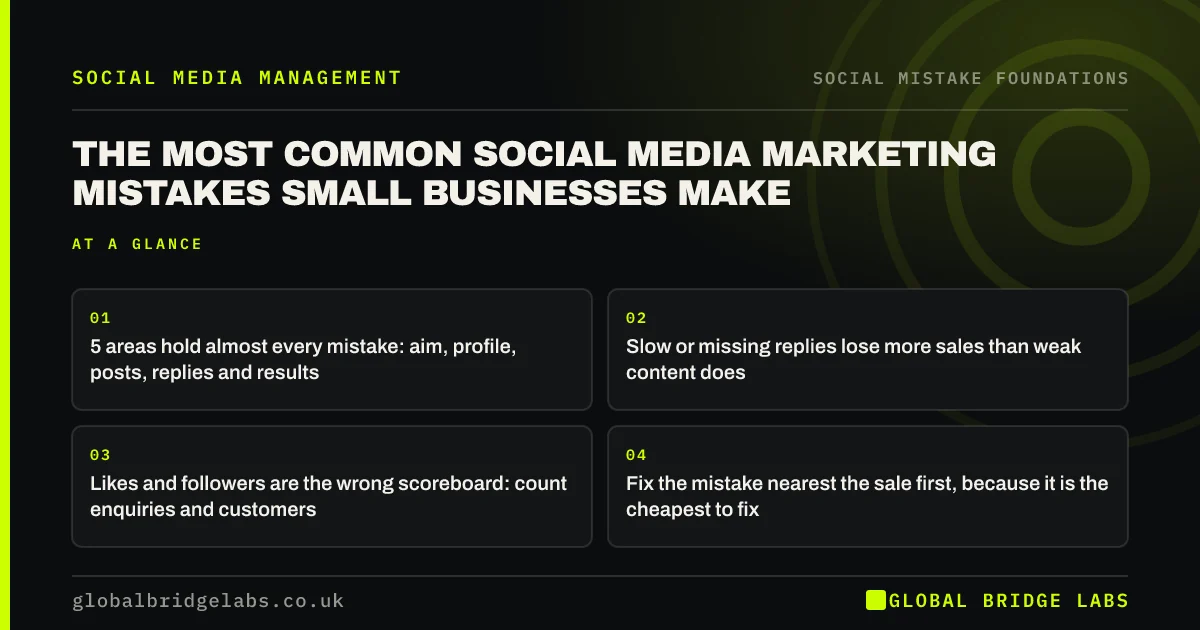
Most social media mistakes examples look ordinary on the screen: a bio that says 'Welcome to our page', a post with no next step, a price question left unanswered, a giveaway that asks people to share on their timeline. None looks dramatic. Each quietly loses enquiries, and each has a quick fix.
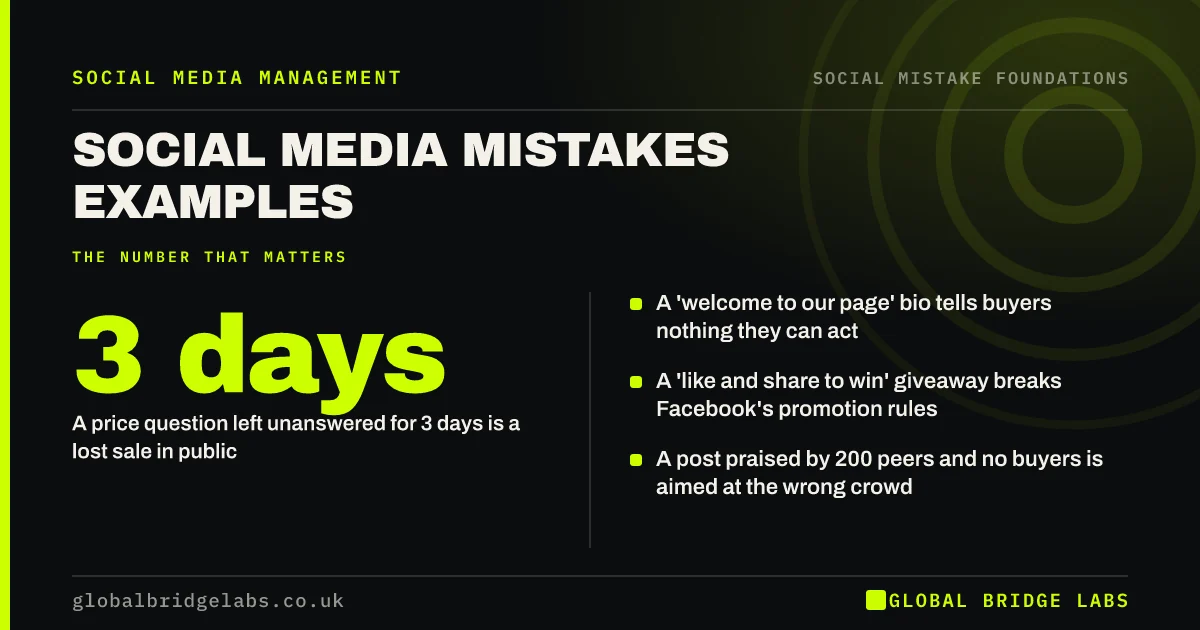
- A 'welcome to our page' bio tells buyers nothing they can act on.
- A price question left unanswered for 3 days is a lost sale in public.
- A 'like and share to win' giveaway breaks Facebook's promotion rules.
- A post praised by 200 peers and no buyers is aimed at the wrong crowd.
Recognise one of these? Send us your handle on WhatsApp.
Chat on WhatsApp →What does a profile mistake look like?
A profile mistake looks like a bio full of slogans: 'Passionate about quality. Est. 2009.' A visitor cannot tell what the business sells, where it works or how to book. The fix reads plainly: 'Kitchen fitting in Leeds and Wakefield. Free quotes. Message us or tap below.'
What does a posting mistake look like?
A posting mistake looks like a good photo of finished work with the caption 'Another happy customer!' and nothing else. It does not say what the job was, what it cost roughly, how long it took or how to get one. The fix adds two lines: what was done and how to ask for the same.
What does a reply mistake look like?
A reply mistake looks like a comment asking 'How much for one of these?' with no answer three days later, under a post that is still being shown to new people. Every viewer sees a business that does not reply. The fix is a same-day public answer and an offer to continue by message.
What does a rules mistake look like?
A rules mistake looks like a giveaway post saying 'Like, share to your timeline and tag three friends to win', or an influencer post about a free product with no '#ad'. Facebook does not allow promotions that require timeline shares, and the ASA expects paid or gifted posts to be labelled as ads.
- Social media giveaway mistakes that break the rules
- Not labelling ads on social media: the ASA mistake
Unsure whether a post breaks the rules? Message us on WhatsApp and we will discuss your requirements.
Chat on WhatsApp →What does a measurement mistake look like?
A measurement mistake looks like a monthly report celebrating 'reach up 40%' with no line for enquiries. The owner cannot tell whether the money worked. The fix is one extra line at the top of every report: enquiries and customers from social media this month, compared with last month.
Are any of these examples not really mistakes?
Some are deliberate choices. A brand that posts beautiful images with no call to action may be building awareness alongside heavy advertising elsewhere. A business that never posts prices may sell bespoke work. Judge each example against your goal, not against a rulebook.
How do you find these examples on your own account?
Find them by searching your own account the way a buyer would. Read the bio aloud, scroll comments for question marks with no reply, open your last giveaway or partner post and check the labels, and look at the first line of your last report. Each of the examples in this guide shows up in under ten minutes of looking.
- Search comments for 'how much' and 'do you'.
- Open old giveaways and read the entry rules.
- Check partner posts for a clear ad label.
- Read the top line of your last report.
What does this look like in practice?
A pattern worth noticing: owners spot these mistakes immediately on a competitor's page and miss them on their own, because they already know what the business does. Asking someone who has never bought from you to read your profile aloud is a fast, honest test.
Examples checklist
- Read your bio as a stranger would.
- Check your last five posts for a next step.
- Search your comments for unanswered questions.
- Read any giveaway or partner post against the rules.
- Look for enquiries on your last report.
Next step
Ask a friend outside the business to look at your profile for one minute and tell you what you sell and how to buy it.
Or send us your handle on WhatsApp for a quick read, or book a 30-minute consultation.
Chat on WhatsApp →Sources and further reading
- Recognising ads: social media and influencer marketing · ASA / CAP
- CAP Code section 8: Promotional marketing · Committee of Advertising Practice
- Meta Business Help Centre · Meta
Frequently asked questions
What are examples of bad social media marketing?
Common examples are a vague bio, posts with no next step, unanswered price questions, giveaways that break platform rules, unlabelled ads, bought followers and reports that track likes but not enquiries. Each looks minor but loses buyers who were already interested.
What should a business never post on social media?
Avoid customer details or photos without consent, private disputes with customers, unlabelled ads, claims you cannot prove, music or images you have no licence for, and anything a member of staff posted in anger. When in doubt, wait an hour and ask a colleague.
How do I fix a bad social media post?
If it is a small error, edit the caption. If it is wrong or harmful, delete it, post a short correction if people saw it, and reply to anyone who commented. Do not delete fair criticism of the post itself, because that usually draws more attention.
Written by

Global Bridge Labs (GBL) is a UK–Sri Lanka partner for social media, websites and BPO. Everything here comes from client delivery, not theory.