On this page
- 01Short answer
- 02Mistake 1: Spreading across too many channels
- 03Mistake 2: No named owner
- 04Mistake 3: Sending attention to a page that cannot convert
- 05Mistake 4: No response standard
- 06Mistake 5: Judging results too early
- 07Mistake 6: Never asking for anything
- 08Mistake 7: Chasing trends that do not fit
- 09Mistake 8: Treating reporting as evidence of work
- 10Mistake 9: Leaving dormant accounts live
- 11Next step
- 12Sources and further reading
- 13Frequently asked questions
Short answer
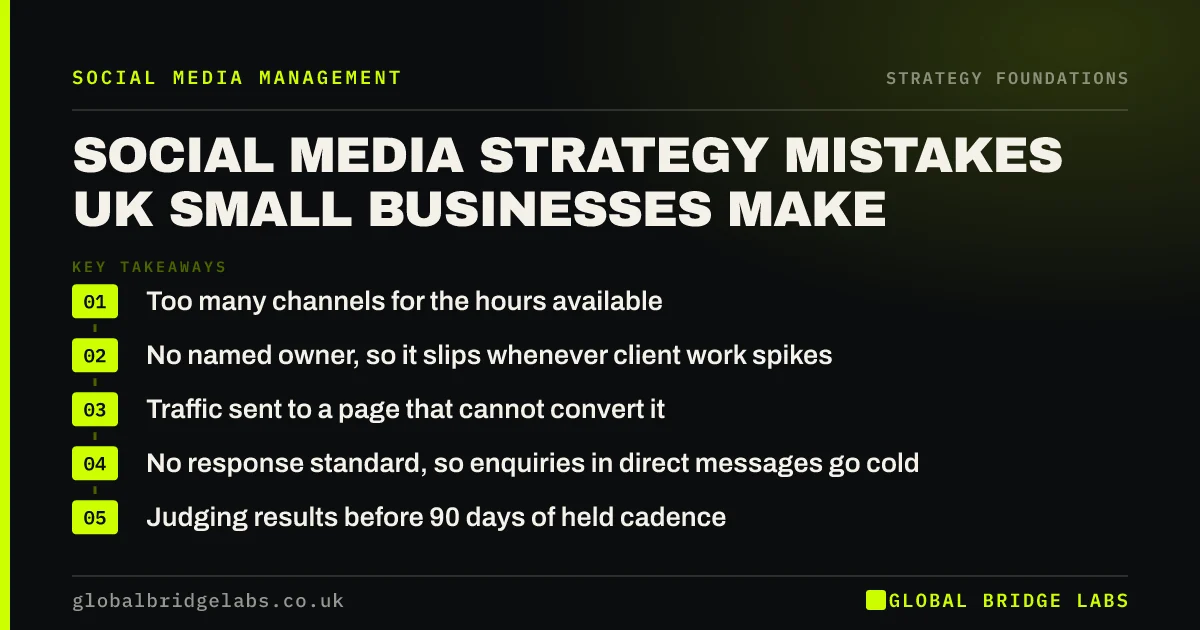
Almost every failing small business social media account fails for one of nine reasons, and only two of them are about content quality. The rest are resourcing, measurement and destination problems that look like content problems from the inside.
- Too many channels for the hours available.
- No named owner, so it slips whenever client work spikes.
- Traffic sent to a page that cannot convert it.
- No response standard, so enquiries in direct messages go cold.
- Judging results before 90 days of held cadence.
Want an honest diagnosis of which one is costing you most? Message us on WhatsApp.
Chat on WhatsApp →Mistake 1: Spreading across too many channels
The most expensive mistake, because it makes every other problem worse. Five channels at a sustainable three posts a week is fifteen pieces of content, which no small UK team produces at quality alongside their actual job.
The fix is subtraction. Two channels, properly maintained, outperform five neglected ones on every metric that matters, including brand perception.
Mistake 2: No named owner
When social media belongs to everyone, it belongs to nobody, and it is the first thing dropped in a busy week. This is why activity charts for small businesses show bursts and gaps rather than a line.
The fix is one name and protected hours in the calendar, treated like a client commitment. If nobody can be given those hours, that is the decision: outsource production or accept a lower cadence honestly.
Mistake 3: Sending attention to a page that cannot convert
This is the mistake that makes good social media look like bad social media. Reach rises, clicks rise, enquiries do not, and the conclusion drawn is that social media does not work for us.
Check the destination before increasing spend. Does the page state what you do, who for, what it costs and what happens next, above the fold, on a phone? If not, fix that first. We publish a 2.4x enquiry rate after website rebuilds precisely because this is where the leak usually is.
Mistake 4: No response standard
A large share of social media enquiries arrive as comments and direct messages rather than through a form, and they decay fast. A question answered in one working hour is a conversation. The same question answered in three days is an apology.
The fix is a written standard, usually reply within four working hours, with one named person responsible and a fallback when they are away.
Mistake 5: Judging results too early
Organic social compounds slowly and then suddenly. Six weeks is not a test, particularly on platforms that need to learn who to show your content to.
Commit to 90 days of held cadence before drawing any conclusion, and be honest about whether the cadence was actually held. Most six-week failures are really three-week failures with a quiet fortnight in the middle.
Mistake 6: Never asking for anything
The opposite failure to constant promotion, and more common among UK SMEs. Feeds full of helpful content with no post that says what you sell, what it costs and how to start.
One post in ten should ask. The audience built by the other nine has no way to act otherwise, and will assume you are busy or expensive.
We will review your last 30 posts and tell you which of these nine is costing you most. Message us on WhatsApp.
Chat on WhatsApp →Mistake 7: Chasing trends that do not fit
Trend participation works when it is adjacent to what you do and is executed quickly. It fails when a professional services firm uses a trending audio three weeks late, which reads as a business trying to be something it is not.
The safer version of the same instinct is format adoption rather than trend adoption. Use the new format, in your own voice, about your own work.
Mistake 8: Treating reporting as evidence of work
Long monthly reports full of platform screenshots create an impression of rigour while answering none of the questions a business owner has.
Cut to three numbers: conversations started, enquiries attributed, cost per enquiry. If a metric would not change a decision, it does not go in the report.
Mistake 9: Leaving dormant accounts live
An account whose last post is eighteen months old ranks for your brand name and tells buyers you may no longer be trading. It costs nothing to fix and almost nobody does it.
Either delete the account or leave a pinned post directing people to the channel you maintain, with current contact details.
Next step
Most of these are structural, which is good news: they can be fixed in a week without new creative, new tools or a bigger budget.
Message us on WhatsApp for a 30-minute review of what is actually blocking your social media results.
Chat on WhatsApp →Sources and further reading
Frequently asked questions
Why is my social media not getting any enquiries?
Usually the destination, not the content. If reach and clicks are healthy but enquiries are not, the page people land on is failing to explain what you do, what it costs and what happens next. Check that before changing anything about your posts.
How long before social media starts working?
Give it 90 days of genuinely held cadence. Organic reach builds slowly while platforms learn who to show your content to, and enquiry volume lags reach by several weeks because buyers watch for a while before they act.
Is posting less often better than posting inconsistently?
Yes. Two posts a week every week beats five posts a week for a month followed by silence. Consistency affects both algorithmic distribution and buyer perception, and a gap reads to a prospective customer as a business that may have stopped trading.
Should I delete old posts that performed badly?
No, unless they are inaccurate, off-brand or make claims you can no longer support. Poor performance on an old post does not harm new distribution, and deleting content removes evidence of how long you have been doing the work.
Written by

Global Bridge Labs (GBL) is a UK–Sri Lanka partner for social media, websites and BPO. Everything here comes from client delivery, not theory.