On this page
- 01Key takeaways
- 02What does a social media mistake cost?
- 03How do you calculate the time cost?
- 04How do you put a value on lost enquiries?
- 05Which mistakes cost the most?
- 06When is the cost not worth worrying about?
- 07How do you spot where the money is leaking?
- 08What does this look like in practice?
- 09Cost checklist
- 10Next step
- 11Sources and further reading
- 12Frequently asked questions
Key takeaways
The cost of social media mistakes for a small business is mostly invisible: hours spent posting that produce no enquiries, ad spend on boosts with no objective, and buyers who message and never hear back. In an illustrative example, four hours a week plus £200 a month of boosts costs about £5,800 to £12,800 a year.
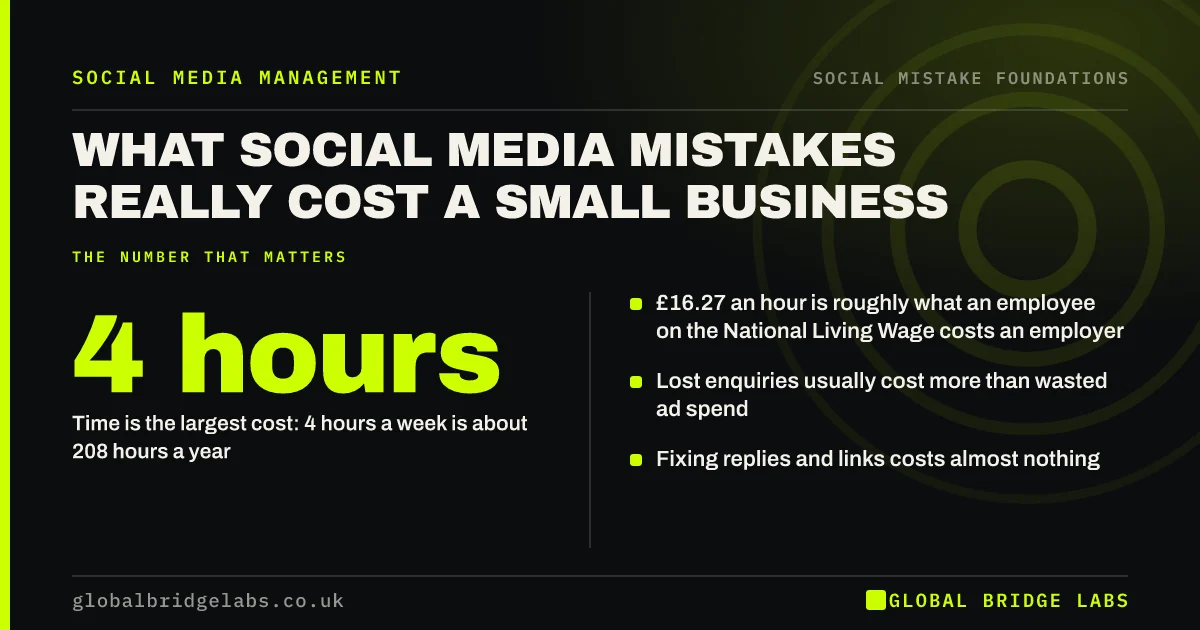
- Time is the largest cost: 4 hours a week is about 208 hours a year.
- £16.27 an hour is roughly what an employee on the National Living Wage costs an employer.
- Lost enquiries usually cost more than wasted ad spend.
- Fixing replies and links costs almost nothing.
Want this sum done for your own accounts? Message us on WhatsApp.
Chat on WhatsApp →What does a social media mistake cost?
A social media mistake costs the time and money spent on activity that cannot produce a customer, plus the value of customers who were interested and lost. The first part shows up on timesheets and card statements. The second never shows up at all, which is why it is usually the bigger number.
How do you calculate the time cost?
Multiply weekly hours by 52 and by the cost of an hour. At the April 2026 National Living Wage of £12.71, an employee hour costs an employer about £16.27 with National Insurance, pension and holiday added. Four hours a week is about £3,380 a year. If the owner does it, use what an hour of their time is worth; at £50 an hour the same four hours cost about £10,400.
How do you put a value on lost enquiries?
Estimate lost enquiries from what you can see: unanswered messages, comments asking prices that got no reply, and profile visits with no clicks. Multiply by your usual enquiry-to-customer rate and average order value. As an illustration, five unanswered buying messages a month, one in four of which would have bought at £800, is about £1,000 a month of lost sales.
Not sure how many enquiries you are losing? Message us on WhatsApp and we will discuss your requirements.
Chat on WhatsApp →Which mistakes cost the most?
The mistakes that cost the most sit closest to the sale: slow replies, broken links and no clear way to get in touch. They waste interest that already exists. Strategy mistakes cost more slowly, by aiming months of posts at the wrong people. Cosmetic mistakes, such as an uneven grid, cost very little.
- Highest: unanswered messages and comments from buyers.
- High: boosting posts with no objective or tracking.
- Medium: posting for the wrong audience or platform.
- Low: visual inconsistency and occasional typos.
When is the cost not worth worrying about?
If you spend under an hour a week on social media and get most work from referrals or search, the cost of mistakes is small. Fix anything a buyer would touch, such as contact details and replies, and do not spend more time on it. The sum matters most when social media takes real hours or real ad spend.
How do you spot where the money is leaking?
Spot the leak by following one month of activity from post to customer. Count the posts, the clicks or profile visits, the messages, the replies sent within the working day and the customers won. The biggest drop between two of those numbers is where the mistake sits and where fixing it pays back first.
- Many posts, few profile visits: content or audience.
- Many visits, few messages: profile or link.
- Many messages, few customers: replies or offer.
- No numbers at all: measurement comes first.
What does this look like in practice?
A pattern we see: an owner who thinks social media is free because nothing is paid out, until the hours are added up. The useful outcome is not guilt but a decision: either cut the time to what works, or hand the work to someone accountable for enquiries.
Cost checklist
- Count weekly hours on social media, including replies.
- Price an hour of the person doing it.
- Add monthly ad spend and tool costs.
- Count unanswered buying messages last month.
- Compare the total with enquiries social media produced.
Next step
Do the sum for last month. If the cost per enquiry is higher than you would pay for an enquiry elsewhere, start with the cheapest fix: replies.
Send us your numbers on WhatsApp for a costed view, or book a 30-minute consultation.
Chat on WhatsApp →Sources and further reading
- National Minimum Wage and National Living Wage rates · GOV.UK
- Workplace pensions: what you, your employer and the government pay · GOV.UK
- About key events · Google Analytics Help
Frequently asked questions
How much time should a small business spend on social media?
Two to five hours a week covers most small UK businesses on one main platform, including replies. More time only helps if the basics are right. If you are spending more than that without regular enquiries, find the mistake before adding hours.
Is social media a waste of money for small businesses?
Not usually, but it is often run in a way that wastes money: boosting without an objective, posting for the wrong audience and missing messages. Fixed, it is one of the cheaper ways to reach local and niche buyers. If it does not suit your buyers, spend the time elsewhere.
How do I work out if social media is worth it?
Add up hours, ad spend and tools for a month, then divide by the enquiries and customers social media produced. Compare that cost per customer with other channels. Ask new customers how they found you, because many social journeys never appear in analytics.
Written by

Global Bridge Labs (GBL) is a UK–Sri Lanka partner for social media, websites and BPO. Everything here comes from client delivery, not theory.