On this page
- 01Key takeaways
- 02What counts as engagement bait?
- 03Why does engagement bait backfire?
- 04What should you post instead?
- 05Is asking for comments always bait?
- 06How do you spot bait in your own posts?
- 07What does this look like in practice?
- 08Engagement bait checklist
- 09Next step
- 10Sources and further reading
- 11Frequently asked questions
Key takeaways
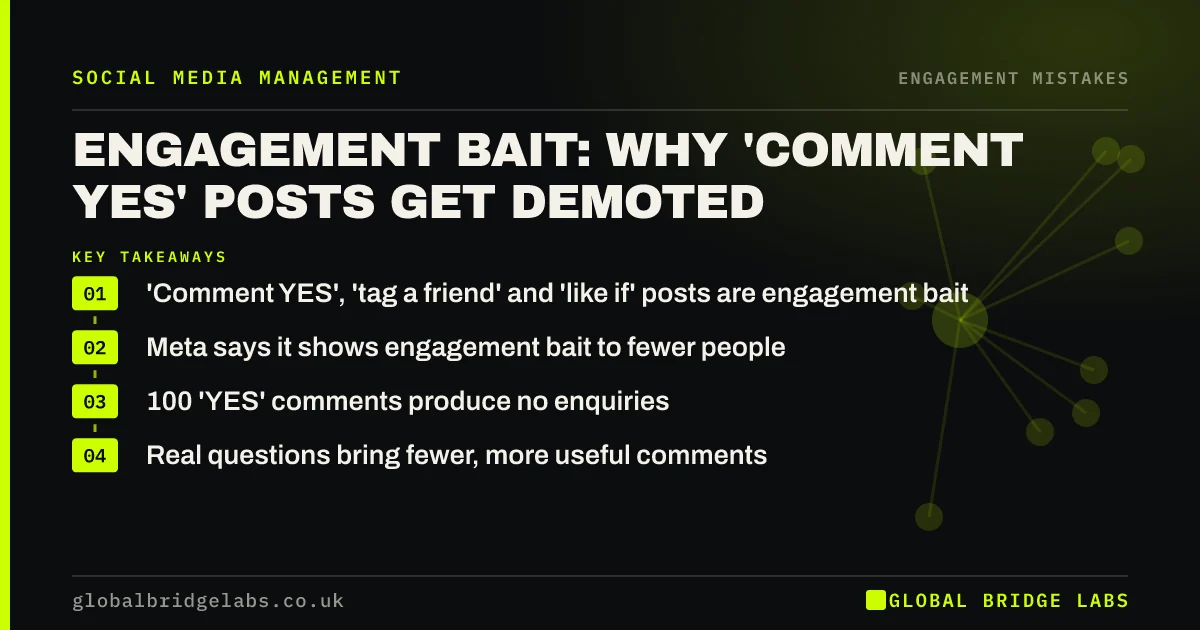
Engagement bait is a post that asks people to like, comment, share, tag or vote purely to inflate engagement, such as 'Comment YES if you agree' or 'Tag a friend who needs this'. Meta has said for years that it demotes this kind of post. It also brings no buyers. Ask genuine questions people want to answer instead.
- 'Comment YES', 'tag a friend' and 'like if' posts are engagement bait.
- Meta says it shows engagement bait to fewer people.
- 100 'YES' comments produce no enquiries.
- Real questions bring fewer, more useful comments.
Want posts that start real conversations? Message us on WhatsApp.
Chat on WhatsApp →What counts as engagement bait?
Engagement bait is any request to interact that exists only to game reach rather than to start a real conversation. Common types are vote baiting ('like for A, love for B'), react baiting, share baiting, tag baiting and comment baiting ('type YES').
Why does engagement bait backfire?
Engagement bait backfires twice. Platforms such as Facebook look for it and reduce its distribution, and the engagement it does get comes from people reacting on reflex, not buyers. Comments saying 'YES' tell you nothing and lead nowhere.
What should you post instead?
Post genuine questions that your buyers have a reason to answer, such as 'What is the one thing you would change about your kitchen?', and polls about real choices. Ask for opinions or experiences, not reflex reactions. The comments will be fewer but useful.
- Ask a question with a real answer.
- Run polls on real choices buyers make.
- Invite questions about your service.
- Ask customers to share their results.
Want a list of real questions for your buyers? Message us on WhatsApp and we will discuss your requirements.
Chat on WhatsApp →Is asking for comments always bait?
No. Asking for a real opinion, a question or a vote on a genuine choice is fine. The test is whether the answer means anything. 'Which of these two colours should we stock?' is a question. 'Comment YES for part two' is bait. Comment-to-receive offers sit in between: use them sparingly and deliver what you promise.
How do you spot bait in your own posts?
Spot bait by reading each call to action and asking whether the answer means anything. 'Comment YES', 'like if you agree', 'tag a friend' and 'share to win' are bait. 'Which of these would you choose for a small garden?' is a real question. Rewrite any prompt where the reply tells you nothing.
- 'Comment YES' or 'type 1'.
- 'Like if' and 'love if' votes.
- 'Tag a friend who...'.
- 'Share to win' or 'share this'.
What does this look like in practice?
A pattern we see: an account whose best-performing posts are 'tag someone who needs this', with reach that collapses whenever they post anything else. Swapping bait for real questions lowers comment counts but brings comments from people who might buy.
Engagement bait checklist
- Remove 'comment YES' and 'tag a friend' prompts.
- Ask questions with real answers.
- Use polls for genuine choices.
- Keep comment-to-receive offers rare.
- Judge posts on useful comments, not counts.
Next step
Rewrite your next 'tag a friend' style post as a real question your buyers would want to answer.
Message us on WhatsApp for help, or book a 30-minute consultation.
Chat on WhatsApp →Sources and further reading
- Meta Business Help Centre · Meta
- CAP Code section 8: Promotional marketing · Committee of Advertising Practice
Frequently asked questions
What is engagement bait on Facebook?
Posts that ask people to like, react, comment, share or tag purely to boost engagement, such as 'Comment YES' or 'Tag a friend'. Meta has said it demotes posts that use these tactics, so they can reduce reach rather than increase it.
Is it engagement bait to ask a question?
No, if the question is genuine and the answer means something. Asking buyers for opinions, experiences or choices is good practice. It becomes bait when the request exists only to inflate numbers.
Do giveaways count as engagement bait?
Giveaways that require tagging friends or sharing to personal timelines can count as bait and may break Facebook's promotion rules. Simple entry methods with clear terms are safer.
Written by

Global Bridge Labs (GBL) is a UK–Sri Lanka partner for social media, websites and BPO. Everything here comes from client delivery, not theory.