On this page
- 01Key takeaways
- 02What turns a complaint into a crisis?
- 03What are the most common crisis mistakes?
- 04What should you do in the first hours?
- 05When should you not respond publicly?
- 06How do you spot that a complaint is becoming a crisis?
- 07What does this look like in practice?
- 08Crisis checklist
- 09Next step
- 10Sources and further reading
- 11Frequently asked questions
Key takeaways
The social media crisis mistakes that make things worse are going silent, deleting posts and comments, posting a defensive statement, letting several people reply separately and carrying on with scheduled promotional posts. In the first hours, pause scheduled posts, acknowledge the issue briefly, name one person to respond and give a time for an update.
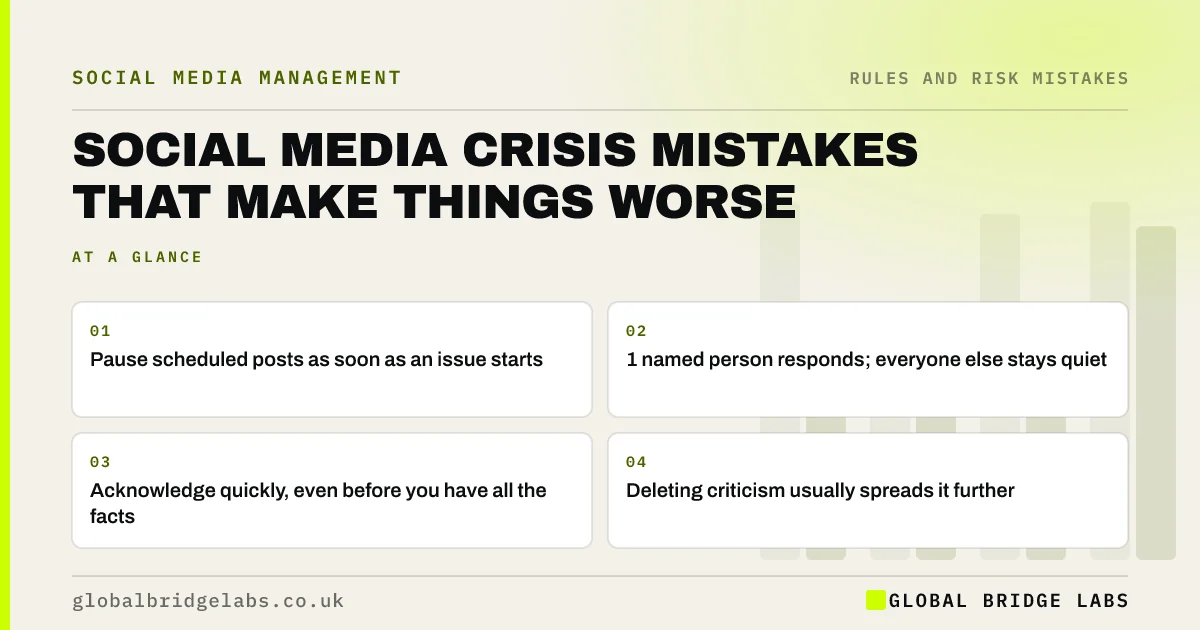
- Pause scheduled posts as soon as an issue starts.
- 1 named person responds; everyone else stays quiet.
- Acknowledge quickly, even before you have all the facts.
- Deleting criticism usually spreads it further.
Facing a backlash now? Message us on WhatsApp.
Chat on WhatsApp →What turns a complaint into a crisis?
A complaint becomes a crisis when it spreads faster than the business responds. Silence, deletion or a defensive reply gives people a second story to share. The original issue is often smaller than the reaction to how it was handled.
What are the most common crisis mistakes?
The most common crisis mistakes are made in the first hours, when people are rushed and upset.
- Saying nothing for a day or more.
- Deleting posts and critical comments.
- A defensive or blaming statement.
- Several staff replying differently.
- Promotional posts going out as normal.
Want a crisis plan in place before you need it? Message us on WhatsApp and we will discuss your requirements.
Chat on WhatsApp →What should you do in the first hours?
In the first hours, pause scheduled posts, name one person to respond, post a short acknowledgement that you are aware and looking into it, and say when you will update. Gather the facts, then post a clear, human update. Apologise where you were at fault.
- 1. Pause scheduled posts.
- 2. Name one responder.
- 3. Acknowledge and give an update time.
- 4. Gather facts.
- 5. Update clearly and apologise if at fault.
When should you not respond publicly?
Not every negative post is a crisis. A single complaint can be handled privately after a short public reply. Where legal action, safety or staff welfare is involved, take advice before saying more than a holding statement.
How do you spot that a complaint is becoming a crisis?
A complaint is becoming a crisis when it is shared beyond your own page, when comments arrive faster than you can read them, when local media or groups pick it up, or when people who are not customers join in. At that point, pause scheduled posts and switch to your crisis routine.
- Shares outside your own page.
- Comments arriving faster than you can read.
- Local groups or media picking it up.
- Non-customers joining in.
What does this look like in practice?
A pattern we see: a complaint shared in a local group, followed by the business deleting comments on its page and a scheduled offer post going out the same afternoon. Each step adds fuel. A short acknowledgement and paused schedule would have kept it small.
Crisis checklist
- Know how to pause scheduled posts.
- Name one responder in advance.
- Have a holding statement template.
- Do not delete criticism.
- Review what happened afterwards.
Next step
Write a two-line holding statement and agree who would post it. Store it where everyone can find it.
Message us on WhatsApp for a crisis plan, or book a 30-minute consultation.
Chat on WhatsApp →Sources and further reading
- Defamation Act 2013 · legislation.gov.uk
- Small Business Guide: response and recovery · National Cyber Security Centre
- Meta Business Help Centre · Meta
Frequently asked questions
What should a business do first in a social media crisis?
Pause scheduled posts, name one person to respond, acknowledge the issue briefly and say when you will update. Then gather the facts and post a clear, human update, apologising where you were at fault.
Should I delete posts during a backlash?
Usually not. Deleting posts and critical comments is often noticed and shared, making things worse. Delete only content that is harmful, abusive or contains personal data.
How quickly should a business respond to a backlash?
Within hours, even if only to acknowledge it and say you are looking into it. Silence for a day or more lets the story grow without you.
Written by

Global Bridge Labs (GBL) is a UK–Sri Lanka partner for social media, websites and BPO. Everything here comes from client delivery, not theory.