On this page
- 01Key takeaways
- 02What counts as a fake testimonial?
- 03Can you edit a testimonial?
- 04What about selectively showing reviews?
- 05How do you get more genuine testimonials?
- 06How do you check your testimonials are safe?
- 07What does this look like in practice?
- 08Testimonial checklist
- 09Next step
- 10Sources and further reading
- 11Frequently asked questions
Key takeaways
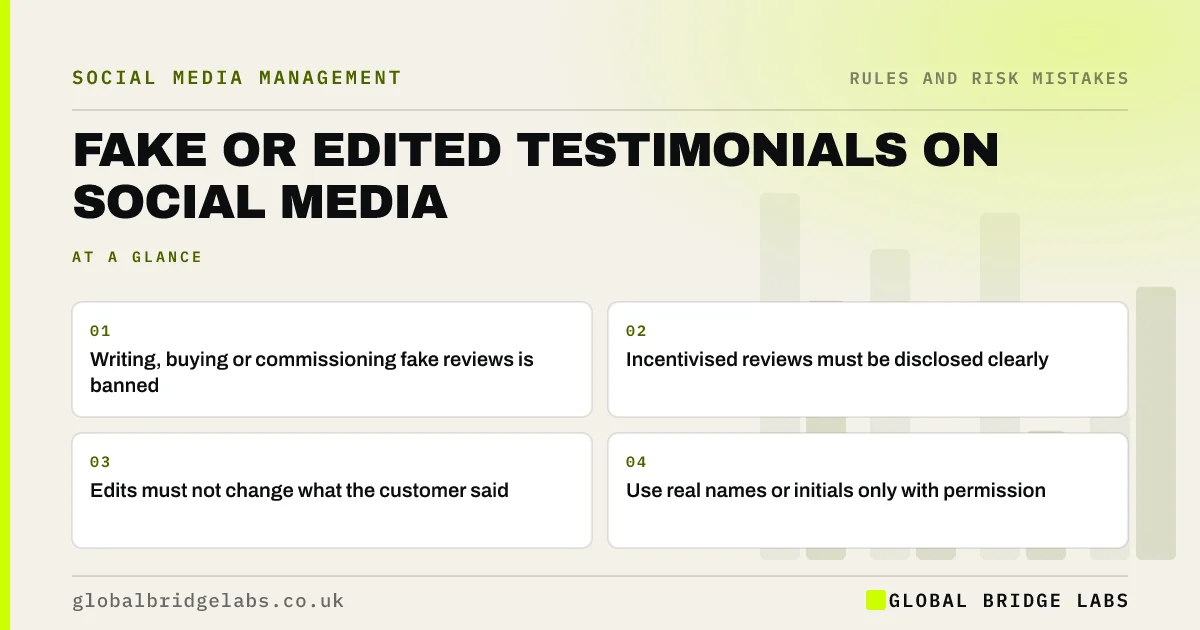
Fake testimonials on social media are banned under UK law. The Digital Markets, Competition and Consumers Act 2024 bans fake reviews and concealed incentivised reviews, and the Competition and Markets Authority (CMA) can fine businesses directly. Editing a review to change its meaning, or only showing the good ones in a misleading way, carries the same risk.
- Writing, buying or commissioning fake reviews is banned.
- Incentivised reviews must be disclosed clearly.
- Edits must not change what the customer said.
- Use real names or initials only with permission.
Want a safe way to share reviews? Message us on WhatsApp.
Chat on WhatsApp →What counts as a fake testimonial?
A fake testimonial is any review or quote presented as a genuine customer's experience when it is not: written by staff, friends or AI, bought from a service, or invented. Concealed incentivised reviews, where a reward was given and not disclosed, are also banned under the DMCC Act 2024.
Can you edit a testimonial?
You can shorten a testimonial or fix an obvious typo, as long as the meaning does not change and the customer would recognise it. You cannot add praise, remove criticism that changes the overall picture or combine several reviews into one. When in doubt, ask the customer to approve the edit.
Want your testimonials checked before you post? Message us on WhatsApp and we will discuss your requirements.
Chat on WhatsApp →What about selectively showing reviews?
Showing your best reviews is normal marketing. Presenting them as representative when they are not, or only inviting happy customers to review on a public platform while steering others away, can mislead. CMA guidance covers how businesses should collect and present reviews.
How do you get more genuine testimonials?
Ask every happy customer soon after the job, make it easy with a direct link, and ask permission before quoting them on social media. Short video testimonials and photos of finished work with the customer's words are especially convincing.
How do you check your testimonials are safe?
Check each testimonial against its original source: the review site, email or message. Confirm the words match, the meaning is unchanged, any incentive is disclosed and you have permission to name the person. Any testimonial you cannot trace to a real customer should be removed.
- Words that differ from the original.
- No traceable source.
- Undisclosed incentives.
- Names used without permission.
What does this look like in practice?
A pattern we see: a business that 'tidies up' reviews by rewriting them in its own words. It means well, but the result reads like marketing, not a customer. Using the customer's own words, shortened and approved, is safer and more convincing.
Testimonial checklist
- Use only genuine customer words.
- Disclose any incentive.
- Edit only for length, with meaning intact.
- Ask permission to name customers.
- Do not present cherry-picked reviews as typical.
Next step
Check every testimonial on your profile and website against the original review. Replace any that have been rewritten.
Message us on WhatsApp for help, or book a 30-minute consultation.
Chat on WhatsApp →Sources and further reading
- Digital Markets, Competition and Consumers Act 2024 · legislation.gov.uk
- Publishing consumer reviews and complying with consumer protection law · Competition and Markets Authority
- Unfair commercial practices guidance (CMA207) · Competition and Markets Authority
Frequently asked questions
Is it illegal to post fake reviews in the UK?
Yes. The DMCC Act 2024 bans fake reviews and concealed incentivised reviews, and the CMA can take enforcement action, including fines. This applies to reviews and testimonials on social media too.
Can I offer a discount for a review?
Incentivised reviews must be clearly disclosed, and the incentive must not depend on the review being positive. Check CMA guidance before offering any reward for reviews.
Can I shorten a customer's testimonial?
Yes, if the meaning does not change and the customer would recognise it. Do not add praise or remove criticism that changes the overall picture. Ask the customer to approve significant edits.
Written by

Global Bridge Labs (GBL) is a UK–Sri Lanka partner for social media, websites and BPO. Everything here comes from client delivery, not theory.