On this page
- 01Key takeaways
- 02Why do product posts fail to sell?
- 03What are the most common e-commerce mistakes?
- 04Which rules apply to e-commerce social posts?
- 05Should every product be posted?
- 06How do you spot where social shoppers drop out?
- 07What does this look like in practice?
- 08E-commerce checklist
- 09Next step
- 10Sources and further reading
- 11Frequently asked questions
Key takeaways
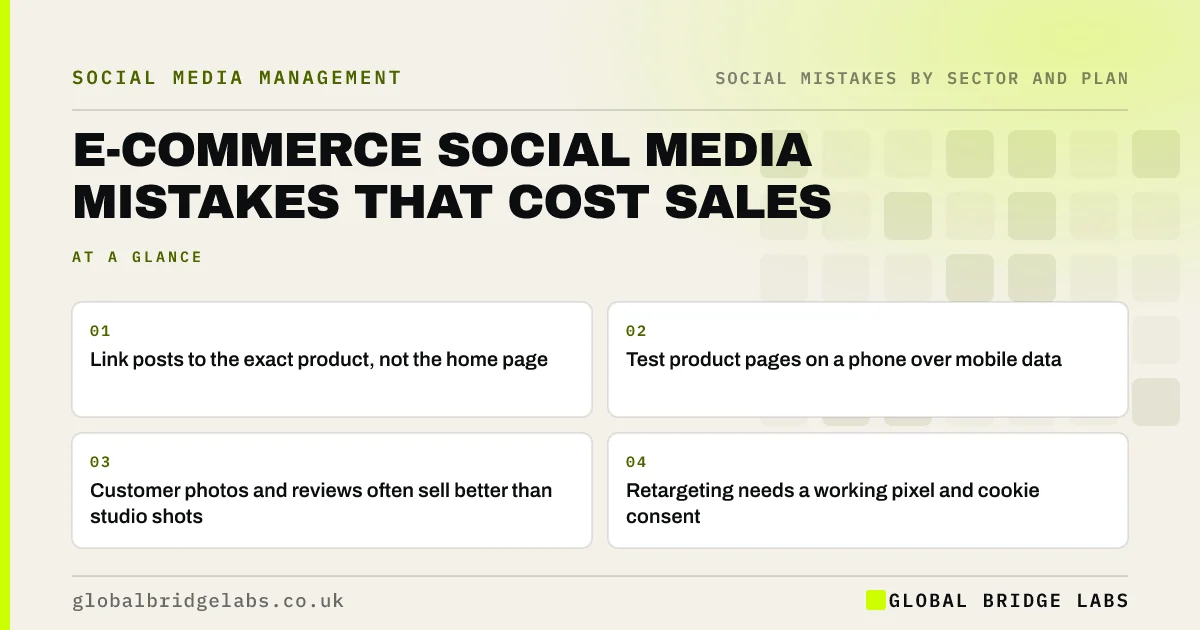
The e-commerce social media mistakes that cost sales are product posts with no direct link to buy, product pages that are slow on phones, ignoring customer photos and reviews, and retargeting without working tracking or consent. Shoppers buy on impulse from social, so the path from post to checkout must be short and fast.
- Link posts to the exact product, not the home page.
- Test product pages on a phone over mobile data.
- Customer photos and reviews often sell better than studio shots.
- Retargeting needs a working pixel and cookie consent.
Run an online shop? Send us your store and handle on WhatsApp.
Chat on WhatsApp →Why do product posts fail to sell?
Product posts fail to sell when the shopper cannot get from the post to the product in a tap or two. Linking to the home page, a slow product page or a checkout that asks for an account loses impulse buyers. Platform shops and product tags can shorten the path where available.
What are the most common e-commerce mistakes?
The most common e-commerce mistakes sit between the post and the payment.
- Links to the home page.
- Slow mobile product pages.
- No customer photos or reviews.
- Ignoring questions about sizing and delivery.
- No retargeting, or retargeting without consent.
- Turn e-commerce followers into first and repeat orders
- Meta pixel mistakes: tracking ads without breaking the law
Want your post-to-checkout path checked? Message us on WhatsApp and we will discuss your requirements.
Chat on WhatsApp →Which rules apply to e-commerce social posts?
Prices must be clear and include unavoidable charges, discounts must be genuine, urgency claims must be true and reviews must be genuine under the DMCC Act 2024. Online buyers usually have a 14-day cancellation right under the Consumer Contracts Regulations, which should be stated clearly.
Should every product be posted?
No. Posting the whole catalogue reads like a feed of adverts. Feature best-sellers, new arrivals, customer photos and how-to content, and let the shop do the cataloguing.
How do you spot where social shoppers drop out?
Spot drop-outs with a GA4 funnel for visits from social media: product page view, add to basket, checkout and purchase. The biggest drop between two steps shows where to look. A big drop before the product page often means a slow page or a link to the wrong place.
- Clicks that never reach the product page.
- Product views with few add-to-baskets.
- Checkouts abandoned at delivery costs.
- Sizing questions left unanswered.
What does this look like in practice?
A pattern we see: an online brand with strong engagement on Instagram, a bio link to the home page and a slow mobile product page. Linking each post to its product and speeding up the page usually lifts sales from the same traffic.
E-commerce checklist
- Link posts to exact products.
- Speed up mobile product pages.
- Share customer photos with permission.
- Answer sizing and delivery questions fast.
- Retarget with consent-based tracking.
Next step
Tap from your latest product post to checkout on your phone. Time it and count the steps.
Message us on WhatsApp for help, or book a 30-minute consultation.
Chat on WhatsApp →Sources and further reading
- Consumer Contracts (Information, Cancellation and Additional Charges) Regulations 2013 · legislation.gov.uk
- Digital Markets, Competition and Consumers Act 2024 · legislation.gov.uk
- Cookies and similar technologies under PECR · Information Commissioner's Office
- TikTok Shop Seller Center UK · TikTok
Frequently asked questions
Why is my online shop not selling on social media?
Often because posts do not link to the product, product pages are slow on phones, there is little customer proof or questions go unanswered. Check the path from post to checkout first.
Should e-commerce brands use Instagram or TikTok Shop?
In-app shops can shorten the path for impulse-priced products. Check current availability, fees and rules for the UK, and keep your own website as the main shop.
How often should e-commerce brands post products?
Mix product posts with customer photos, how-to content and behind the scenes. Feature best-sellers and new arrivals rather than the whole catalogue.
Written by

Global Bridge Labs (GBL) is a UK–Sri Lanka partner for social media, websites and BPO. Everything here comes from client delivery, not theory.