On this page
- 01Key takeaways
- 02What are the most common Facebook mistakes?
- 03What are the most common Instagram mistakes?
- 04What are the most common LinkedIn mistakes?
- 05What are the most common TikTok mistakes?
- 06What are the most common YouTube and X mistakes?
- 07Should you be on every platform?
- 08How do you spot a platform mismatch in your own posts?
- 09What does this look like in practice?
- 10Platform checklist
- 11Next step
- 12Sources and further reading
- 13Frequently asked questions
Key takeaways
Social media mistakes by platform follow one pattern: using a platform the way another one works. Facebook rewards local community and groups, Instagram rewards strong visuals and saves, LinkedIn rewards people over pages, TikTok rewards a fast hook, and YouTube rewards search. Copying one post to all of them suits none.
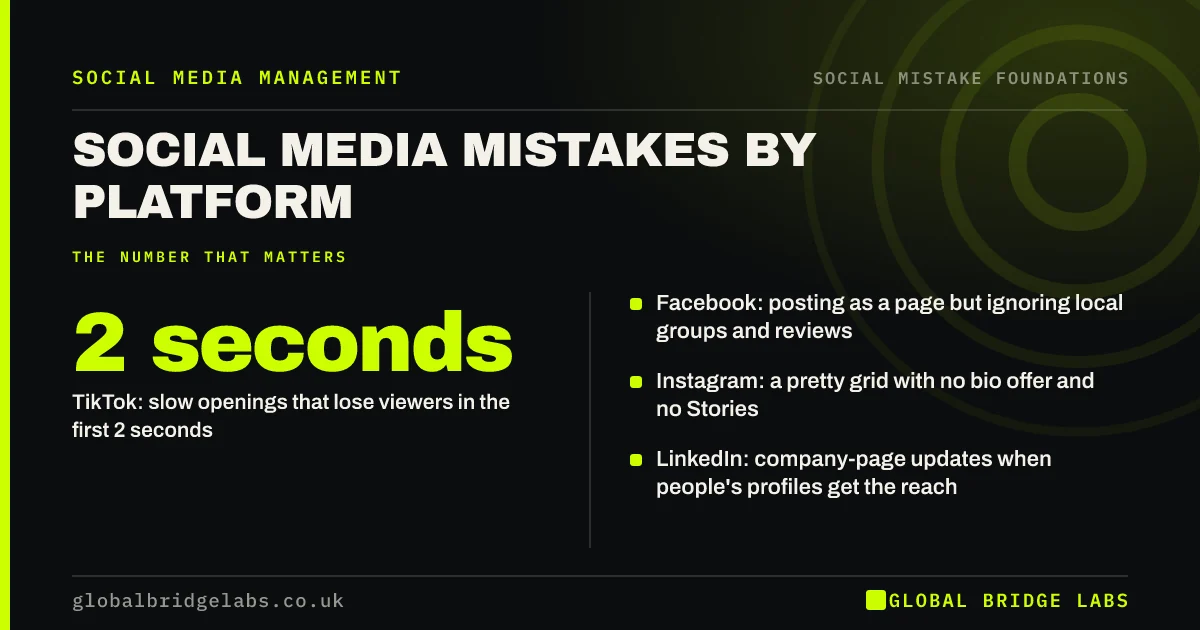
- Facebook: posting as a page but ignoring local groups and reviews.
- Instagram: a pretty grid with no bio offer and no Stories.
- LinkedIn: company-page updates when people's profiles get the reach.
- TikTok: slow openings that lose viewers in the first 2 seconds.
- YouTube: videos with titles nobody searches for.
Not sure your platforms suit your buyers? Message us on WhatsApp.
Chat on WhatsApp →What are the most common Facebook mistakes?
The most common Facebook mistakes are treating the page as a noticeboard, ignoring local groups where customers ask for recommendations, leaving reviews and messages unanswered, and boosting posts with no objective. Facebook still works well for local and older audiences when the page is active in conversations.
What are the most common Instagram mistakes?
The most common Instagram mistakes are a bio that does not say what you do or where, a link to the home page, polished posts with no caption reason to act, and ignoring Stories and direct messages. Instagram buyers often message before buying, so a slow inbox costs sales.
What are the most common LinkedIn mistakes?
The most common LinkedIn mistakes are posting only from the company page, sharing news about the firm rather than insight for the buyer, pitching in connection requests and running ads to audiences too small or too broad. On LinkedIn, posts from people usually reach far more than posts from pages.
What are the most common TikTok mistakes?
The most common TikTok mistakes are slow openings, repurposed landscape video, chasing trends that have nothing to do with the business and using music that is not cleared for business accounts. TikTok shows videos to people based on how they watch, so the first two seconds decide most of the reach.
What are the most common YouTube and X mistakes?
On YouTube, the common mistake is publishing videos with titles and thumbnails nobody would search for or click, when YouTube behaves partly like a search engine. On X (formerly Twitter), it is broadcasting links without replying to anyone, on a platform built around conversation. Both are worth it only if your buyers use them.
Want a platform-by-platform check? Message us on WhatsApp and we will discuss your requirements.
Chat on WhatsApp →Should you be on every platform?
No. Being on every platform is itself a mistake for most small businesses, because each platform needs its own style and its own replies. One main platform done well, plus a tidy presence where buyers might check you, beats five half-run accounts.
How do you spot a platform mismatch in your own posts?
Spot a platform mismatch by comparing the same post across platforms after a week. If one version consistently does far worse, it was probably not adapted to that platform: the shape, opening, length or hashtags suit somewhere else. Also check that the people engaging on each platform look like your buyers.
- Landscape video on TikTok, Reels or Shorts.
- Hashtag blocks on LinkedIn or Facebook.
- Bare links on Facebook with no comment.
- 'Link in bio' on a platform where links work in posts.
What does this look like in practice?
A pattern we see: one landscape video posted unchanged to Facebook, Instagram, LinkedIn and TikTok on the same day. It does reasonably on Facebook and poorly everywhere else. Recutting it vertically with a new opening for each platform takes an extra 30 minutes and usually does better than four uploads of the same file.
Platform checklist
- Pick one main platform your buyers use most.
- Learn what that platform rewards before posting.
- Adapt, do not copy, posts for each platform.
- Check music and formats suit a business account.
- Review each platform's results separately.
Next step
List the platforms you are on and how many enquiries each produced last quarter. Any platform with none is a candidate to pause.
Message us on WhatsApp with your list, or book a 30-minute consultation.
Chat on WhatsApp →Sources and further reading
- Meta Business Help Centre · Meta
- LinkedIn relevance: optimising the member experience · LinkedIn Help
- How TikTok recommends videos #ForYou · TikTok Newsroom
- How YouTube works: recommendations · YouTube
Frequently asked questions
Which social media platform is best for a small business?
The one your buyers use most when they are deciding. For local consumer services that is often Facebook or Instagram; for B2B services, LinkedIn; for younger audiences and products, TikTok or Instagram. Ask recent customers where they found or checked you before choosing.
Can I post the same content on every platform?
You can reuse the idea, but adapt the format, length and opening for each platform. Copying the same file and caption everywhere is a common mistake, because each platform rewards different behaviour. Repurposing well usually takes a few extra minutes per post.
Is X (Twitter) worth it for a small business?
Only if your buyers or your industry conversations are there, such as some B2B, media and technology sectors. For most local UK businesses, the time is better spent on Facebook, Instagram or LinkedIn. If you keep an X account, reply to people rather than only posting links.
Written by

Global Bridge Labs (GBL) is a UK–Sri Lanka partner for social media, websites and BPO. Everything here comes from client delivery, not theory.