On this page
- 01Key takeaways
- 02Why does deleting criticism backfire?
- 03When is deleting or hiding right?
- 04What do UK rules say about negative reviews?
- 05How do you reply to a negative comment?
- 06Is it ever fine to leave a comment unanswered?
- 07How do you decide quickly whether to remove a comment?
- 08What does this look like in practice?
- 09Negative comment checklist
- 10Next step
- 11Sources and further reading
- 12Frequently asked questions
Key takeaways
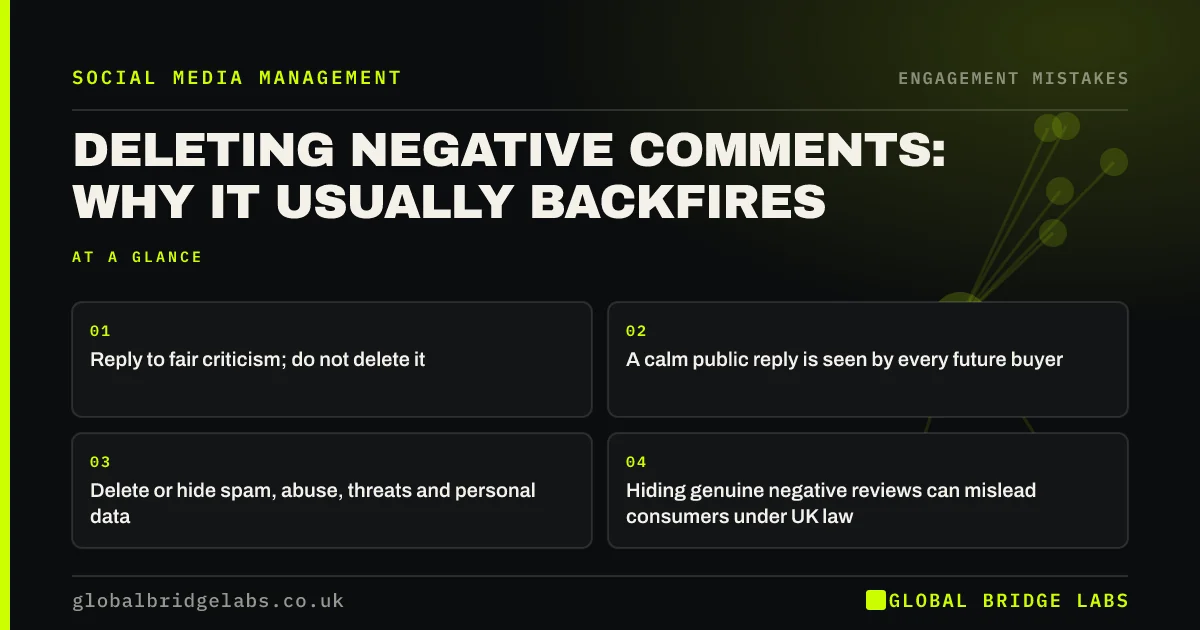
Deleting negative comments on social media usually backfires: the customer feels ignored, often posts again more angrily, and screenshots of a deleted complaint spread further than the original. Reply calmly to fair criticism instead. Hide or delete only spam, abuse, threats, personal data and clear falsehoods that break platform rules.
- Reply to fair criticism; do not delete it.
- A calm public reply is seen by every future buyer.
- Delete or hide spam, abuse, threats and personal data.
- Hiding genuine negative reviews can mislead consumers under UK law.
Facing a difficult comment now? Message us on WhatsApp.
Chat on WhatsApp →Why does deleting criticism backfire?
Deleting criticism backfires because the person notices, feels silenced and usually returns louder, sometimes with a screenshot. Other customers who saw the comment see it vanish. A business that answers criticism well looks more trustworthy than one with no criticism at all.
When is deleting or hiding right?
Deleting or hiding is right for spam, scams, abuse, hate, threats, someone's personal details and comments that break the platform's rules. Hiding keeps the comment visible to its author and their friends but not to others, which can calm a situation without provoking the person.
- Spam and scam links.
- Abuse, hate or threats.
- Personal data, such as phone numbers or addresses.
- Clear falsehoods that break platform rules.
What do UK rules say about negative reviews?
Under the Digital Markets, Competition and Consumers Act 2024 and CMA guidance on reviews, businesses must not publish fake reviews or present reviews in a misleading way, which includes suppressing genuine negative ones. Comments on posts are not always reviews, but deleting critical feedback systematically carries the same risk to trust.
Unsure whether to remove a comment? Message us on WhatsApp and we will discuss your requirements.
Chat on WhatsApp →How do you reply to a negative comment?
Reply within the working day, briefly and calmly. Thank them for raising it, acknowledge the problem without arguing over details, say what you will do, and offer to continue privately with a named contact. Then follow through, and update the thread if it is resolved.
- 1. Thank and acknowledge.
- 2. Do not argue details in public.
- 3. Say what happens next.
- 4. Move to a private channel.
Is it ever fine to leave a comment unanswered?
Yes, for obvious trolling that has nothing to do with your business, where any reply would feed it. Hide it if it breaks rules. For anything from a real customer, a short reply is almost always better than silence.
How do you decide quickly whether to remove a comment?
Decide by asking one question: is it fair criticism from a real person, even if harsh? If yes, reply and keep it. If it is spam, abuse, a threat, someone's personal details or breaks the platform's rules, hide or delete it. When unsure, reply calmly and wait before removing anything.
- Fair but harsh: reply and keep.
- Spam or scam: hide or delete.
- Abuse or threats: delete and report.
- Personal data: remove immediately.
What does this look like in practice?
A pattern we see: a complaint deleted within minutes, followed by the same customer posting in a local group with a screenshot. The issue reaches far more people than the original comment would have. A calm reply and a phone call usually ends it where it started.
Negative comment checklist
- Do not delete fair criticism.
- Reply calmly within the working day.
- Move details to a private channel.
- Hide spam, abuse and personal data.
- Never suppress genuine reviews.
Next step
Write a three-line reply template for complaints today, so the next one gets a calm answer instead of a deletion.
Message us on WhatsApp for help with replies, or book a 30-minute consultation.
Chat on WhatsApp →Sources and further reading
- Digital Markets, Competition and Consumers Act 2024 · legislation.gov.uk
- Publishing consumer reviews and complying with consumer protection law · Competition and Markets Authority
- Meta Business Help Centre · Meta
Frequently asked questions
Should I delete negative comments on my business page?
Usually no. Reply calmly to fair criticism and move details to a private channel. Delete or hide only spam, abuse, threats, personal data and comments that break platform rules. Deleting fair criticism often makes the situation worse.
Is hiding a comment better than deleting it?
Hiding keeps the comment visible to its author and their friends but not to others, so it can calm a situation without provoking the person. Use it for comments that break rules but are not worth escalating.
Is it illegal to delete negative reviews in the UK?
Businesses must not present reviews in a misleading way, which includes suppressing genuine negative ones, under the DMCC Act 2024 and CMA guidance. Removing fake, abusive or rule-breaking content is fine. Check the CMA guidance for your situation.
Written by

Global Bridge Labs (GBL) is a UK–Sri Lanka partner for social media, websites and BPO. Everything here comes from client delivery, not theory.