On this page
- 01Key takeaways
- 02What is the social media mistake scorecard?
- 03How do you score each area?
- 04What do the totals mean?
- 05How do you run the check in 30 minutes?
- 06When is the scorecard the wrong tool?
- 07What evidence should you gather before scoring?
- 08What does this look like in practice?
- 09Scorecard checklist
- 10Next step
- 11Sources and further reading
- 12Frequently asked questions
Key takeaways
The GBL Social Media Mistake Scorecard checks a business account in five areas: aim, profile, posts, replies and results. Score each 0, 1 or 2, add them up out of 10 and fix the lowest area first. It takes about 30 minutes with a phone and last month's messages.
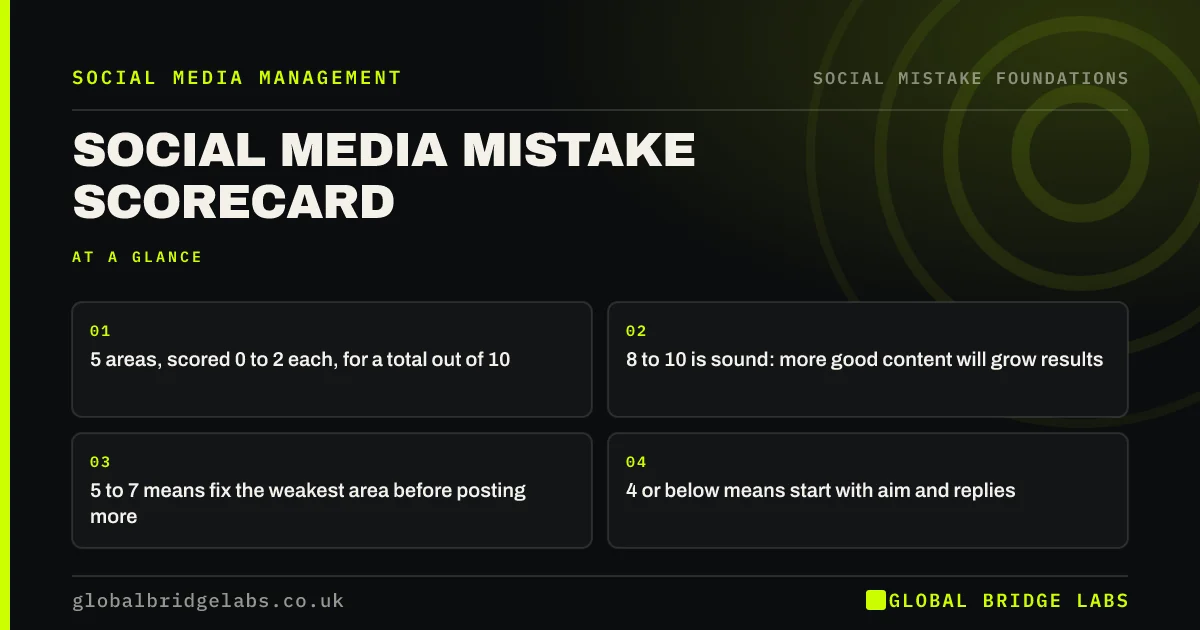
- 5 areas, scored 0 to 2 each, for a total out of 10.
- 8 to 10 is sound: more good content will grow results.
- 5 to 7 means fix the weakest area before posting more.
- 4 or below means start with aim and replies.
Want a second opinion on your score? Send us your handle on WhatsApp.
Chat on WhatsApp →What is the social media mistake scorecard?
The social media mistake scorecard is a 10-point self-check that shows which part of a business's social media is losing it customers. It replaces a long audit with five questions an owner can answer honestly in half an hour, and it points to one area to fix rather than twenty.
How do you score each area?
Score each area 0 if it is missing or broken, 1 if it partly works and 2 if it works well. Be strict: if you have to think hard about whether something is true, it is a 1.
- 1. Aim: one measurable goal, one type of buyer and the platform they use.
- 2. Profile: a stranger sees what you do, where and how to contact you in 5 seconds.
- 3. Posts: most posts give buyers a reason to stop and a clear next step.
- 4. Replies: comments and messages answered within the working day.
- 5. Results: you know how many enquiries social media produced last month.
What do the totals mean?
A total of 8 to 10 means the basics are sound and growth will come from more of what works. A total of 5 to 7 means one or two areas are holding the rest back, so fix the weakest before adding content or ads. A total of 4 or below means start with aim and replies, because nothing else can work without them.
Scored 4 or below? Message us on WhatsApp and we will discuss your requirements.
Chat on WhatsApp →How do you run the check in 30 minutes?
Use your phone, not a laptop, because that is how customers see you. Spend about five minutes on each area and write the score down as you go.
- Minutes 1–5: write the goal and buyer; check they match the platform.
- Minutes 6–10: open your profile as a stranger; time how long contact takes.
- Minutes 11–15: read your last ten posts; count those with a next step.
- Minutes 16–25: check comments and messages from last month for reply times.
- Minutes 26–30: find last month's enquiry count from social media.
When is the scorecard the wrong tool?
The scorecard is the wrong tool for a business running large paid campaigns, several brands or regulated advertising, where a fuller audit of ad accounts and compliance is needed. It is also less useful for an account under three months old, because results will not yet be meaningful. In those cases, score aim, profile and replies only.
What evidence should you gather before scoring?
Gather evidence before scoring so the numbers are honest rather than remembered. You need your main profile open on a phone, your last ten posts, last month's comments and messages with their reply times, and any record of enquiries from social media. Without that evidence, most owners score themselves a point or two too high.
- A screenshot of your profile as a stranger sees it.
- Your last ten posts, with any next step marked.
- Reply times for last month's messages.
- Last month's enquiries, from any source you keep.
What does this look like in practice?
A common pattern: an owner expects a low score for posts and is surprised that posts score 2 while replies score 0. Messages sit in three inboxes and are answered on Sunday evenings. Fixing replies is free and takes a week; it is also the change most likely to show in enquiries first.
Scorecard checklist
- Score on a phone, not a laptop.
- Use last month's real messages and numbers.
- Write a score for every area before fixing anything.
- Fix the lowest area first.
- Re-score every quarter.
Next step
Run the scorecard today and write down the lowest area. That single area is your plan for the next 30 days.
Message us on WhatsApp with your score and we will tell you the first fix, or book a 30-minute consultation.
Chat on WhatsApp →Sources and further reading
- Meta Business Help Centre · Meta
- LinkedIn Pages best practices · LinkedIn
- About key events · Google Analytics Help
Frequently asked questions
How do I score my business social media?
Score five areas from 0 to 2: aim, profile, posts, replies and results. Use your phone and last month's real messages. Add the scores for a total out of 10. Fix the lowest area first, and re-score every quarter to see whether the fixes are working.
What is a good social media score for a small business?
On the GBL Social Media Mistake Scorecard, 8 to 10 is sound, 5 to 7 means one area needs fixing, and 4 or below means start with aim and replies. Most small business accounts we look at score between 4 and 6, usually losing points on replies and results.
How often should I check my social media for mistakes?
Every quarter is enough for most small businesses, with a short monthly look at enquiries and reply times. Check again after any big change, such as a new platform, a new person running the account or a change of offer.
Written by

Global Bridge Labs (GBL) is a UK–Sri Lanka partner for social media, websites and BPO. Everything here comes from client delivery, not theory.