On this page
- 01Key takeaways
- 02Why do benchmarks mislead small businesses?
- 03Which comparisons are worth making?
- 04Should you ignore competitors completely?
- 05Are published benchmarks ever useful?
- 06How do you spot a misleading benchmark?
- 07What does this look like in practice?
- 08Benchmark checklist
- 09Next step
- 10Sources and further reading
- 11Frequently asked questions
Key takeaways
Social media benchmark mistakes come from comparing the wrong things: your account with a national brand, your sector with another, one platform's figures with another's, or follower counts that may be inflated. The most useful benchmark is your own last quarter. Compare with close competitors only on things you can see, such as activity and replies.
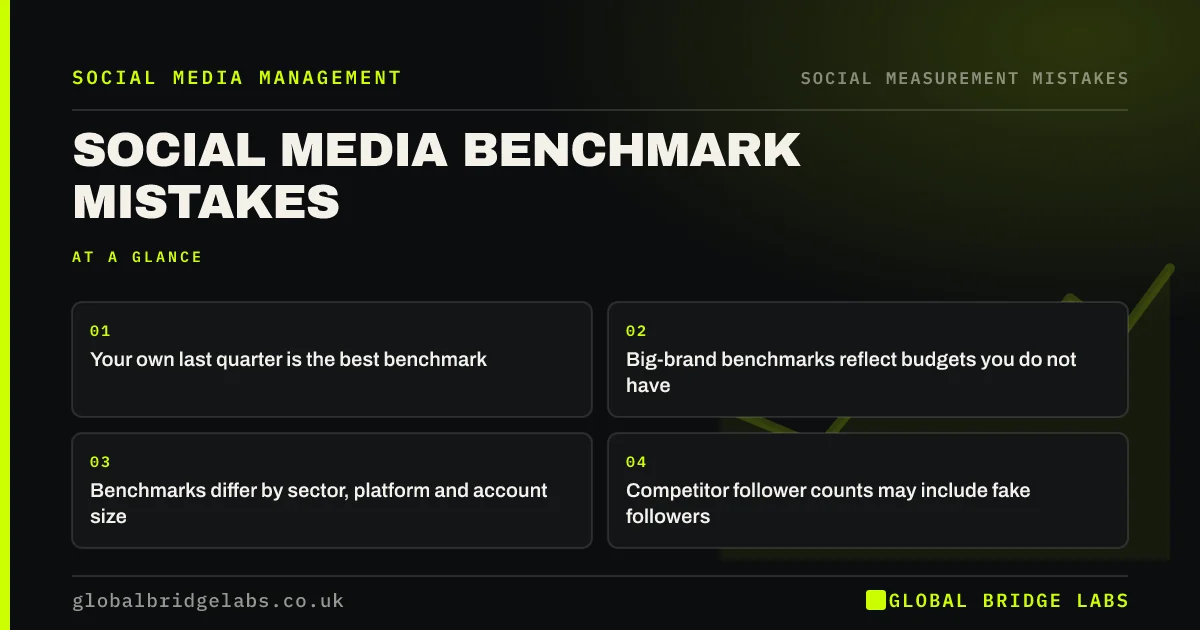
- Your own last quarter is the best benchmark.
- Big-brand benchmarks reflect budgets you do not have.
- Benchmarks differ by sector, platform and account size.
- Competitor follower counts may include fake followers.
Want a fair comparison with your competitors? Message us on WhatsApp.
Chat on WhatsApp →Why do benchmarks mislead small businesses?
Benchmarks mislead because published averages often come from large accounts, mixed sectors and formulas you cannot check. A small local business compared with an industry average built from national brands will look either brilliant or terrible, and neither tells it what to do.
Which comparisons are worth making?
Worth making: your own results month on month and quarter on quarter, enquiries per post or per pound spent, and how close competitors with similar customers present themselves, post and reply. Those comparisons lead to actions.
Want a benchmark built from your own data? Message us on WhatsApp and we will discuss your requirements.
Chat on WhatsApp →Should you ignore competitors completely?
No. Competitors show what buyers in your market see, which ideas get conversations and where gaps are. Learn from what they do; do not copy their numbers as targets. A competitor with more followers may have fewer customers from social media than you.
Are published benchmarks ever useful?
They can be a rough sense check, for example whether an ad's cost per click is wildly out of line. Use them as a range, check the source and sample, and give your own trend more weight.
How do you spot a misleading benchmark?
Spot a misleading benchmark by checking who it was measured on, when, on which platform and with which formula. Benchmarks from large brands, mixed sectors or unstated methods should carry little weight. If a benchmark would push you to change something that is already bringing enquiries, trust your own data.
- Sample drawn from large brands.
- Mixed sectors or platforms.
- Unstated formula or date.
- Conflicts with your own results.
What does this look like in practice?
A pattern we see: an owner discouraged because a competitor has five times the followers. On closer look, the competitor's comments are sparse and unanswered, while the owner's smaller account gets steady enquiries. The benchmark that matters, customers, was already better.
Benchmark checklist
- Benchmark against your own past.
- Compare enquiries, not followers.
- Use competitors for ideas, not targets.
- Check the source of any published figure.
- Review quarterly.
Next step
Write down last quarter's enquiries from social media. That is your benchmark for this quarter.
Message us on WhatsApp for help, or book a 30-minute consultation.
Chat on WhatsApp →Sources and further reading
- Meta Business Help Centre · Meta
- LinkedIn Pages best practices · LinkedIn
- About key events · Google Analytics Help
Frequently asked questions
How do I benchmark my social media performance?
Start with your own results, comparing enquiries, clicks and engagement month on month and quarter on quarter. Use close competitors for ideas about content and responsiveness, not as numeric targets.
Are industry social media benchmarks reliable?
They vary by source, sample, platform and account size, and often reflect large accounts. Use them as a rough range and give more weight to your own trend.
Should I worry if competitors have more followers?
Not necessarily. Follower counts can include inactive or fake accounts and do not show enquiries. Focus on whether your social media brings customers.
Written by

Global Bridge Labs (GBL) is a UK–Sri Lanka partner for social media, websites and BPO. Everything here comes from client delivery, not theory.