On this page
- 01Key takeaways
- 02What is social media marketing?
- 03What are the main advantages?
- 04What are the main disadvantages?
- 05What does it really cost?
- 06How does it compare with traditional advertising?
- 07Who gains most from social media?
- 08When is social media the wrong priority?
- 09What does this look like in practice?
- 10Decision checklist
- 11Next step
- 12Sources and further reading
- 13Frequently asked questions
Key takeaways
The pros and cons of social media marketing come down to control against effort. You control the audience, the budget and the message, and you see results quickly. In exchange it needs steady work every week, and you are building on a platform you do not own.
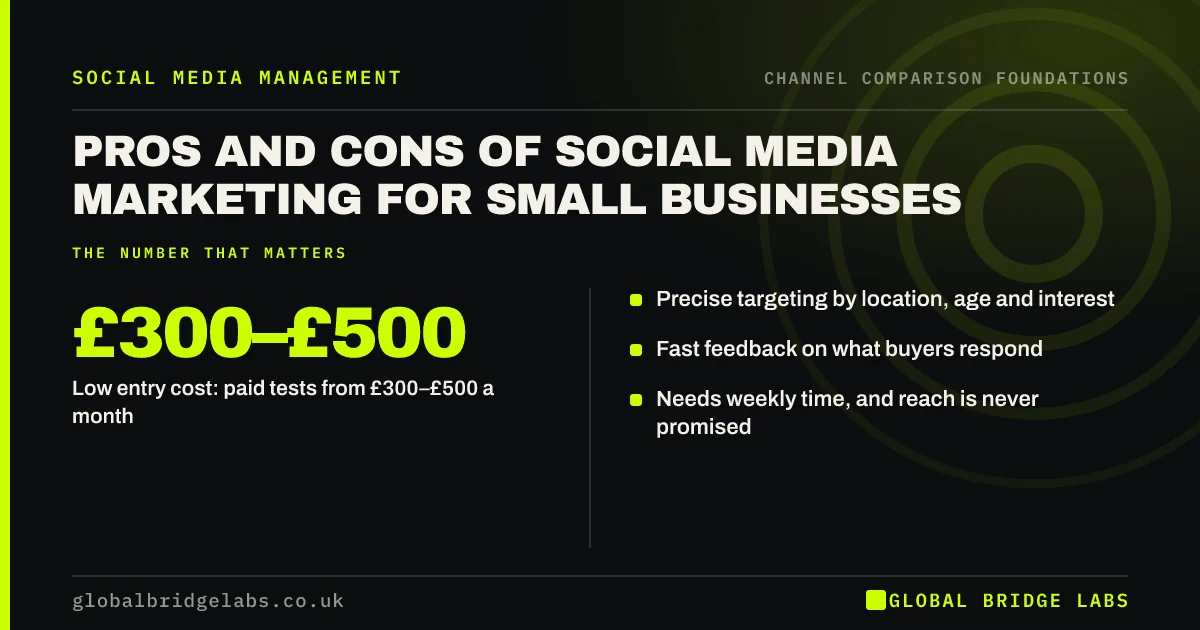
- Low entry cost: paid tests from £300–£500 a month.
- Precise targeting by location, age and interest.
- Fast feedback on what buyers respond to.
- Needs weekly time, and reach is never promised.
Weighing up whether it is worth it for you? Message us on WhatsApp for a straight answer.
Chat on WhatsApp →What is social media marketing?
Social media marketing is the use of social platforms to reach and win customers through regular posts, replies to comments and messages, and paid adverts. For a small business it does three jobs at once: it advertises, it proves the work is real and it gives buyers an easy way to ask a question.
What are the main advantages?
The main advantages are low cost to start, precise targeting, quick feedback and proof. A small firm can reach a chosen audience in a chosen area for a modest sum, learn within a fortnight which message works, and leave behind a public record of finished jobs and happy customers.
- Start, pause or stop spending the same day.
- Aim at an area, an age range or an interest.
- See views, clicks and messages for each post.
- Show real work, reviews and replies.
- Talk to buyers directly before they commit.
What are the main disadvantages?
The main disadvantages are the time it takes, the limits on unpaid reach, public criticism and dependence on the platform. Posting, replying and reviewing results takes hours every week. Platforms change what they show without notice, and a complaint in the comments is visible to everyone.
- Regular time for content and replies.
- Unpaid reach is small without good content.
- Complaints are public and need a prompt reply.
- Rules, formats and costs change often.
- You rent the audience. You do not own it.
What does it really cost?
Social media is cheap to enter, not free. At the April 2026 National Living Wage an hour of staff time costs about £16.27 with employer costs, so three two-hour posts a week comes to roughly £5,076 a year. Most UK SMEs that use an agency pay £950–£2,500 a month, with a paid advertising floor of £300–£500 a month on top.
Want a costed plan before you commit time or money? Message us on WhatsApp and we will discuss your requirements.
Chat on WhatsApp →How does it compare with traditional advertising?
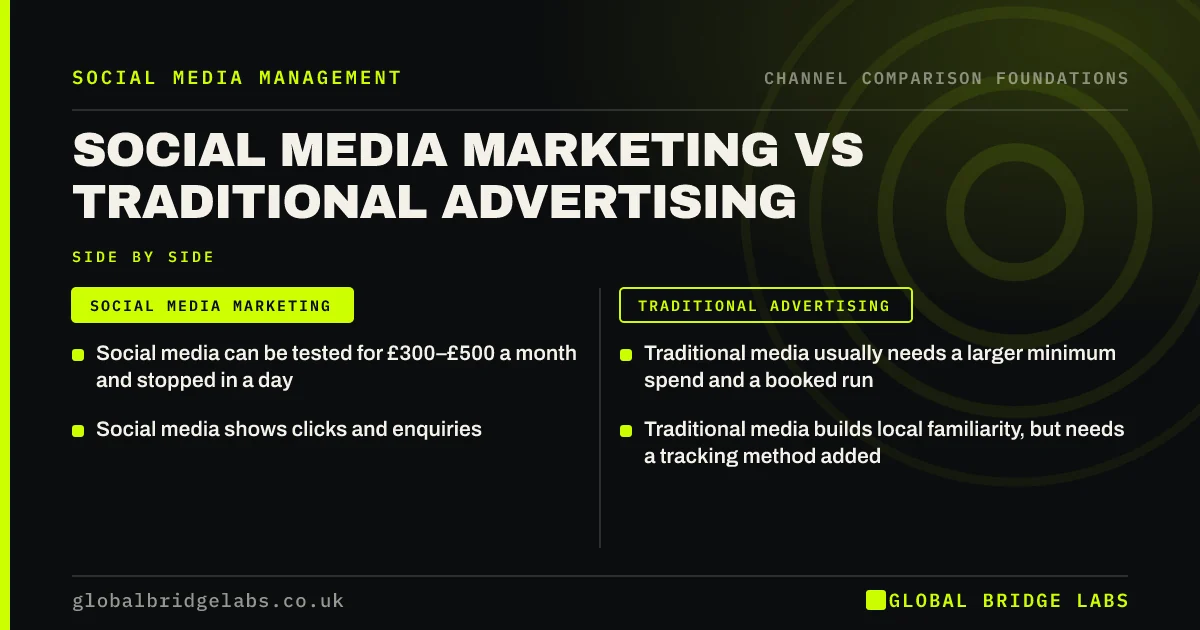
Compared with traditional advertising, social media is easier to target, test and track, and harder to keep up. A printed advert is finished once it is booked. A social account is never finished. Traditional media can also reach people who do not use social platforms much, which matters for some older or rural audiences.
Who gains most from social media?
Businesses gain most when their work can be shown, their buyers can be described and someone is available to reply. Trades with visible results, food and hospitality, shops, clinics and consultants with expertise to share all fit. Ofcom's 2026 research found that 89% of adult internet users use at least one social platform.
When is social media the wrong priority?
It is the wrong priority when nobody can commit time weekly, when your buyers only search at the moment of need, or when your website cannot turn a visitor into an enquiry. Fix the website and the Google Business Profile first in those cases, then return to social media.
What does this look like in practice?
A pattern we see with small firms that say social media does not work: the account was busy for three weeks, quiet for three months, and never linked to a way of recording enquiries. The disadvantages they met were real, but most came from the stop-start rhythm and not from the channel.
Decision checklist
- Can someone give it two to four hours every week?
- Can you describe your buyer and your area?
- Do you have photos, results or advice to share?
- Can you reply to messages within a working day?
- Do you record where each enquiry comes from?
Next step
Answer the five checklist questions honestly. Three or more yes answers means social media deserves a proper 90-day trial.
Message us on WhatsApp with your answers and we will suggest a starting plan, or book a 30-minute consultation.
Chat on WhatsApp →Sources and further reading
- Adults' media use and attitudes · Ofcom
- National Minimum Wage and National Living Wage rates · GOV.UK
- Rates and thresholds for employers 2026 to 2027 · HM Revenue & Customs
- Meta Business Help Centre · Meta
Frequently asked questions
What are the advantages of social media marketing for a small business?
The main advantages are a low starting cost, the ability to aim at a specific area and audience, fast feedback on what works and a public record of your work and reviews. It also gives buyers a simple way to ask questions before they commit.
What are the disadvantages of social media marketing?
It takes regular time, unpaid reach is limited, criticism is public and the platforms can change rules or costs without warning. You also do not own the audience, so an account problem can cut you off from followers you spent years gaining.
Is social media marketing worth it for a small business?
For most, yes, if someone can keep it going weekly and enquiries are recorded. It is one of the cheapest ways to test demand in a defined area. It is not worth it as an occasional burst with no tracking, which is how many firms conclude it failed.
Is social media enough on its own to market a business?
Rarely. It works best alongside a clear website and a Google Business Profile, so that people who discover you can check you and get in touch. Some local firms also add one physical channel, such as leaflets or vehicle signs.
Written by

Global Bridge Labs (GBL) is a UK–Sri Lanka partner for social media, websites and BPO. Everything here comes from client delivery, not theory.