On this page
- 01Key takeaways
- 02When does a post count as an ad?
- 03What are the common labelling mistakes?
- 04Who is responsible: the brand or the creator?
- 05Do your own posts need an ad label?
- 06How do you check your creator posts for labels?
- 07What does this look like in practice?
- 08Ad labelling checklist
- 09Next step
- 10Sources and further reading
- 11Frequently asked questions
Key takeaways
Not labelling ads on social media is a common breach of the CAP Code. When a business pays, gifts or otherwise rewards a creator and has some control over the content, the post is an ad and must be obviously identifiable, usually with a clear label such as '#ad' at the start. Burying the label among hashtags is not enough.
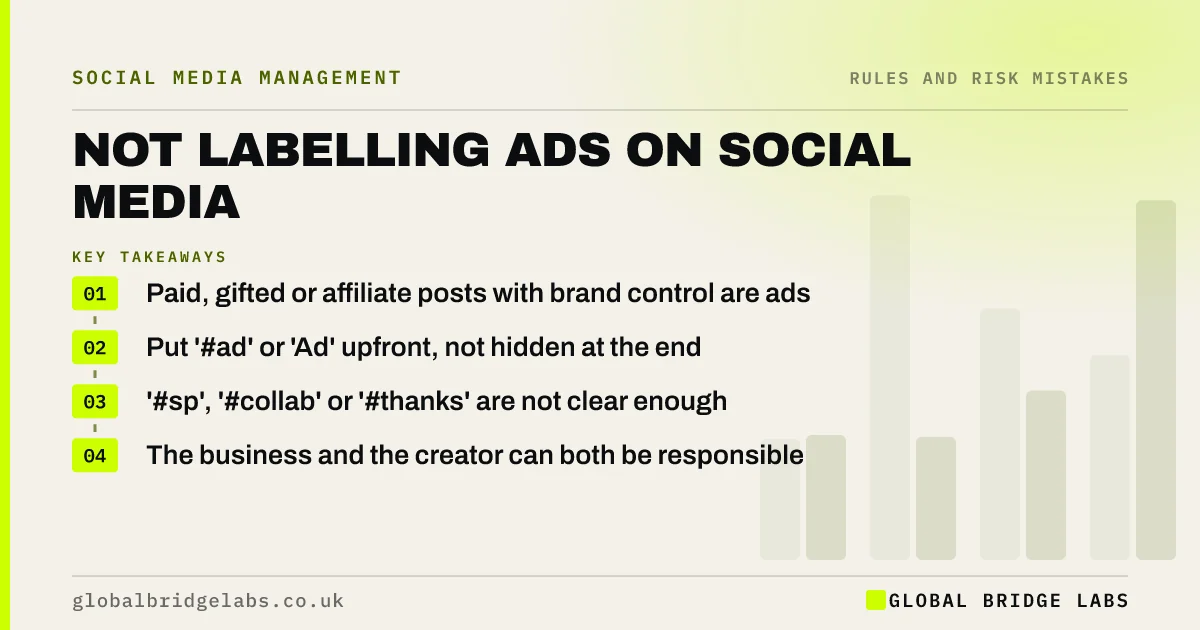
- Paid, gifted or affiliate posts with brand control are ads.
- Put '#ad' or 'Ad' upfront, not hidden at the end.
- '#sp', '#collab' or '#thanks' are not clear enough.
- The business and the creator can both be responsible.
Working with creators? Message us on WhatsApp to check your labelling.
Chat on WhatsApp →When does a post count as an ad?
Under ASA and CAP guidance, a post counts as an ad when the creator has been paid or rewarded, including with free products or affiliate commission, and the brand has some control over the content, such as approving it or asking for particular messages. If both apply, it must be labelled.
What are the common labelling mistakes?
The common mistakes are no label at all, a label hidden in a block of hashtags, a vague label such as '#sp' or '#collab', a label only in the comments, and relying on the platform's paid partnership tag alone when the ASA has said it may not be enough on its own.
- No label.
- Label hidden at the end of the caption.
- Vague labels such as #sp or #collab.
- Label only in comments.
- Video ads with the label only in the caption.
Want a creator brief with labelling built in? Message us on WhatsApp and we will discuss your requirements.
Chat on WhatsApp →Who is responsible: the brand or the creator?
Both. The ASA can rule against the brand, the creator or both. As the business, put the labelling requirement in your brief and agreement, check posts before or after they go live, and ask for corrections promptly.
Do your own posts need an ad label?
Usually not, because a post on your own business account is obviously from you. The CAP Code still applies to the claims you make. Staff posting about the business on personal accounts may need to make their connection clear.
How do you check your creator posts for labels?
Check them by searching each creator's profile for posts about you and reading the first line of each caption and any on-screen text. The label should be visible without tapping 'more'. Check video ads for a label on screen as well as in the caption.
- Label missing from the first line.
- Label only in hashtags at the end.
- No label on video content.
- Affiliate links with no disclosure.
What does this look like in practice?
A pattern we see: a business gifting products to local creators with no brief, then sharing their posts, none labelled. Adding one line to every gifting message, 'please mark this as an ad at the start of the caption', and checking each post fixes it.
Ad labelling checklist
- Treat paid, gifted and affiliate posts as ads.
- Ask for '#ad' or 'Ad' upfront.
- Put the rule in every brief.
- Check posts once live.
- Correct unlabelled posts quickly.
Next step
List every creator you have gifted or paid this year and check their posts for a clear label.
Message us on WhatsApp for help, or book a 30-minute consultation.
Chat on WhatsApp →Sources and further reading
Frequently asked questions
Do gifted posts need to be labelled as ads in the UK?
If the creator received the gift and the brand had some control over the content, yes. Even without control, the ASA and CMA expect commercial relationships to be disclosed. Ask creators to label clearly upfront.
Is '#sponsored' or '#partner' enough?
The ASA prefers clear labels such as '#ad' or 'Ad' placed upfront. Vague tags such as '#sp', '#collab' or '#thanks' are unlikely to be clear enough. Check the ASA's influencer guidance for current advice.
Who gets in trouble for an unlabelled ad?
The ASA can name the brand, the creator or both. Businesses should require labelling in briefs and agreements and check posts after they go live.
Written by

Global Bridge Labs (GBL) is a UK–Sri Lanka partner for social media, websites and BPO. Everything here comes from client delivery, not theory.